Going inside the secret bunker built to survive nuclear war

 BBC
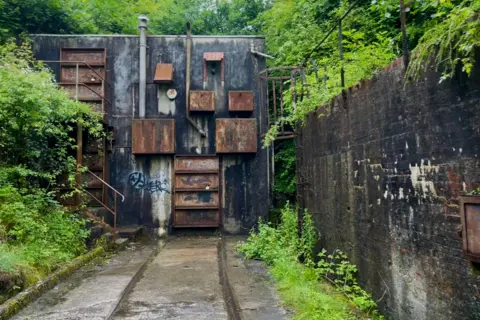
BBCBeneath an unassuming hill just next to a newbuild housing estate there lies a bunker that was designed to keep Wales running in the event of a nuclear attack.
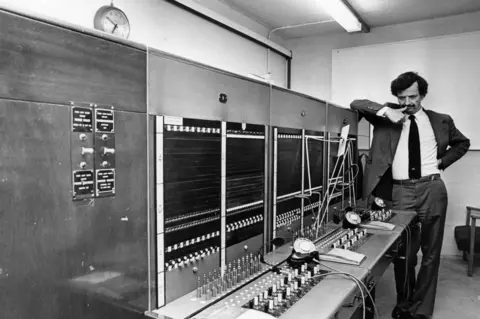
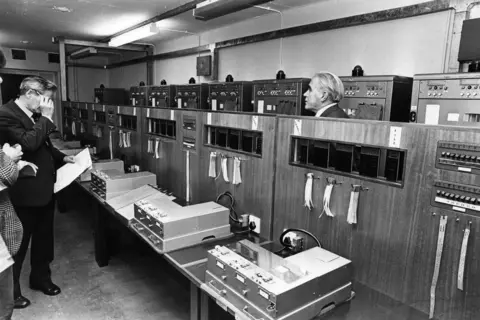
Hidden behind blast-proof steel doors, now covered in graffiti, the former Cold War command centre would have housed selected officials responsible for organising the country.
But it had a severe weakness rendering it useless, said the manager of the security company that has occupied it since the 1990s.
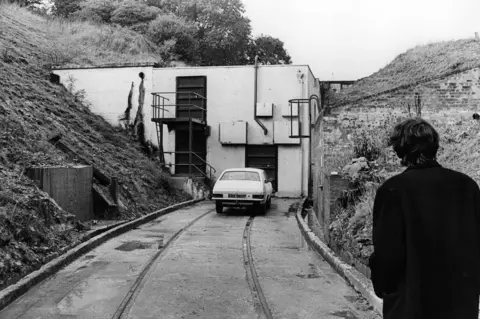
The entrance is easy to miss, sitting behind a fence and down an overgrown lane in Bridgend, and the rusting exterior looks almost like an abandoned industrial building rather than a key part of the UK's Cold War preparations.
I was granted rare access on the condition that the man who managed the security company was not named and no photographs were taken inside.
When the steel door swung open, the first thing that struck me, unexpectedly, was the smell of fresh paint, which then made way for damp.
 Media Wales
There were props littered around, ranging from nuclear emergency posters to mouldy Egyptian statues - he said the location was often used in films and TV series, including Doctor Who and the Pembrokeshire Murders.
As lights flickered on along the passageways, I followed my guide further inside.
The bunker was built within two of the seven tunnels excavated beneath Brackla Hill during World War Two to store munitions from the nearby Royal Ordnance factory.
Had the bunker been needed, the occupants would have survived only as long as their supplies lasted.
But even then, my tour guide said, it was unlikely they would have been protected: "They were not really that nuclear bomb-proof."
He showed me the storm drain that ran through the tunnel from the outside and explained that, in the event of a nuclear blast, radioactive waste would pile up outside - with the drain carrying it inside the bunker itself.
Inside, their water supply for drinking and washing was installed right next to it, with the tap just inches away from the open drain.
"Nobody ever thought of that," he said.
 Media Wales
The manager of the site said this bunker was poor in comparison to the one the government built in Essex around the same time beneath a farmer's field.
"Then they built a long, thin corridor, about half a mile long, to a small dummy house, and that's where you go in," he said.
"It's not a straight line from a nuclear blast to the front door, like this one."
As we made our way deeper inside, I was taken to a corridor where the lights would not turn on.
In total darkness and my senses hyper alert, any conversation we had bounced off the walls of what felt like a never-ending tunnel.
A heavy metal door stood open at the end, but I could not help but feel like it may slam shut and I would be trapped in this labyrinth forever.
Used to the site, my guide was not affected in the least and tapped on the wall to remind me "this is the external wall, we're not miles underground at all... right on the surface".
 Media Wales
He turned to leave and I felt the silence and the darkness behind me as I walked as quickly as I could to get out of there - it felt like the start of a horror film.
I am not the only person who has been inside this bunker, aside from the many actors and crew members from various productions.
Brett Exton was taken inside by the grandson of the owner in the early 2000s when it was being used to store evidence for South Wales Police.
Exton, 59, is a historian fascinated by the World War Two sites in his hometown of Bridgend.
He likened it to a hospital "standing at one end of a corridor which goes on for miles, it was that sensation, there were all these rooms branching off left and right".
Exton said he was only allowed in one room as the others were being used to store sensitive information.
The room had been used as a dormitory when it was a nuclear bunker and he could "see where the outline of all the beds were".
He said the tunnels "go in parallel to one another under the houses of the Brackla Hillside, the housing estate".
The tunnels are nicknamed the 8Xs, so people think there are eight of them but it was in fact the different zones of one huge factory.
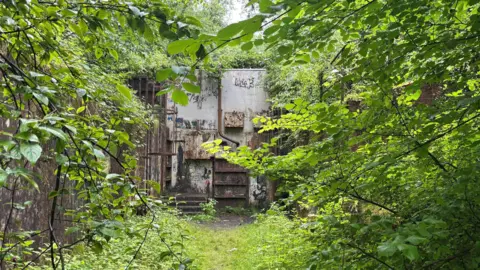
Historian Mike Clubb and his three young sons stumbled upon the tunnels when blackberry picking in the early 1980s.
Back then they were all open, he said.
Curious about where they led, the family walked into one as far as they dared, until there was no light left.
"They were really spooky, all you could hear was drip, drip, drip. There were no lights."
Puzzled by what he had found, he began asking questions and discovered that the outside of the tunnels were painted with 8x1, 8x2 and 8x3.
He returned with a torch and said it felt like "a labyrinth".
"The first part is like a tube station, with a dead end and a platform, then from the platform smaller tunnels went at right angles."
The discovery of the tunnels sparked Clubb to spend the next 27 years researching and in 2007 he published a book called The Welsh Arsenal.
The seven 8X tunnels were built to store high explosives and cordite, Clubb said.
"Then, when it was needed at the factory, it was brought on by a diesel train pulling a single truck so that it could be delivered."
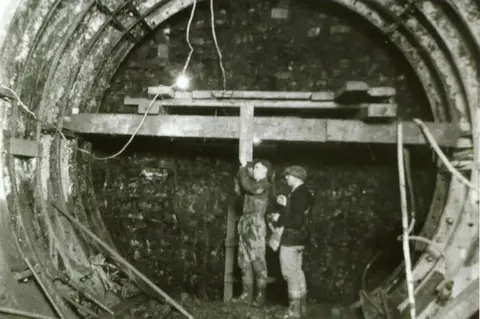 Brett Exton
Lee McGrath, 51, from Bridgend, remembers spending his summers exploring and playing hide-and-seek with the other kids in the tunnels.
His grandad was in charge of chasing people away from the bunker and the other tunnels, he said.
"Because of the Cold War there was somebody actually in the tunnels all the time, whose job was basically to test all the things inside the bunker.
"He always used to tell us not to go up there, but you know, obviously nobody used to listen."
He said his grandad "chased away some devil worshippers once" and "broke his leg" doing so.
A childhood spent in the tunnels inspired his urban exploration and photography.
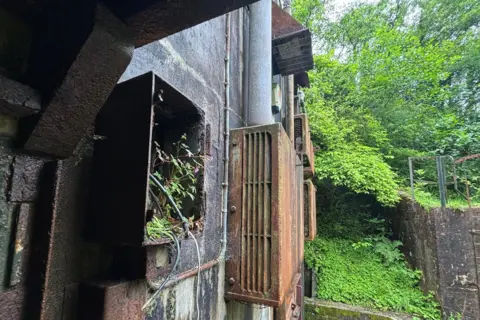
McGrath is part of a growing community of online urban explorers and has been back to the tunnels to photograph them and remember his grandad.
He said he gets transported back to his childhood when he goes in, "memories of walking around with a torch with hardly any batteries, getting lost underground".
He said there were still "two or three" tunnels "you can crawl down into".
"They're not very safe," he said.
"They took all the metal inside out to scrap, so a lot of the supports inside are no longer there."
When challenged on the fact this is trespassing, he said: "They're all wide open, so anybody can walk in. I think it's public land."
The Ministry of Defence, which previously owned these tunnels, sold them in 1995.
McGrath added: "It's strange, you can speak to people who live in Bridgend they've never heard of the tunnels."
