The historic sites being rescued from ruin

 Rebecca Noakes Photography
From mansions to monuments, the West of England is dotted with heritage landmarks that have become woven into local identity.
But ageing stonework, decades of neglect and the rising cost of repairs have landed some sites on Historic England's Heritage at Risk list, facing an uncertain future.
Determined charities and community campaigners have rallied together, pieced together grants, donations and public funding to rescue them from ruin.
Ashton Court Mansion
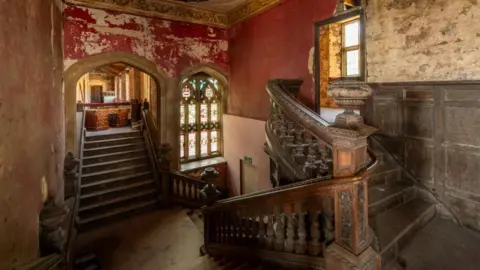
Overlooking one of Bristol's most popular green spaces, the formidable Grade I-listed Ashton Court Mansion is slipping into decay.
The yellow stone mansion, which has a core that dates back to the 14th Century, is deemed to be in "very bad" condition by Historic England, with about 75% of the building derelict.
Once a private home for the wealthy Smyth family, it is now occupied by Bristol Historic Buildings Trust, which is applying for a 125-year lease from the council.
 Rebecca Noakes Photography
Plans to revive the mansion include turning it into an event space, studios, museum and education facilities - but a full restoration could cost about £20m.
Simon Cook, chair of the trust, said just £200,000 had been raised so far through grant applications and public donations, but added he remained optimistic that the rest would come.
"We have ensured the building is safe and watertight, but action in the next two or three years is required if areas like the north west wing are not to deteriorate further," he said.
Cook warned the scale of decay meant some areas of the house were unable to be restored "in a historic sense", but would be made "elegant and flexible".
The Assize Court
After decades of decline, the Grade II-listed Assize Court in Devizes, Wiltshire, faces hefty restoration costs of nearly £15m.
The former courthouse, which was built in 1835, closed its doors in 1983 and has remained derelict ever since.
But the Devizes Assize Court Trust, which owns the building, has partnered with Wiltshire Museum to transform the building into a new home for artefacts.
 Wiltshire Museum
A museum spokesperson said it was "an honour" to revive the "iconic building".
"Inside we will have brand new galleries to showcase Wiltshire's Rich History and Archaeology, a learning centre and a multi-use events space," they said.
"We have every intention to make the courts into a community hub where anyone can come along to learn, create, connect and enjoy."
Ground works are due to begin soon, with the main restoration beginning in 2027 and an intended opening in 2030.
The project is being funded by supporters and donors, including £8.5m from the National Lottery Heritage Fund.
However, a further £2m is still required for the project.
The Lansdowne Monument
 Getty Images
Towering above the Cherhill White Horse in Wiltshire, the Grade II*-listed Lansdowne Monument has spent about 15 years hidden behind protective netting.
Its deterioration has been linked to earlier repair work that used unsuitable stone, which had weathered badly on the exposed hilltop and led to crumbling masonry.
Now, after years on Historic England's at Risk Register, the 125ft (38m) stone obelisk is undergoing a multi-million-poundrestoration led by the National Trust.
A National Trust spokesperson said: "Work is progressing as expected, and the aim is to complete the majority of the repairs by the end of 2026."
"We're confident that these repairs will enable the monument to be removed from the Heritage at Risk Register," they added.
Tonedale Mill and Tone Works
 Daniel Mumby
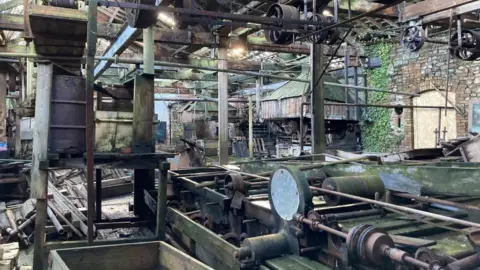
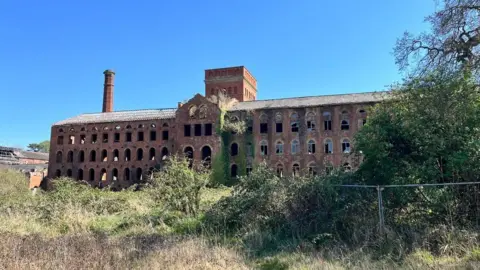
Once the heart of one of Britain's great textile empires, Tonedale Mill on the edge of Wellington, Somerset, is now a vast abandoned industrial complex engulfed by ivy.
It contains an unusually complete collection of historic industrial machinery and buildings, making it one of the most significant surviving textile sites in the country.
Somerset Council earmarked more than £16m of Levelling Up funding to salvage it in 2023, but subsequent surveys revealed extensive deterioration and asbestos.
The authority, which does not own the building, said seeking to purchase the site and pursuing the original proposals would be a "massive financial risk".
"The council understands the value of Tonedale Mill in terms of heritage and importance to the area," a spokesperson said.
"We are happy to support efforts by local groups to identify a way forward and potential funding streams, but we have no choice but to carefully review any involvement in the building."
Instead, much of the focus and funding has shifted to the neighbouring Tone Works site, where the woven cloth was once dyed, washed and finished.
Repairs at this site are actively under way, and include roof replacement, structural repairs, asbestos removal, timber conservation and protection of historic machinery.
Jacobs Wells Baths
 Khali Ackford Photography
Built in 1889 as Bristol's public swimming house for working-class residents, Jacobs Wells Baths later became a community dance centre before it closed down in 2016.
After years of deterioration, Trinity Community Arts took on stewardship of the site in 2023 through a 35-year lease from Bristol City Council.
More than £2m has already been spent on major structural repairs, asbestos removal and stabilisation completed to secure the Grade II-listed building.
"One of the things that comes through really strongly is just how personal people's connection to this building is," a charity spokesperson said.
"People remember swimming, dancing and spending time here.
"That history is part of why there is such a strong desire to see the building brought back into use for future generations," they added.
The venue is expected to reopen to the public in 2029 as a multi-purpose community, arts, dance, and music hub.
The Fleece Hotel
 Historic England Archive
The Grade I-listed Fleece Hotel, a former pilgrims' inn dating back more than 500 years, is one of Gloucester's most important medieval buildings.
The site has been out of use since 2002 and on Historic England's Heritage at Risk register since 2013 after it was deemed to be at "immediate risk of further rapid deterioration".
Gloucester City Council said it "remains committed" to securing the "best possible future" for the site, but there is currently no agreed redevelopment scheme in place.
"We've undertaken work to keep the site secure and continue to explore opportunities to find a future for the buildings there," a spokesperson added.
On Thursday, The Fleece was announced as one of the 74 sites set to benefit from £41m of government funding as part of the Heritage at Risk Capital Fund.
The council will be awarded £261,500 to undertake surveys, conservation planning and capital repairs to the Fleece complex, including the Westgate Range roof and parapet gutters.
Follow BBC Bristol on Facebook, X and Instagram. Send your story ideas to us on email or via WhatsApp on 0800 313 4630.
