NHS trust 'too late' to learn before fatal attacks

 Supplied
An NHS trust missed opportunities to properly address a "fatal incident" by a patient weeks before discharging triple killer Valdo Calocane, a public inquiry has heard.
Calocane, who was diagnosed with paranoid schizophrenia in 2020, went on to kill Barnaby Webber, Grace O'Malley-Kumar and Ian Coates, and seriously injure three others on 13 June 2023.
Nottinghamshire Healthcare NHS Foundation Trust was aware of previous incidents involving other patients and former patients, including a homicide in August 2022.
Former chairman of the trust's board, Paul Devlin, accepted lessons were not learned until "far too late" - and steps could have been taken earlier to help avoid the Nottingham attacks.
'Poor risk assessments'
Calocane was under the care of the trust from May 2020 to September 2022, when he was discharged back to his GP due to a lack of engagement.
He was sectioned four times within that period and had a history of violence and aggression when he was unwell, the Nottingham Inquiry - which is examining the attacks - has heard.
Calocane - referred to throughout the inquiry as VC - is currently serving an indefinite hospital order in a high-security facility after pleading guilty to three counts of manslaughter on the grounds of diminished responsibility and to three counts of attempted murder.
Devlin, who was trust chairman from January 2020 until December 2025, gave evidence to the inquiry on Tuesday. His role was to lead the board of directors.
The inquiry heard the board were aware of issues around discharging patients, and that poor risk assessments were a "systemic problem" in the years leading up to the attacks.
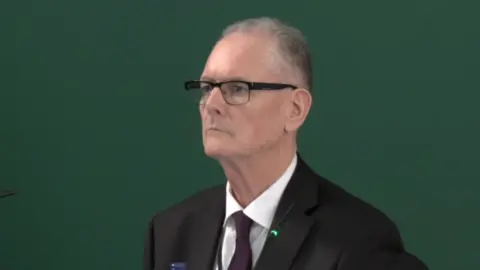 The Nottingham Inquiry
After the attacks of June 2023, a series of work was done to understand the incident, including a thematic review of homicides and attempted homicides, the inquiry heard.
Recommendations made as a result of that review included rewriting policy around serious incidents, and an audit designed to identify patients who had been discharged following disengagement.
Devlin accepted those were steps that should have been taken earlier.
Inquiry barrister James Weston said: "The trust were aware, and the board were aware, of the concerns with risk assessments, potential issues with discharge by September 2022.
"You've said these policies should have been reviewed. Had that opportunity been taken, these policies would have been in place, or some learning would have been in place long before June of 2023."
"Yes, some learning would've been," Devlin said.
Weston said: "If there'd been an audit of unsafe discharges - as I think you would agree should have happened in 2022 - that process would have picked up VC's case wouldn't it?"
"Yes, I expect it would have done," Devlin replied.
Weston said: "And steps taken, to avoid the attacks in June of 2023?"
"It may be the case, yes," Devlin replied.
 Nottinghamshire Police
The board was made aware of a separate incident in which a death was caused by a former patient in August 2022.
However, an investigation into that incident and subsequent action plan was not completed until May 2025.
Devlin told the inquiry the delay was due to an "instruction" by police regarding an ongoing police investigation, "rather than a matter of choice".
However, that instruction was not challenged and no legal advice was sought, the inquiry heard. Devlin said a new process was in place to deal with serious incidents that had police involvement.
He said he accepted "not enough was done" to address the August 2022 incident at board level.
Weston said: "We're a few weeks before VC's discharge to the GP, when he was discharged from the trust to the GP.
"We've got a case here that involved a former patient with an issue about discharge, but no meaningful steps are being taken by the board at this stage. Do you agree?"
"Yes. No meaningful steps were taken. I agree," Devlin said.
Weston said: "This was a missed opportunity wasn't it?"
"Yes it was," Devlin replied.
'Non-fatal incident'
Devlin agreed the August 2022 incident should have been a "trigger point" that led to a review of processes and policy around issues such as discharge and risk assessment.
A further serious incident involving another patient was raised to the board in February 2023.
An investigation into that was not completed until 2024 and found a number of issues relating to staff understanding of mental capacity, medication drop-off, risk management and information sharing with police.
The inquiry heard those findings were all relevant to Calocane's case, but no learning had happened until after the attacks, which Devlin agreed was "far too late".
There was a third serious, non-fatal, incident prior to the June 2023 attacks, in April that year.
The inquiry heard an investigation was completed in June but was not discussed at board level.
In a board meeting about serious incidents in May 2023, the inquiry heard, a review of 22 serious incident investigations was discussed.
The inquiry continues.
Listen to BBC Radio Nottingham on Sounds and follow BBC Nottingham on Facebook, on X, or on Instagram. Send your story ideas to eastmidsnews@bbc.co.uk or via WhatsApp on 0808 100 2210.
