Triple killer brought hammer on to hospital ward

 Nottinghamshire Police
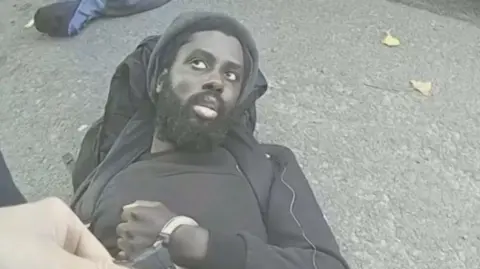
A mentally ill man who went on to kill three people in a spate of attacks took a hammer on to a hospital ward after being sectioned, a public inquiry has heard.
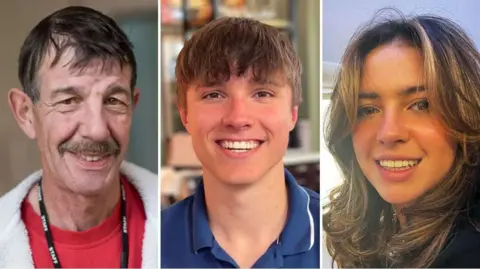
Valdo Calocane, who was diagnosed with paranoid schizophrenia in 2020, fatally stabbed Barnaby Webber, Grace O'Malley-Kumar and Ian Coates, and tried to kill three others on 13 June 2023.
In October 2021, after being admitted to the privately-run Priory Hospital in Nottinghamshire, Calocane took a hammer on to his ward, telling staff he needed to hang items in a new property.
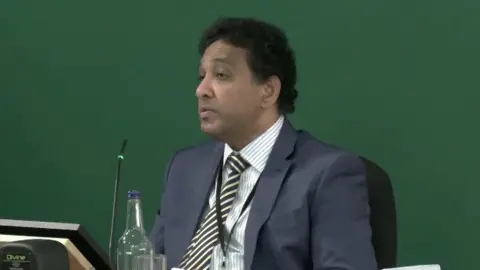
Dr Ajith Gurusinghe, who was Calocane's consultant at the time, said he knew the explanation "wasn't valid" but it was not the "right time" to challenge him.
The Nottingham Inquiry, which is examining the attacks in the city, heard Calocane was transferred to the Priory Hospital in Arnold from another facility on 1 October 2021 after being sectioned for the third time under the Mental Health Act.
Calocane was sectioned a total of four times between 2020 and 2022 and eventually discharged from mental health services in September 2022, nine months before the attacks.
 Supplied
Calocane was allowed to have periods of leave in the community during his admission to the Priory Hospital, the inquiry was told.
He told staff on 10 October 2021 that he wanted to leave the ward to collect items, such as books, so he could study.
When he returned, Calocane was found to have a hammer in his rucksack.
On Monday, consultant psychiatrist Gurusinghe - who was also the medical director of private hospital - told the inquiry: "My recollection of his explanation was that he was moving to a new property and needed a hammer to hang items."
However, the inquiry heard that, at that time, Calocane had not secured any new accommodation.
Questioning Gurusinghe on behalf of the inquiry, inquiry team barrister Craig Carr said: "That explanation was completely implausible wasn't it?"
In response, the doctor said Calocane's explanation "was plausible in his mind", but staff were "sceptical" and discussed keeping an eye on him.
 The Nottingham Inquiry
Asked why Calocane was not probed further on his explanation, Gurusinghe said: "Because if someone is insisting that that's their plan, then there's no point challenging them at that time. It's not the right time."
That incident was not documented in any records, the inquiry heard.
Carr said: "That was a failure wasn't it?"
Gurusinghe replied: "I agree with that."
He added: "I admit that it's been missed as an incident.
"But in terms of any harm occurred to anyone, there was no harm. Probably that's why it hasn't been highlighted enough."
Gurusinghe told the inquiry he did not want to link the hammer incident with Calocane's "general presentation", because he had managed his risk "really well" during his admission and there had been no incidents of violence towards others.
The inquiry heard during his time on the ward, Calocane did not engage with staff, or available therapies, kept mostly to himself, and spent a lot of time alone in his room.
Gurusinghe said he accepted the hospital "should have been more proactive" in getting Calocane to engage with staff and the available services.
Calocane was discharged on 22 October 2021.
Two days before he was discharged, Calocane returned from another period of leave - which he said was to sign up for an engineering course at the University of Nottingham - and had a cut on the bridge of his nose.
Calocane said he had fallen, but the inquiry heard it was unclear when the injury occurred and it was not queried further.
'Knee-jerk reaction to incidents'
The inquiry was told that, at the time of Calocane's transfer to Priory Hospital, the facility was under "special measures" imposed by the health and social care watchdog, the Care Quality Commission (CQC).
An inspection report from June 2021 - before Calocane's transfer - found staff "did not have a good track record on safety".
Following another inspection in December the same year - after Calocane's discharge from the service - the CQC rated the service as "inadequate" with safety remaining an issue, the inquiry heard.
Helen Foster, a former charge nurse, who worked at the facility at the time Calocane was admitted, said the hospital had a "knee-jerk reaction to incidents".
She added: "I worked there for four years and I can only remember one occasion when somebody came down and discussed an incident that had happened and the way forward.
"I just don't think they do what they say they're going to do."
The inquiry continues.
Listen to BBC Radio Nottingham on Sounds and follow BBC Nottingham on Facebook, on X, or on Instagram. Send your story ideas to eastmidsnews@bbc.co.uk or via WhatsApp on 0808 100 2210.
