Our live coverage has endedpublished at 17:25 BST 13 May
Our live coverage has now come to an end.
You can read more about today's evidence here.
Elias Calocane - the brother of Nottingham triple killer Valdo Calocane - has given evidence to a public inquiry, which is examining the deaths of Barnaby Webber, Grace O'Malley-Kumar and Ian Coates on 13 June 2023
Elias documented interactions with his brother, the inquiry heard, and was told Calocane - who was diagnosed with paranoid schizophrenia in 2020 - could "break heads with my hands"
The killer's brother told the inquiry he did not find out about the diagnosis until after the spate of attacks in the city, adding he "felt powerless" over his brother's mental health
Dr Karthik Thangavelu - who was the killer's consultant during Calocane's final admission to Highbury Hospital - gave evidence first on Wednesday
Thangavelu told the inquiry he did not ask Calocane about hallucinations he was having, with the hearing told the killer had talked about a "computer brain interface" being used on him on the day of his discharge
Our live coverage has now come to an end.
You can read more about today's evidence here.
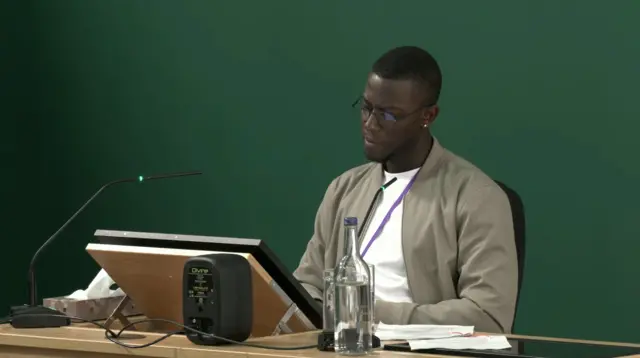 Image source, The Nottingham Inquiry
If you'd like to find out about more of the evidence heard in the Nottingham Inquiry so far, you can get up to speed with the latest as part of our Need to Know series.
The cross-examination of Elias Calocane has now finished, with that the inquiry has ended for the day.
Proceedings are set to resume tomorrow, with evidence due to be given by Valdo Calocane's mother Celeste.
Elias Calocane has this afternoon spoken about his feeling that his brother Valdo Calocane was going to take his own life.
Speaking about how he felt "powerless" over his brother's mental health, Elias had to pause his testimony to gather his emotions.
Cartwright said that Elias, having taken a call from Calocane on the morning of the attacks, should have called 999.
Two people had been killed by Valdo Calocane, but Ian Coates had not been attacked at that point and the killer told Elias it had "been done", and asked his brother to take their parents out of the country.
"There was an opportunity," Cartwright told Elias.
Elias said: "I guess I say this over and over again, that I had this long view of him wanting to commit suicide and me thinking that's what's happened."
Sophie Cartwright KC, who is representing the survivors Wayne Birkett, Sharon Miller and Marcin Gawronski, said there was a "gathering storm" over calls from Valdo Calocane to his family.
But Elias said: "He didn't sound unwell in the ways that we had known previously, if that makes sense.
"It basically became much harder to detect crisis."
He said there was an idea that "we've been here before", and would have called crisis [the mental health crisis team] if they had detected one.
"We didn't understand the paranoia as part of an illness," he said.
Emily Williamson
BBC News
Tim Moloney KC, who is representing the bereaved families, questions Elias Calocane on why he did not visit his brother.
He said: "I found it very difficult and the way I dealt with it was by withdrawing."
A dramatic end to very tense cross-examination by the barrister then sees Elias say: "I understand that you have instructions to essentially bully me and my family, but I do find this interaction a little bit strange."
Emma Webber - mother of Barnaby Webber - loudly scoffed as Moloney ended questioning abruptly.
Elias Calocane is now being cross-examined.
Tim Moloney KC, who is representing the bereaved families, is asking Elias about the family's worries about Valdo Calocane and suicide.
He said both Celeste and their father Amissao raised fears about him taking his own life.
However, Elias said the family did not discuss this between themselves.
Elias said: "We all individually had this fear, and also the fear of talking about it bringing it up.
"Every time the phone rang, I thought this was going to be it."
Moloney asked Elias if he would have called the police if he thought his brother would harm someone, other than himself, after their call on the morning of the attacks.
Elias replied: "Of course, yes."
He added he only considered another context to the messages and calls after the attacks.
The Nottingham Inquiry has been told that the Calocane family had raised concerns that the press had been turning up at addresses of relatives following the killings, and that a report by the Telegraph newspaper had information that only police had been told about.
Detectives visited the family to discuss this.
Elias was asked by counsel to the inquiry, Rachel Langdale KC, about his brother wanting to be known as Adam Mendes.
Elias said he thought his brother was experiencing "disassociative symptoms".
"The voices were telling him Valdo had died," he said. "I think he was feeling he wasn't the same person and needed a new name to recognise that."
Calocane lived in Portugal as a child, and moved to Wales with his family.
Elias has told the inquiry that while the move from Portugal "might have knocked his confidence a little bit", he did not believe it was "stigmatising".
He said Calocane had "more social difficulties", but that he recalled "a sense of popularity" around Calocane's football talents at school.
Asked if he saw evidence of good friends or people that Calocane socialised with, Elias said: "He did. Maybe not as much as he did when he was in Portugal, but he did."
Elias said he went to check X, formerly known as Twitter, as it "moves quicker than the news".
He said he was searching for Coventry, as he believed his brother was there, but saw that Nottingham was trending.
He told the inquiry: "I looked at it out of curiosity, I associate Nottingham with Valdo, and there was lots of chat about a potential terrorist incident in Nottingham - police involved, city cordoned off.
"I thought there's no way this is related and then eventually Nottinghamshire Police released an update and mentioned an incident on Ilkeston Road, and I remembered Valdo had lived on Ilkeston Road, and I thought it matched up with the timings for my phone call with him."
Elias messaged his mother Celeste to see if the description of the suspect matched his appearance at the time.
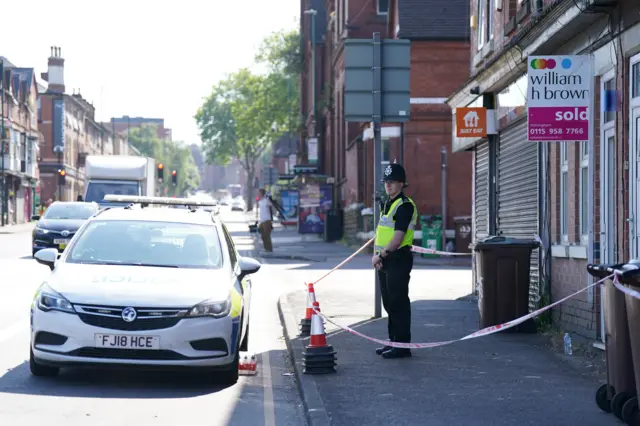 Image source, PA Media
Elias said he tried to call his brother a few times to get his attention after Calocane told him on 13 June 2023 that "it's already done".
Asked if he was worried about violence to others at that point, considering Calocane's earlier incidents, Elias said: "I guess I associated all those incidents with VC in crisis.
"And I guess it's very apparent that it became much harder for us to tell when he was in crisis."
He said he checked local Coventry news - because Calocane had told his brother he had moved there after graduating from university in Nottingham - and considered contacting police to file a missing persons report.
However, upon checking the force website, he said he did not have enough information to fill out the form.
Emily Williamson
BBC News
Emma Webber, the mother of Barnaby Webber, audibly groaned, threw her glasses on to the table and shook her head as Elias Calocane told the public inquiry he thought his brother was going to kill himself when he carried out the Nottingham attacks.
The inquiry heard Valdo Calocane woke Elias up at 04:52 BST on the morning of 13 June 2023 with another phone call.
Elias said: "I was a little bit confused as to what he was talking about.
"I asked, 'are you going to do something stupid?' Thinking about suicide.
"He said 'it's already done'."
Elias told the inquiry: "I still have that in my head.
"I think I messaged him a few times saying, 'you have to think about mum and dad if you do something'... and trying to get his attention."
Elias did not know at this point that his brother had already stabbed to death students Barnaby Webber and Grace O'Malley-Kumar.
In his statement to police, Elias said he had just let his brother talk during the phone call the day before the killings.
He told police he had suggested his brother needed help and medication.
He said: "A lot of our conversation was just back and forth, the same circular conversations we'd been having in previous years.
"I remember the detectives were looking at me like I was crazy, as none of it makes sense.
"I was trying to explain to them he's unwell, he's been ill, and they were like 'none of this makes sense'.
"I was trying to convince them this isn't a terrorist incident, that he's just unwell."
Elias said he received a call from his brother the day before the Nottingham attacks on 13 June 2023.
He recalled during the call, at 19:09 BST on 12 June, the sound of an announcement for a train to Blackfriars, so he was aware his brother was in London.
Elias said the call was mostly Calocane trying to convince him to read the zip files he had sent to their parents over Christmas.
In his witness statement, Elias wrote: "He said something like 'this will be the last time I will talk to you. After this I will leave you alone'."
Rachel Langdale KC, counsel to the inquiry, said: "What did you understand that to be saying?"
"I thought it was just like, you know 'after this I won't bother you any more, just listen to me now and then you don't have to deal with this'," Elias said.
Speaking about having less contact with Calocane, Elias said he was "convinced" his brother was going to take his own life.
Elias held back tears, as he said: "I guess I can say more confidently looking back, but part of this was a defence mechanism on my part, of dealing with a loss ahead of time, if that makes sense.
"I thought that - and I explained this to people - that every time mum called me during that period, I thought it was going to be... um, yeah, I just found it really hard," he said.
He added there was a "sense of hopelessness that comes with all of this", and that he did not really know what was going on.
"So then it's either, we wait for something to happen, or I try to sort of convince VC to engage with services or to try to reason with him.
"And that's not possible so, it leads to frustration and it leads to [a feeling] like none of this can ever be fixed," he said.
Elias said he had to wait for something to happen and hoped it would not be that bad.
"I couldn't see another way out," he said. "I just didn't know what to do about it. I felt powerless."
Elias said he saw his brother once during 2022, when Elias was going to a concert in Birmingham with his sister and Calocane insisted he needed to travel there.
"It was good that we saw him," he said.
But he added: "He was just sort of acting on his paranoia. We tried to reason with him in the build-up to this, 'it's OK, we're safe, you don't need to'."
