What social media study tells us about teens' scrolling

 Emma Shales/BBC
Back in May, social media was an everyday part of the lives of Bradford teenagers who were asked to limit their smartphone use for a landmark research project. Six weeks on, their age group now faces a looming UK ban from major platforms - so what has the study discovered?
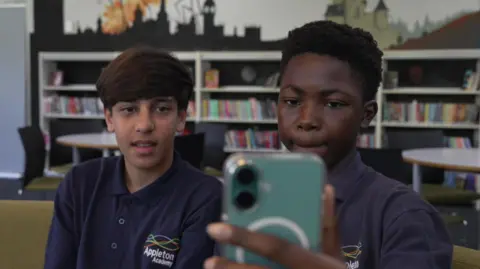
It's been a challenging summer so far for 15-year-olds Lucia and Declan, from Appleton Academy in Wyke. The were asked to limit their time on apps like Snapchat, TikTok and Facebook to one hour a day for six weeks, with no use after 9pm.
For Lucia, who used to scroll for four hours a day, it's been a positive experience.
"It's made me feel more in control and it's made my life feel calmer because I'm not constantly sat on the phone," she says.
But Declan has struggled.
"It's been hard to contact the people I don't have the phone numbers of.
"I do late night racing and stuff, so definitely the bedtimes it's quite hard to stick to."
In June, the prime minister announced that a ban on social media use for under 16s would be introduced by spring 2027.
On Wednesday, the government announced older teenagers in the UK will face an overnight social media curfew - though they will be able to opt out by changing their account settings.
 Amy Garcia/BBC
Researchers at Born In Bradford believe the IRL (In Real Life) trial is the first major scientific study into the impact of social media on young people's mental health.
Two hundred teenagers were involved in the initial research, with thousands more from schools across the district due to take part in the autumn.
Pupils in Year 10 - those aged 14 or 15 - were asked to limit social media use to just one hour a day, with no use between 21:00 and 07:00.
Children in Year Nine - aged 13 to 14 - were asked to limit social media use to two hours a day, with no use between 21:00 and 07:00.
Finally, pupils in Year Eight - aged 12-13 - were able to continue with their normal use.
 Alice Evans/BBC
The teenagers completed surveys and installed a special app on their phones to monitor their usage.
The software found, on average, participants used social media for five-and-a-half hours a day, much higher than the four hours they reported in surveys.
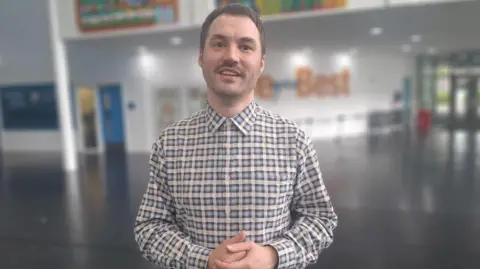
According to Dr John Pickavance, who is managing the trial, many of the pupils were unable to stick to the restrictions.
"About half of them had the app installed for the full duration, and of those, half of them successfully completed the targets that we'd set them.
"Although, interestingly, even those who didn't stick to those targets, they were also successful at reducing the amount of social media they were using."
The one-hour cap will now be scrapped for the main trial to improve participation levels.
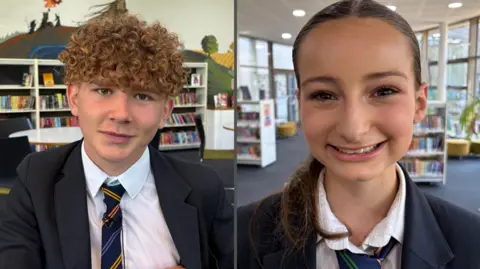
Fourteen-year-old Star felt his two-hour restriction was just right.
"It definitely made me happy and feel better in myself. It gave me a lot of self-confidence," he says.
But some families found the strict time limit impossible. Fifteen-year-old Oliver uses Snapchat and TikTok to communicate with friends.
"After school I went over it about two or three hours and then on weekends I went over it about four or five hours more," he says.
Oliver's mum Vicky says: "I thought it was important to see if our young people could actually stick to a bit of a limit. It didn't work this time though unfortunately.
"I'm just as bad. I can sit there for hours lost on TikTok just scrolling away."
 Amy Garcia/BBC
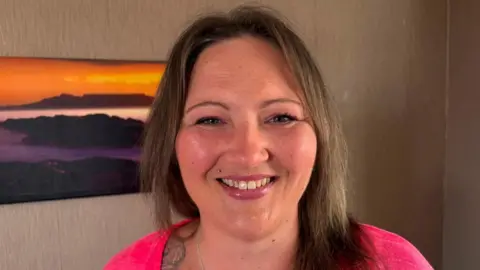
Head teacher Rachel Garlick says the trial has sparked some positive conversations with the young people.
"They've talked to us about the fact that they are more considerate around their use of social media outside of school, meeting up with their friends rather than communicating everything through social media or games platforms.
"That's been quite a unique response."
Now the feasibility study is complete, researchers are planning to start the major project in September, with initial results expected by early next year.
The pupils involved in the research have mixed views on the upcoming restrictions.
"I don't think it will work because social media is a big part of everyone's life," says 14-year-old Imogen.
But Star is more optimistic.
"I'm not very happy with it, but I think overall it's the best decision for the youth and it will help them socialise and help their mental health get better."
Dr Pickavance feels the ban makes this research even more important.
"This now represents our last chance to run a rigorous scientific study at a time when social media is available to all under-16s.
"We hope it will keep this conversation going and keep our policymakers making decisions in the best interests of our young people."
Listen to highlights from West Yorkshire on BBC Sounds, catch up with the latest episode of Look North.
