'I only talk to my friends on my phone - I don't meet them'

 BBC
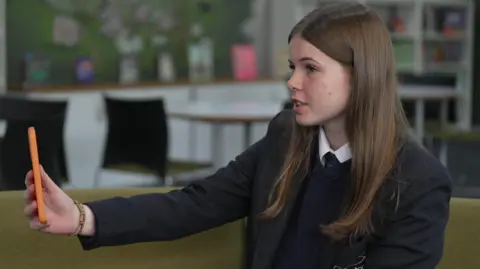
BBCSpending seven hours a day on social media is normal for 14-year-old Imogen, who is online every day with friends before and after school, and who says it feels like she is "always on her phone" - but for the next six weeks, that will change.
She is one of a group of teenagers who are about to limit their social media use as part of a landmark research project in Bradford.
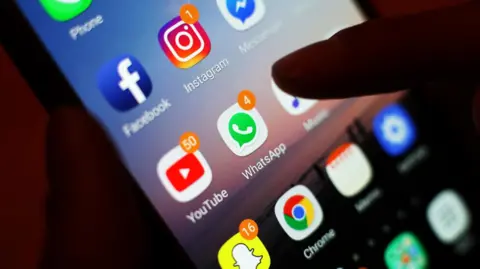
The IRL (In Real Life) trial is believed by those behind it to be the first major scientific study into the impact on young people of regularly using apps like Snapchat, Instagram, YouTube and X.
More than 200 pupils at Appleton Academy in Wyke are involved in the initial research, with about 4,000 children due to take part in the main project later this year.
The teenagers have downloaded a special app onto their phones, which sets a range of time limits and a night time curfew.
Once the trial is under way, researchers from Born In Bradford project and the University of Cambridge will look at the levels of anxiety, depression and sleep among those taking part, meanwhile bullying and the amount of time spent with friends and family will also be measured.
Imogen, who has been asked to restrict her social media use to two hours a day for six weeks as part of the IRL project, says while she would like to cut down, she also admits she is feeling "scared" at the prospect.
 Yui Mok/PA Wire
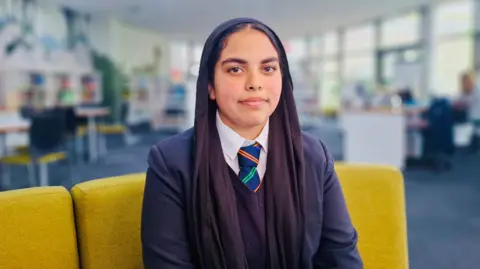
Imogen's classmate, Aisha, has similar feelings and says she thinks being part of the trial will be "really hard".
"The only way I talk to my friends outside of school is on my phone, I don't go and meet them," she says.
"But hopefully it'll make me more relaxed because I'll be able to go outside and not be just stuck at home."
Meanwhile, Lucia, 15, who normally spends four hours a day on social media, is preparing to adjust to a limit of just one hour per day.
"It's such a big part of my life at the minute," she says.
"I was thinking about ways to reduce my screen time and realised that I don't actually have the phone numbers of some of my friends. I only have them on Snapchat or Instagram.
"So, it was a challenge to then say to these people, can I actually have your phone number so we can still like talk?"
Declan, another participant in the trial, says he thinks his one-hour restriction will affect the research he carries out for his homework.
"When I'm at home, for my revision, I just go straight to TikTok, because I know I can find it on there. Really, it's everyday life now, for everyone," he says.
 Alice Evans/BBC
As part of the study, pupils in Year 10 - aged 14-15 - will be asked to limit social media use to just one hour a day, with no use between 21:00 and 07:00.
Pupils in Year 9 - aged 13-14 - will be asked to limit social media use to two hours a day, with no use between 21:00 and 07:00.
Finally, pupils in Year 8 - aged 12-13 - will be asked to continue with their normal use.
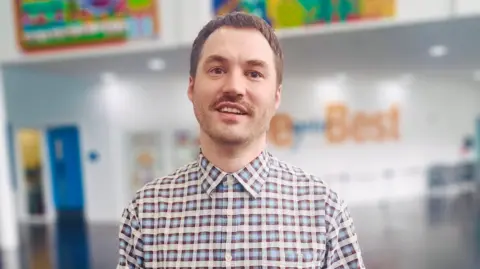
Dr John Pickavance, managing the trial in Bradford, says he has seen a mixed reaction from students.
"We've had it all. We've had whooping and hollering, with some really excited about participating in world first research," he says.
"But then, naturally, we've had a lot of uncertainty and anxiety."
Pickavance acknowledges that social media apps are "at the centre of young people's lives" and that changing habits will be "incredibly challenging".
The government is already consulting on an outright ban on under-16s using social media, along with measures to stop teenagers accessing addictive and harmful material.
In April, the government said it would introduce a legal ban on smartphones in schools in England.
 Alice Evans/BBC
But Pickavance says he does not feel the upcoming study has come too late.
"These are blanket measures that are going to apply to an entire population," he explains.
"So, it's important we understand, not at the individual level, but at the population level, what those effects would be.
"In Australia, they've introduced a ban and we're looking carefully to see what's happened there.
"But that's not in a controlled setting, the ban's just been brought in, and then we're just kind of scrambling to see what the effects are. This is a scientifically rigorous study."
Rachel Garlick, head teacher at Appleton Academy, says she wants young people to "have their voices and opinions heard in terms of a potential ban on social media for under-16s".
Garlick says she also hopes it will help her pupils "understand the impact of the overuse of social media on their mental health and anxiety".
The research team involved in the trial aims to use expertise from the Born In Bradford project, which has tracked over 60,000 Bradfordians from birth in a bid to improve child health in the city.
The main social media trial is due to get under way in September, with results expected by early next year.
Listen to highlights from West Yorkshire on BBC Sounds, catch up with the latest episode of Look North.
