Tunnel Noah Donohoe was found in would have been 'filled with sea water'

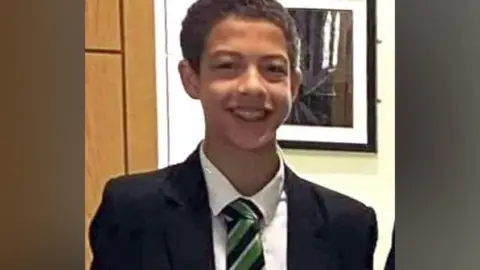 Pacemaker
An inquest into the death of schoolboy Noah Donohoe has heard that the area where his body was found would have been filled with sea water on the night of his disappearance.
Noah's body was found in a tidal part of an underground drainage tunnel, six days after he disappeared.
The discovery was made more than 600 metres downstream from where the 14-year-old was last seen close to a culvert inlet behind houses at Northwood Road in north Belfast.
Jonathan McKee, from the Department for Infrastructure, told the hearing that the tidal area, which is close to the M2, would have been "substantially or completely filled with sea water" from 22:00 BST on 21 June 2020, the day of Noah's disappearance.
McKee also described how the department had been contacted by the Police Service of Northern Ireland's (PSNI) hazardous environment team during the search for Noah, requesting information about "likely places for someone to end up if they were washed down the culvert".
The witness also explained that the maintenance of the system prior to Noah's disappearance was in line with industry standards.
Commenting on the area around the culvert inlet, beside where Noah was last seen, the witness said, "this is not an area of abandoned land".
The witness described how checks had been conducted at the site at least once a week.
He also explained that there are no records in departmental files, covering the period from 2016 to the time of Noah's death, to indicate that residents or elected representatives had any concerns about unauthorised access at the site.
He said this position was underlined by the absence of any graffiti, litter, or any signs of anti-social behaviour around the culvert inlet.
The witness also said the purpose of a steel bar screen at the site was to control debris flowing from an adjoining stream.
'Risk associated with locking hatches'
McKee said there is no requirement to lock a hatch on a debris screen and an unlocked hatch can allow maintenance workers to open it in the event of a build-up of debris or flooding.
He also said an unlocked hatch can allow someone who became trapped inside to escape.
The witness said: "There's actually a risk associated with locking hatches."
Concern had been expressed following Noah's death that he could possibly have gained entry to the culvert through the unlocked hatch at the inlet.
Noah was last seen running behind houses at Northwood Road, where back gardens run alongside the waste ground where the culvert inlet is located.
McKee explained that the only people who were known to have access to the area around the culvert inlet were the residents of four local homes.
He said they were therefore "more alive and aware" of any risk than other members of the public.
"The site wouldn't have been regarded as being accessible to the general public," he said.
A barrister for the coroner asked the witness if the department considered if it might have been appropriate to liaise regularly with local families about any potential risk at the site.
McKee said the department has considered this matter, but it could not be done in isolation at one location.
He said there are hundreds of other locations across Northern Ireland and if it was to be done at one location it would have to happen at all locations, and this could create potential administrative and logistical issues potentially involving thousands of people.
Locks put on all culvert hatches after death
The witness also told the inquest that a lock on a security gate at another side of the culvert inlet, alongside a public park, was cut by what appeared to be an angle grinder during the search for Noah and about 40 to 50 people came onto the site.
He also explained that locks were put on all culvert hatches after the death of Noah Donohoe.
McKee explained that this was necessary because people, including members of the media, were visiting the site in question and other locations elsewhere around locked or unlocked culvert hatches became a matter of public interest.
He said that increased the level of risk at various sites and "we were concerned about copy-cat instances".
However, he said, the matter remains under review.
During his evidence to the jury and the coroner, Mr Justice Rooney, the Department for Infrastructure official said it "was not possible to manage risk down to zero".
He went on to tell the inquest that there are "no doubts" there are hazards in the culvert.
Asked if he accepted that the culvert inlet was in a densely populated urban area, the witness said it was "located in a piece of land that couldn't be accessed by the general public".
