Irish PM quizzed on Troubles interstate case

 Liam McBurney/PA Wir
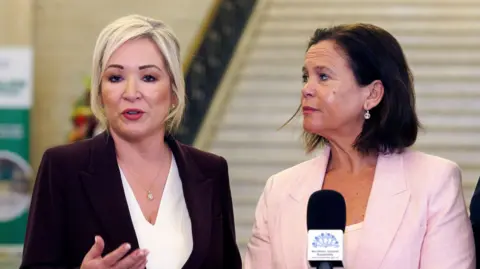
The Irish government's interstate legal case against the UK government over the controversial Troubles Legacy Act must "remain on the table" while uncertainty over replacement legislation is ongoing, Sinn Féin has said.
The party's vice-president Michelle O'Neill was speaking after a Sinn Féin delegation met Taoiseach (Irish PM) Micheál Martin at Stormont.
In 2023, the Irish government announced it would go to the European Court of Human Rights to challenge the UK over the Troubles law it passed earlier that year.
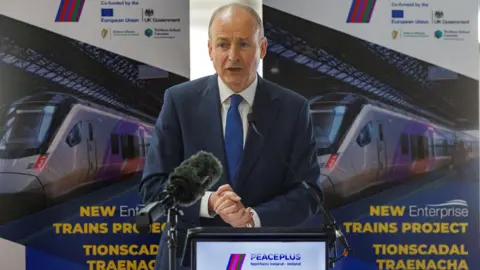
The taoiseach said on Thursday that there is "no basis" to suggest that the UK government is reneging on its previous promises on legacy.
Sinn Féin party leader Mary Lou McDonald said Martin assured her there would be "absolute vigilance" on the part of the Irish government in relation to legacy commitments.
The original law was introduced by the then Conservative government, despite opposition from all parties at Stormont, Troubles victims' groups as well as Dublin.
Much of the opposition to the law stemmed from the fact the law provided a form of immunity from prosecutions for Troubles-era crimes in certain cases.
On Thursday the UK Supreme Court allowed a government appeal in the case on a decision which victims' campaigners have branded "a bitter blow".
Martin said the Irish government will be examining the judgement "very carefully".
When the Labour government took power the following year, they pledged to repeal the act and replace it with their own legislation.
Last September, the UK and Irish governments agreed a new joint framework on dealing with the Troubles, promising that new legislation would follow.
That deal was hailed as "a big step forward" and was part of a reset of Anglo-Irish relations which had been strained by years of tensions over legacy and Brexit.
However, the UK government is facing pressure from Army veterans and some MPs who have said the legislation does not go far enough to protect veterans.
 PA Media
"We would very much welcome the fact that Micheál Martin has restated that they maintain the ability to take the interstate case if the British government reneges on commitments that they've made in the framework," O'Neill said.
McDonald told reporters it was important that they "do not go down road of the British government pandering to their veterans and compromising the effectiveness and the legality of the legacy framework".
The taoiseach said the UK government had "fulfilled their commitments to date".
"We are also fulfilling our commitments and developing legislation under the joint framework," he said.
Martin added that his government wanted to see "continuing progress" in London and that he remains of the view that the plans agreed by London and Dublin last year represent the "best opportunity in a generation to bring into effect a meaningful and sustainable" legacy framework.
"There is strong confidence and mutual trust between the British and Irish governments," he said.
'Disgrace'
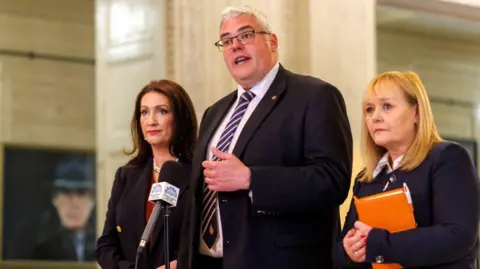
After meeting the taoiseach, the leader of the Democratic Unionist Party (DUP) spoke of his "continued disappointment" over the Irish government's approach to legacy.
Speaking to the media, Gavin Robinson said while the Irish government was willing to engage with the Omagh Bombing Inquiry, they were ignoring a "flaw" by not establishing a parallel inquiry in the Republic.
 PA Media
"There is no opportunity for families to have an answer to the questions they have about what the Irish government could have done and of what the authorities of the Irish Republic could have done to prevent that atrocity," the East Belfast MP said.
"The inquiry we have can only answer half of the questions that families have," he added.
He said the Irish government "talks a lot about legacy but has delivered nothing for victims".
Robinson was also critical of the government's interstate case against Westminster over the Legacy Act, calling it a "disgrace".
"It is not sustainable for the Irish government to challenge the United Kingdom's approach while abysmally failing to address its own role in the Troubles," he said in a statement after the meeting.
'What we need is a joint approach'
 Liam McBurney/PA Wire
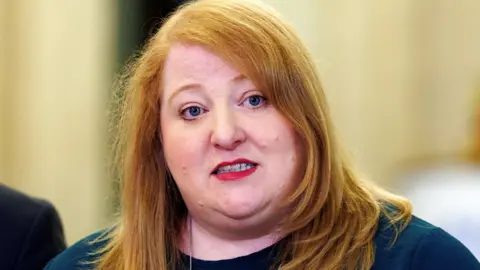
Justice Minister and Alliance Party leader Naomi Long said the current arrangements on legacy "aren't fit for purpose".
"The (UK) government has already conceded that that is the case which is why they're bringing new legislation to deal with the legacy issues," she said.
She added: "What we need to see now is some progress."
She also said there needed to be "fairness across the board" on legacy.
"What we were stressing today to the Irish government is that they also at pace need to start dealing with the legislative situation on their side because what we need is a joint approach to legacy issues."
"For too long the focus has been on vested interest rather than on victims and the victims' families," Long said.
'Fairness' for ex-service personel
The leader of the Ulster Unionist Party (UUP) said he held "candid and constructive" talks with Martin on legacy, post-Brexit trade problems and the European Council.
It was their first engagement since Jon Burrows became UUP leader in January, but as he was in London on Thursday their conversation was held by phone.
"The way Dublin has handled legacy to date is simply not good enough, and that needed to be said directly," Burrows said in a party statement.
"Former soldiers and police officers who served this community with courage and dedication must be treated with dignity and fairness. That is non-negotiable."
But he added he would "always strive to have a constructive relationship with the taoiseach to promote reconciliation and co-operate on areas of mutual interest".
The SDLP, Stormont's official opposition, said that keeping all mechanisms on the table, including the interstate case, were necessary because of the approach taken by the previous Conservative government on legacy.
Its leader Claire Hanna said it was "vital" that Irish government ensures that the UK upholds its commitments and "does not close down routes to truth and justice for victims and survivors".
Hanna added it was also important that disclosure of information is dealt with properly in the legacy legislation going through Westminster, to ensure victims and families have confidence in the process.
