'Like a prisoner being released' - Relief for Iranians as internet shutdown ends

 APTN
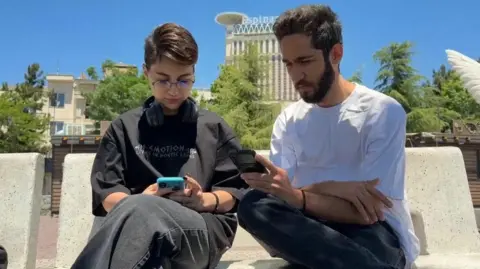
APTN"After 88 days, it felt exactly like a prisoner being released after three months of imprisonment and seeing the sky for the first time."
That is how an Iranian said it felt to be reconnected to the internet, after their government ended what a monitoring group called the longest nationwide shutdown in modern history.
"You wouldn't believe it, but when I clicked on a website and watched it open, I felt as though I could fly with joy," he told the BBC's Middle East Daily programme. "And when I realised I could once again send messages through Telegram, WhatsApp, and other platforms, the feeling was indescribable.
"Even now, as I speak, I'm on the verge of tears from happiness."
He added that his first notification on his phone had told him to update a long list of apps, which left him "overwhelmed with emotion".
While there is relief at the partial restoration of connectivity in Iran, there are also concerns about increased censorship in a country where internet access was already heavily restricted and monitored.
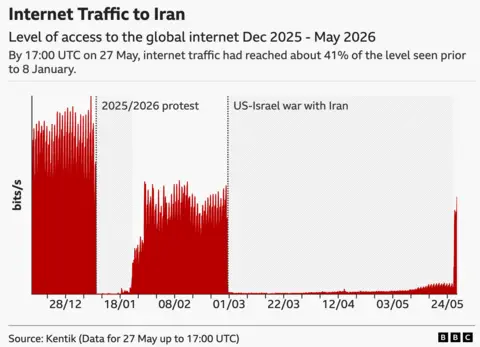
The Iranian government cut internet access after the US and Israel launched a war against Iran on 28 February. Officials suggested the aim was to prevent surveillance, espionage and cyber-attacks.
First Vice-President Mohammad Reza Aref wrote on X on Tuesday that the government had taken a "first step" towards "free and regulated" internet access following a directive from President Masoud Pezeshkian.
He linked the reopening of the internet to restoring smart services and meeting demands of citizens who had "stood by the system and Iran", while portraying it as necessary for scientific and knowledge-based development.
Another Iranian told Middle East Daily that although some users still lacked access and some platforms were still blocked, the "mere fact that the internet is back is cause for celebration".
"The three months during which the internet was down were incredibly difficult," he said. "It was painful not being able to contact our families and friends outside Iran.
"We knew, especially during the war, how worried they were, but we couldn't even reassure them that we were safe."
For those who make their living online, reconnecting to sites and apps on which they depended before the war comes as relief.
"I'm very happy the internet is going to be restored because businesses can get back to normal," computer science student Pantea told Associated Press.
"I had an online shop for a while and sold products. Definitely it will benefit us.
"But the only problem is the censorship. If they come up a good solution and correct solution to this, many problems would be solved."
Rastin, who also studies computer science, told AP the end of the outage was "100% a positive thing".
"The online market is thirsty to go back to its previous state," he said. "But this social prosecution that keeps happening significantly harms online businesses.
"The businesses highly depend on the internet and every time, these restrictions make life more difficult for them."
This was not the first internet blackout in Iran, with access also cut off during a deadly crackdown on nationwide anti-government protests by security forces in January.
Some Iranians had sought to get around the restrictions using methods like expensive virtual private networks (VPNs) and smuggling satellite internet systems into the country.
Internet monitor Netblocks noted that, as connectivity was restored, there were signs of "more extensive filtering" than it had observed during January's crackdown.
"Service remains heavily filtered, with new restrictions on messaging and app stores compared to pre-January. Calls for a free and open internet transcend political divisions and should be heard," the group said on Wednesday.
Since connection began to be restored, Proton VPN said it had seen a 6,000% rise in sign ups.
A number of people who have contacted BBC Persian have said their home internet is connected but their SIM card internet is not working on their phone, while others have said they have no service at all and are connecting using the same methods they used before Tuesday.
One 17-year-old in Tehran wrote: "We're really tired. Of the high prices, of the sanctions, of the weak internet. Things have also gone to hell. I can't live anymore."
While the relief of reconnection will be felt greatest in Iran, it will also be welcomed by those living elsewhere, who are once again able to contact family members.
The Iranian-born British comedian and author Shaparak Khorsandi told BBC Radio 4's Today programme that it was "painful and very joyful" to hear of others speaking to their loved ones, as she had not yet been able to reach her aunt in Iran.
"It feels such a familiar thing for Iranians to just be disconnected and worried and frantic and feeling helpless. So, it's a tricky time, but we keep trying," she said.
"What it feels like when you are out of the country is... a strangely isolating experience, because your life is suspended, you can't really move forward but you get on."
She said one message from an uncle that had come out of Iran during the blackout had been him wishing himself happy birthday on her behalf.
"One of my uncles wrote to us to say, 'It's my birthday today, and I know that you can't contact me to wish me a happy birthday, so I am sending you this message to wish myself a happy birthday on your behalf,'" she said.
Khorsandi said his humour had been "so kind" because he was doing what he could to stop the family worrying.
She was emotional as she said the first thing she would like to say to her family in Iran was that "we love them and hope no amount of silence lets them stop feeling that".
