Iran condemns US strikes as 'gross violation' of ceasefire

 Getty Images
Iran says the US has committed a "gross violation" of the ceasefire with new air strikes it launched on the country.
The US Central Command (Centcom) said Iranian missile sites and boats attempting to place mines had been targeted with what it called "self-defence strikes" in southern Iran on Monday.
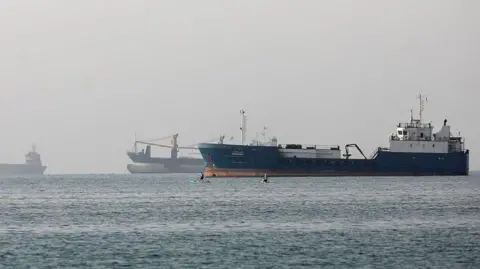
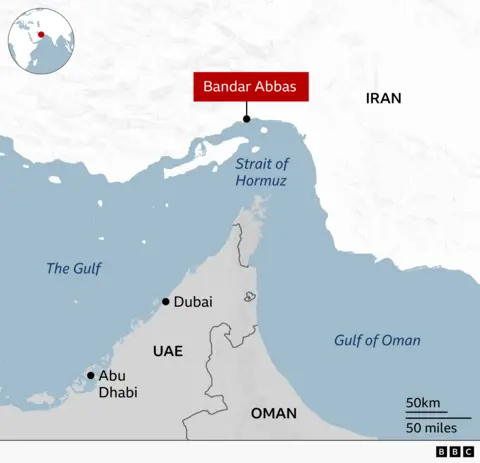
Iran's foreign ministry said it held the US responsible for the consequences of its "aggressive and unjustified actions" in the Hormozgan region, which has a coast along the Strait of Hormuz - the crucial waterway Iran has blocked causing a spike in world energy prices.
It is unclear what impact the strikes will have on talks aimed to end the conflict.
"Without a doubt, the Islamic Republic of Iran will not leave any evil unanswered and will not hesitate to defend the Iranian nation," the Iranian statement said.
The US and Israel started the war with Iran on 28 February with a wave of deadly attacks, including one which killed the country's supreme leader.
After weeks of fighting, a ceasefire was agreed on 8 April and it has been largely observed ever since, barring one notable clash earlier in May.
In its statement, Centcom said US forces "conducted self-defense strikes in southern Iran today to protect our troops from threats posed by Iranian forces".
It did not give details about the location of the strikes, but an official cited by the New York Times said they had targeted an area near Bandar Abbas - a southern port city and home of an Iranian naval base that sits on the Strait of Hormuz.
Iranian state media had earlier reported that local officials in Bandar Abbas were investigating after explosions were heard.
Iran's Islamic Revolutionary Guard Corps (IRGC) later said it had downed a US drone and fired at a fighter jet that entered Iranian airspace, though it did not specify when this happened.
This takes place against the backdrop of talks aimed at extending the current ceasefire, with the eventual aim of bringing an end to the conflict.
US Secretary of State Marco Rubio has said a deal from the talks is still possible, but it will "take a few days".
At the weekend, President Donald Trump initially suggested a deal was close before later saying he had instructed negotiators "not to rush into" an agreement.
According to US media, the possible deal is not a final settlement, but a memorandum of understanding that reportedly involves a 60-day ceasefire extension, reopening the Strait of Hormuz, and a plan for further negotiations over Iran's nuclear programme.
Iran said on Monday that some progress had been made, but a deal "is not imminent".
One of the stumbling blocks reportedly centres on Tehran's request for the release of frozen Iranian funds held abroad.
The peace talks have been mainly mediated by Pakistan.
However, Iranian negotiators have been taking part in talks with Qatari mediators this week.
An official briefed on the Doha visit told Reuters news agency that Iran's central bank governor had attended Monday's talks to discuss the frozen assets, with discussions focusing primarily on Iran's stockpile of highly enriched uranium, and the Strait of Hormuz.
Iran has effectively blocked the vital shipping lane, through which around one fifth of the world's oil passes, since the US and Israel started the conflict on 28 February.
US, Israel and many Western countries have accused Iran of enriching uranium in order to make a nuclear weapon. Iran says the programme is for peaceful purposes only.
