Trump retreat over Hormuz tolls suggests he is struggling to end Iran war

 Reuters
Donald Trump's latest Iran war demand lasted all of 24 hours and suggests a president searching for unorthodox ways out of a difficult position.
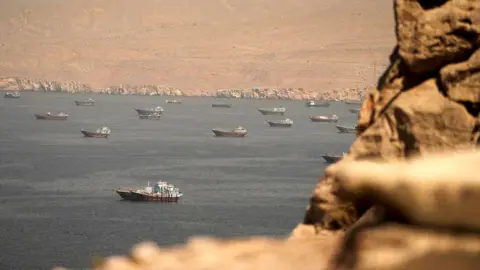
On Monday morning, in a social media post announcing the resumption of an American naval blockade on Iranian shipping, he said that all vessels transiting the Strait of Hormuz - including those of US allies - must pay a 20% fee to reimburse the US "for any and all costs necessary to do the job of providing safety and security to this very volatile section of the world".
The following day, he abandoned that proposal completely, offering instead that he would strike "trade and investment deals" with America's Gulf allies, implying the US would offer them safe passage through the Strait in return.
The abrupt about-face was the latest twist in a conflict that has now lasted more than four months and, despite a month old "memorandum of understanding" that secured a temporary ceasefire and set up a framework for negotiations, shows no sign of ending.
Trump may be reluctant to escalate the war given its continued unpopularity, the likelihood of rising energy prices and the risks associated with American forces and allies once again coming under Iranian attack. He might find the prospect of ending the conflict without reaching an agreement he can claim is better than the one Barack Obama's administration negotiated in 2015 also distasteful, however.
"I think the most likely ending is a non-ending," Rosemary Kelanic, Director of the Middle East programme at Defense Priorities, said. "This has turned into a war of attrition, and wars of attrition tend to go on for a long, long period of time."
The US-Iran memorandum of understanding (MOU) - and the hopes that came with it for an end to the war - died at 10:16 EST (15:16 GMT) on Tuesday on Truth Social, when Trump announced a resumption of the US blockade of Iranian shipping, amidst a flurry of new US military strikes on targets across Iran.
The Iranians countered by stepping up attacks on US allies and commercial shipping in the region, grinding traffic through the Strait of Hormuz to a near standstill once more.
After nearly a month of on-again, off-again negotiations between the two nations, punctuated by occasional hostilities that tested the definition of a "ceasefire", Trump and the Americans appear to be facing the same challenges that had been present through much of the Iran war.
While militarily, the Americans were achieving their objectives, as measured in Iranian ships, planes and targets destroyed and defence capabilities degraded, politically the conflict was far from resolved.
Iran, militarily weakened though it may be, could still deny access to the Strait of Hormuz. And unless the Americans were willing to dramatically escalate their military operations in the region, there was little they could do to stop them.
Trump's new twist of a 20% fee - possibly a means of making that military commitment more palatable to the American public - wasn't entirely new. He had suggested such an arrangement on several occasions over the course of the war.
But just last month, US Secretary of State Marco Rubio had condemned an Iranian plan to charge "fees" on shipping through Hormuz.
"No country is allowed to charge tolls or fees on an international waterway," he said. "That's existing international law. That's the way it is in international waterways all over the world, and that's the way we expect it here."
Trump's Hormuz U-turn is just the latest evidence of a president who does not appear to have a clear path forward. The memorandum of understanding, which both Americans and Iranians claimed as a victory for their side, was intentionally vague, leaving much up to later negotiation.
The document envisioned some role for Iran in overseeing shipping in Hormuz. It read: "The Islamic Republic of Iran will make arrangements using its best efforts for the safe passage of commercial vessels with no charge."
This is a role that Iran has been intent on asserting. The MOU also included billions of dollars in promised "investment" in Iran and an end to international sanctions.
Americans may have believed those sweeteners, accompanied by warnings of the consequences of noncompliance, would be enough to dissuade Iran from attempting to use its geographic advantages to more forcefully assert control over Hormuz. That calculation, at least for the moment, appears incorrect.
"The MOU is completely dead," said Kelanic. "All of the things that it stipulated have now been undone."
Now Trump, and the Iranians, find themselves in a familiar predicament. The latter are once again facing American military attacks across their territory, underlining their inability to defend their territorial sovereignty. With the reimposed blockade, their oil revenue - a lifeline for the Iranian regime - is again cut off.
Meanwhile, Trump is again facing a choice between escalation, which comes with domestic economic and political costs, and settling for some kind of resolution that leaves a hostile Iranian regime in power.
"We're back to where we were initially, where the question was: who's got more patience?" said Elliot Abrams, senior fellow for Middle Eastern studies at the Council on Foreign Relations. "The Iranians, who will not be able to export oil, or the US and other countries that use Gulf oil?"
After months of concern that the Iran war was triggering a new round of popularity-crushing inflation, Trump received some good news on Tuesday that consumer prices were dropping.
A resumption of full hostilities, or even an escalation in the conflict, would inevitably push oil prices back toward previous highs, endangering that positive trend and again putting Republicans in a tenuous position heading into November's midterm congressional elections.
On Monday, after Trump's Truth Social post, the price of a barrel of oil jumped nearly 10% - the biggest one-day increase in six years.
The first time around, Trump's blockade helped pressure the Iranians to the negotiating table and paved the way for the memorandum of understanding and a framework for a more lasting peace.
Now, according to Kelanic, the president's leverage over Iran may be diminished.
"He has already tried the things he can easily do, can credibly do," she said. "He can attack military targets, regime targets. He's done that before, and it didn't cause Iran to surrender."
The latest target Trump has suggested is Pickaxe Mountain, a heavily fortified nuclear research site south of Tehran. But there is conflicting evidence of the value of the site - or of whether US air strikes can cause significant damage to the tunnels which are deep beneath granite rock.
If Trump's latest moves do ultimately end with yet another ceasefire and face-to-face talks, the underlying, difficult-to-reconcile disagreements - over Hormuz, over the disposition of Iran's nuclear programme, over Iran's influence in the Middle East - remain.
"I think there's room for negotiation here over a Strait of Hormuz deal," said Abrams. "But not a return to the MOU."
With the war approaching its fifth month, Trump again on Monday noted that other American conflicts - including the Vietnam War - stretched on for years.
That particular quagmire, however, hobbled and ultimately ended the presidency of Lyndon Baines Johnson and damaged US global standing for at least a decade. That is a fate Trump is certainly hoping to avoid.
His supporters also are weary to repeat the kind of Middle East "forever wars" that Trump condemned in previous presidential campaigns.
But with the memorandum of understanding in tatters, the ceasefire ended and the prospect of further conflict looming, the end of the Iran war appears no closer to a resolution than it was in the weeks after it began.

Follow the twists and turns of Trump's second term with North America correspondent Anthony Zurcher's weekly US Politics Unspun newsletter. Readers in the UK can sign up here. Those outside the UK can sign up here.
