IT firm still hiring graduates despite AI job fears

 Pacemaker
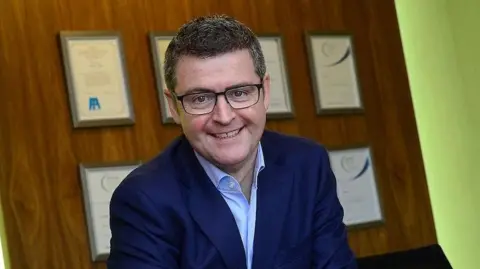
The chief executive of Northern Ireland's biggest software firm has said he intends to hire more graduates this year, despite fears that Artificial Intelligence (AI) is replacing jobs in the sector.
Brendan Mooney, who runs Kainos, said he was sceptical that large organisations would be producing their own "DIY" software with AI and deploying it across the business.
Mooney added that while AI could be used for solving unique, local problems in a business, he doesn't think it "scales at all".
It comes as Kainos produced strong annual results with sales up 17% to £431m and pre-tax profit up 2% to £67m.
Over the past year the number of employees has risen from 2,800 to 3,200.
That includes around 120 people at a Canadian firm taken over by Kainos.
Mooney says the firm hired 130 graduates last year and they plan to take on another 200 over the coming months.
'The SaaSpocalypse'
Kainos operates in a sector broadly known as Software as a Service (SaaS).
SaaS is a way of delivering software over the internet as a subscription rather than downloading it permanently onto your computer.
Over the past 15 years SaaS has become the standard operating model for the software industry.
It made software firms very popular with investors as it provides a predictable source of recurring revenue.
However, over the last year the valuations of many software companies has fallen sharply as fears grow about how AI will disrupt the SaaS model - a phenomenon dubbed "the SaaSpocalypse".
There are two main concerns. That companies which buy software will replace workers with AI and therefore need fewer software subscriptions and that companies will use AI to create their own software.
'Responsible AI'
Industry leaders like Mooney argue that fear is overstated, as it can be difficult to scale AI tools across a large organisation while maintaining security compliance and integration of different systems.
"The constant theme is getting AI from pilot to production is really hard," he told BBC News NI.
"It's one of the most complex things you can do - how do you make sure that that new system operates as planned?"
Kainos' revenues for AI and data-related projects increased 11% over the last year to almost £46m and accounted for about 20% of revenue in its Digital Services division.
It is intending to double the size of its "Responsible AI" team which helps organisations design and deploy AI applications.
