Saxon coin hoard linked to time of Viking raids

 Colchester and Ipswich Museum Service
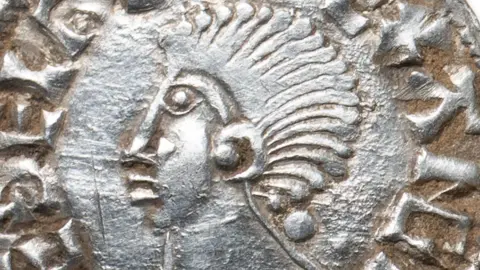
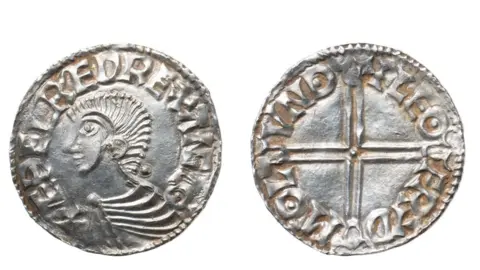
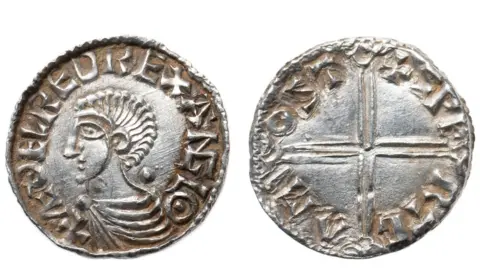
A hoard of 14 Saxon silver pennies has been discovered by a group of metal detectorists.
The barely used coins were struck for Ethelred II, better known as Ethelred the Unready because he was unable to prevent the Vikings from over-running England.
"Under Ethelred's rule, Viking raiders were paid in coins, termed 'Danegeld', on agreement that they would leave," said Lori Rogerson, Essex finds liaison officer.
The hoard was unearthed near Maldon in January 2025 and has been declared treasure by a coroner. Braintree Museum hopes to acquire it.
 Colchester and Ipswich Museum Service
Ethelred had taken over the throne aged about 12 in AD978, after the brutal assassination of his half-brother Edward, possibly at the instigation of his mother.
Bad feeling about Edward's murder may have undermined his authority in the face of increasing Danish raids which led to the battle of Maldon in AD991, a resounding defeat for the English.
Ethelred eventually tried to pay off the Vikings, but in the long term, the Danegeld policy was not effective.
Hoards of his coins have been found across Scandinavia, said Rogerson.
 Colchester and Ipswich Museum Service
The Maldon pennies were minted between AD997 and 1003, and are in good condition, suggesting they were not in circulation long before they were buried for safe-keeping - or lost by a traveller.
"Fourteen silver pennies may not sound like much today, but at the time this represented a significant sum - roughly two weeks' wages or up to £1,000 in today's money," Rogerson said.
While there is no record of Viking raiding in 1003, the find site is close to the River Chelmer, which could be accessed through the Blackwater estuary at Maldon and in turn allowed access to places like Hatfield Peverel, where Danes were known to have settled, she added.
Ethelred's tumultuous reign reached its lowest point when he was briefly ousted from the throne by the King of Denmark, Sweyn Forkbeard, in 1014, although he managed to return to London by 1016, where he died.
It was not until the 12th Century that he gained the nickname "unready". It meant badly advised - as a pun on his name, which meant "noble counsel".
 Colchester and Ipswich Museum Service
Braintree Museum is also hoping to acquire another, earlier Saxon find declared treasure at the same inquest.
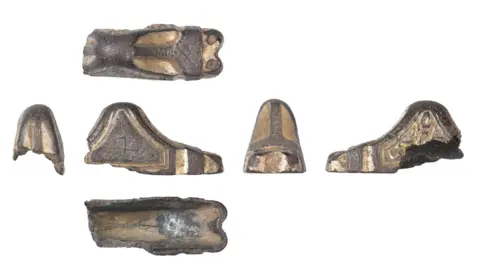
It is a 6th Century warrior's gilded silver sword pommel cap and was discovered by a metal detectorist near Hatfield Peverel.
Rogerson said: "It provides rare evidence for elite groups in Essex that are otherwise poorly represented in the archaeological record.
"Even the sword from the Prittlewell Prince burial lacks a surviving pommel."
She suspects it comes from a lost burial or maybe even a cemetery.
"A lot of what's coming through the Treasure Act is early medieval at the moment," Rogerson said.
"What's exciting is that this kind of object quietly changes how we think about early Anglo-Saxon Essex."
Do you have a story suggestion for Essex? Contact us below.
Follow Essex news on BBC Sounds, Facebook, Instagram and X.
