Why are these beaches so rich in fossils?

 Getty Images
An amateur fossil hunter recently discovered a rare fragment of the world's oldest marine crocodile in Lyme Regis, so what is it about the Jurassic Coast and the Isle of Wight that makes them so rich in prehistoric fossils?
In the early Jurassic period ichthyosaurs and plesiosaurs ruled the waves in what is modern-day Dorset, amid schools of smaller weird and wonderful sea creatures.
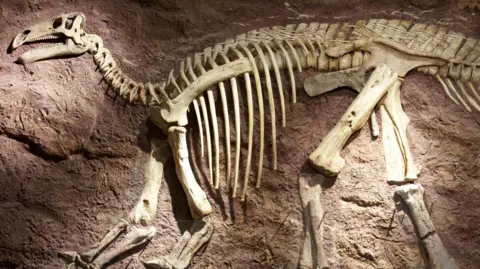
Later, in the Cretaceous period, the Isle of Wight was the "acme of dinosaur diversity in the UK", according to palaeontologist Dr David Button, with specimens of almost every shape and size.
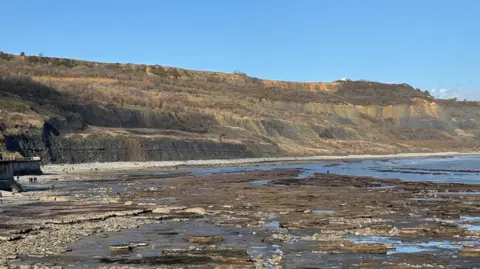
We know this because of the unique geology of these places, where seas continually erode the cliffs and new and exciting fossils emerge into the light of day.
 Lyme Regis Museum
"If you've got a house on the tip of a cliff you don't like erosion but if you're a palaeontologist you do like erosion," says Dr Paul Davis, geology curator at Lyme Regis Museum.
At sites inland, such as Oxfordshire, where the remains of the first dinosaur were found, spectacular traces of prehistoric reptiles are more likely to turn up in quarries.
But coastal erosion means the Jurassic Coast, a World Heritage Site about 95 miles long (153km) between Old Harry Rocks in Dorset and Exmouth in East Devon, continues to reveal samples spanning the entire Age of Reptiles - the Triassic, Jurassic and Cretaceous periods.
These are mainly of ocean creatures, stemming from when the region was a warm and tropical sea.
When it comes to the Isle of Wight, it is quicker to say which dinosaurs did not call it home, according to Button, curator and general manager of the Dinosaur Isle Museum.
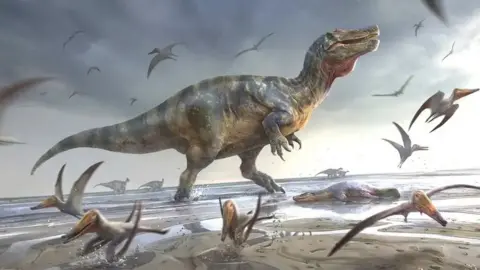
"If you came here about 125 million years ago you'd see all the main dinosaur groups apart from horned dinosaurs, dome-headed dinosaurs and Stegosaurs," he says.
Recent discoveries include the remains of Europe's largest-ever land-based predator dinosaur, dubbed the "white rock spinosaurid", as well as the Comptonatus and the Istiorachis.
 Lyme Regis Museum
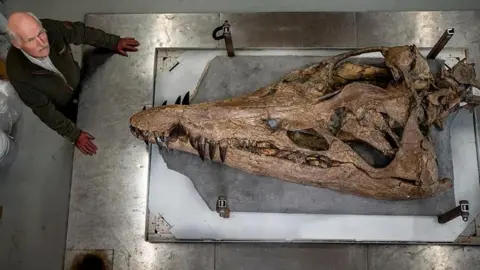
In Dorset, the huge skull of a pliosaur was extracted from the cliffs in Kimmeridge Bay, and the upper jawbone fossil of a Jurassic crocodile was discovered by a tourist in Lyme Regis.
"We've got a lovely slice through the layer cake of essentially pretty much all of the Mesozoic era," Davis says, though he points out that smaller specimens are more common.
"Most life in the ocean is not massive, big creatures," he explains.
"For every whale, there are millions and millions and millions of shells.
"Soft-bodied things rarely do preserve in the fossil record because they decay away or they get eaten, basically they rot or get stuffed down something else's throat as a food source."
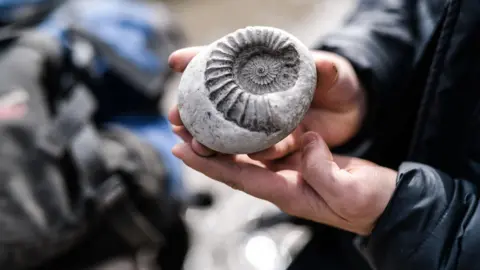
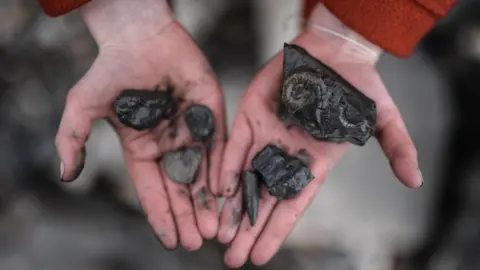
He says a visit to Lyme Regis could turn up bivalve shells (such as mussels or cockles), snails or the extinct ammonite, which he describes as a "coily shell that had a squid-type creature living in the end of the aperture, and these things were super-numerous in the Mesozoic oceans".
The ammonite also gave its name to the Kate Winslet-starring film about self-taught palaeontologist Mary Anning, now an iconic historical figure in Lyme Regis.
 Lyme Regis Museum
But what of the apex predators at the other end of the food chain?
"If you've gone up into the reptiles, the commonest thing are ichthyosaurs," Davis says.
"These were probably the most abundant large predator. We're talking the top of the food web here.
"Rarer than the ichthyosaurs are plesiosaurs and pliosaurs, which are very closely related.
"These things started out looking like the Loch Ness Monster with a big fat body, four flippers, a long snake-like neck with a small little head.
"These plesiosaurs evolved into the pliosaurs, with the same sort of body plan except the neck became shorter, and the head became bigger, and they became a very large size.
"But you can get dinosaurs washed in. Dinosaurs aren't a marine creature but things living on land do get washed out to sea.
"And we have pterosaurs, which were flying reptiles, those occasionally do get preserved in the marine rocks.
"Obviously these things were fishing and eating fish in the sea and, again, you would occasionally find bones of those but these are rare."
 Lyme Regis Museum
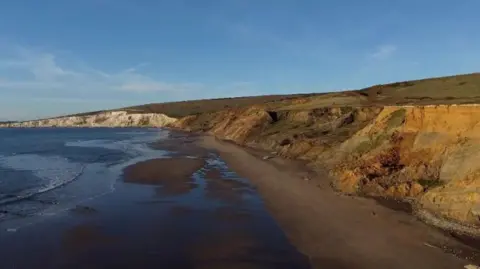
The Isle of Wight was connected to mainland Europe in the early Cretaceous period and was a hive of activity, with more than 25 different species of dinosaur.
Many are preserved in a body of rock known as the Wessex Formation along an 11-mile stretch (17.7km) of coastline that runs between Compton and Sandown.
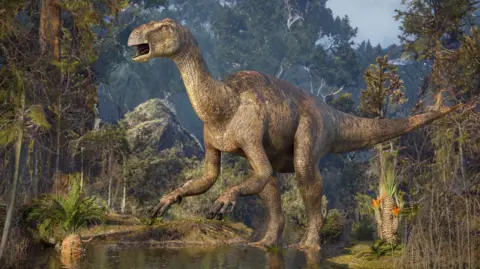
"We've got carnosaurs, sauropods, ornithopods, tyrannosauroids, spinosaurs, we've got several kinds of theropods," Button says.
"We've even got some raptors, like probable dromaeosaurs - overall it's a really impressive sample of dinosaurs."
He describes the prehistoric world they lived in as a "very rich and diverse environment" with a "Mediterranean-type climate of two main seasons - a hot, dry season and a mild-to-wet season".
All of this means it is pretty likely you could make your own special find on one of these beaches.
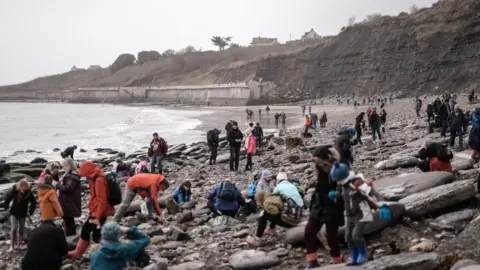
Davis thinks an official fossil walk with his museum is a good place to start - guides there currently take out 6,000 people each year.
He says: "It's not only us, Charmouth Heritage Coast Centre do it, there are other private guides as well. Book onto one of those, they will show you what to look for and how to find fossils.
"Once you've been shown, you are then free to explore. You will have been shown and given the tips on how to do it safely."
Charmouth and Lyme Regis beaches are the best places to find fossils.
 AFP
AFPButton recommends Compton Bay, which includes a large number of dinosaur footprints, and Yaverland, and there are many more.
"What we'd say to amateurs is to focus on looking for loose material on the beach that can be picked up," he suggests.
"Leave anything that is embedded that will require extraction for the sustainability of the site and for the safety of the specimen, to make sure that it's not damaged."
He adds: "It's common to find rolled pieces of bone that have been in the sea and spat out again... but also people find identifiable dinosaur bones quite regularly as well.
"So if you go out looking at the beaches, it's not too uncommon at all to find a dinosaur bone."
Dinosaurs on the Isle of Wight
 Getty Images/Science Photo Library
- Iguanodon
- Hypsilophodon
- Mantellisaurus
- Polacanthus
- Eucamerotus
- Baryonyx
- Ceratosuchops
- Eotyrannus
- Neovenator
- Vectiraptor
Sea creatures off the Jurassic Coast
 BBC/Tony Jolliffe
- Ichthyosaurs
- Plesiosaurs
- Pliosaurs
- Ammonites
- Gastropods
- Sea urchins
- Bivalves
