Village garden digs reveal 6,000-year-old artefact

 Carenza Lewis
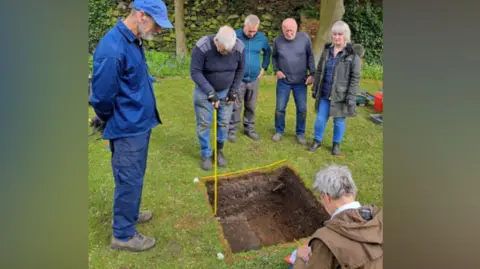
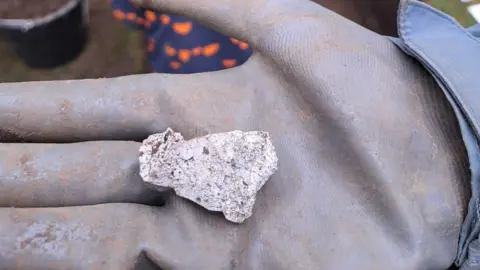
Flint from the prehistoric period was among a "huge range of stuff" found during a series of digs in a village in Leicestershire.
Archaeologists and volunteers unearthed the flint in Newtown Linford on Saturday and Sunday, with more digs planned later this year in Stanton-Under-Bardon, and Woodhouse and Woodhouse Eaves.
Prof Carenza Lewis, from the University of Lincoln, who is leading the project, said in addition to the 4,000 to 6,000-year-old flint, medieval artefacts were found, but no Roman material was located, which she described as "quite intriguing".
"Each [test pit] is like one piece of a jigsaw puzzle. So what you're looking at is the bigger picture that builds up," she said.
"But, of course, with archaeology, it's not even just one jigsaw puzzle. We've got different jigsaw puzzles of different periods in history."
 Carenza Lewis
The findings from the digs at Newtown Linford have been catalogued and will be sent for further analysis, Lewis said.
"There's a bit of a pattern coming up in these Charnwood villages. We're starting to get a bit of an insight that the area was perhaps not very intensively used in the Roman period."
She also said a "cluster of pottery", which was found, could be dated to around the 1100s.
"That's pushing back the earliest documented record of Newtown Linford by 100 years or more, so at the moment the pottery is earlier than written history, which is quite cool.
"Then we had a lot more recent material, 19th and 20th Century material as well."
 Carenza Lewis
 Carenza Lewis
Lewis said the success of the digs had made her excited for more later this year.
"We've got a little bit of a grip on Newtown Linford, so going to Stanton-Under-Bardon, we'll be able to compare the results.
"And then in July, we're going to be doing the same thing again at Woodhouse and Woodhouse Eves, which I think will be the biggest of all of them."
Jan Croft, 73, who volunteered her garden for the digs in Newtown Linford, said she had fun taking part.
"I wasn't worried about them digging up my garden," she said.
"The badger often comes and it's practically turfed the whole of the garden over before. Within three months, it's fine."
Listen to BBC Radio Leicester on Sounds and follow BBC Leicester on Facebook, on X, or on Instagram. Send your story ideas to eastmidsnews@bbc.co.uk or via WhatsApp on 0808 100 2210.
