Roman silver coin hoard found in field

 Michael Eakers/Brian Dixon
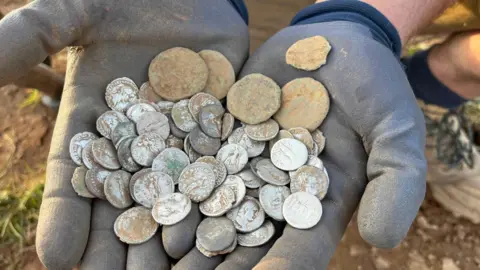
A metal detecting trip led to the discovery of a Roman silver coin hoard.
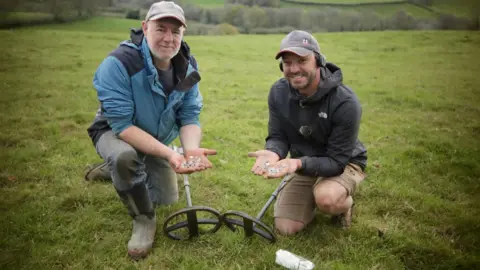
Michael Eakers, from Plymouth, and his friend Brian Dixon made the find while searching pasture land at North Huish near South Brent in Devon.
In total, the pair uncovered 97 silver coins and six copper alloy coins, just a few inches below the surface. The coins span more than 200 years of Roman history, from the time of Mark Antony in 32BC to the joint rule of Septimius Severus and Caracalla in the early 3rd Century.
Experts say the hoard was probably buried after AD205 and is likely to be the largest hoard of Roman silver coinage known from Devon in recent times.
 Michael Eakers/Brian Dixon
The find has now been declared treasure under the Treasure Act after a coroner's inquest. Eakers estimates it could be worth at least £10,000.
Eakers said that under the Treasure Act, finds like this are legally owned by the Crown once declared treasure, so he cannot simply keep the coins.
Instead, the hoard is valued and usually passed to a museum if they want it, with any payment then split between the finder and the landowner.
For historians, the discovery adds fresh evidence that Romans were active further into south Devon than once thought.
"For this part of Devon, it's quite an amazing find because people think the Romans never came to Devon, so, of course, there's not going to be anything here," he told BBC Radio Devon.
For Eakers, the moment still feels unreal, especially when he told the landowner.
"I said this is a 2,000-year-old Roman coin that we've just found in field, he was really taken aback."
Follow BBC Devon on X, Facebook and Instagram. Send your story ideas to spotlight@bbc.co.uk.
