More coins found at site of largest Iron Age hoard

 Fountains Media
More treasure has been discovered at the site of Britain's largest hoard of Iron Age gold coins.
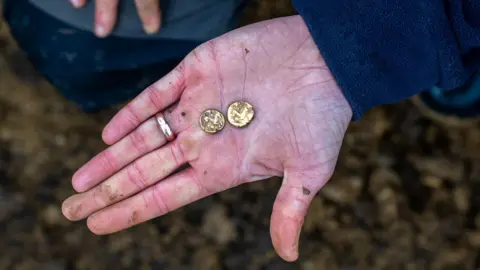
Two further 2,000-year-old coins, known as gold staters, were found during fresh digs at the field in Great Baddow, Essex, in the autumn and details have been made public.
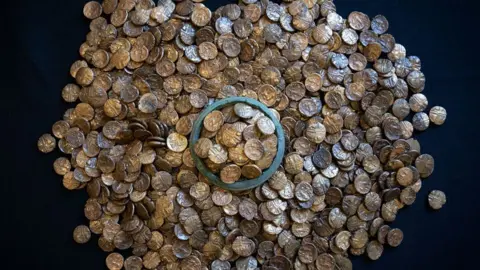
They will join the 933 other coins, discovered in 2020, which will go on display for the first time at the Museum of Chelmsford in July.
Curator Claire Willetts said the hoard's purpose remained a mystery, but suggested it may have been an offering to the gods or a tribute to Roman Emperor Julius Caesar.
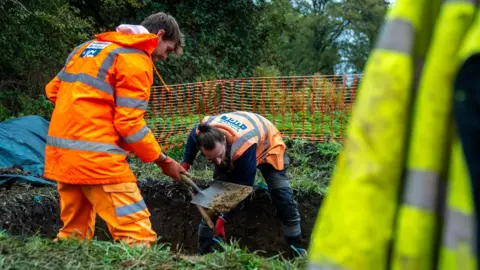
Experts commissioned the latest excavation, by Archaeology South-East, as part of their efforts to answer that enigma.
A team of two dug a two-metre-square trench to search for clues about the burial of the hoard.
 Fountains Media
Halfway through the excavation, senior archaeologist Rob Cullum recovered the two coins from the mud.
They were both identified as the same "Whaddon Chase" type of Eastern British staters as the previously discovered coins, featuring designs of a horse and a wreath.
Yet despite the find, the excavations did not reveal any further context about the wider burial.
Willetts said: "Though these additional coins are an incredibly exciting find, it seems that the Great Baddow hoard findspot is yet to reveal all of its secrets.
"With no further evidence revealed through this recent excavation, the question of why this huge sum of late Iron Age coins was buried and never retrieved will remain a great mystery... for now."
 Fountains Media
The coins were declared as treasure by the coroner after their discovery, before being acquired by the Museum of Chelmsford in April.
The wider hoard remained in the ground for more than 2,000 years before metal detectorist Shane Wood uncovered them.
However, he did not have permission to detect on the private land and failed to notify the coroner of the find.
Wood admitted the theft of 22 staters and one quarter stater, and breaching the Treasure Act 1996 at Chelmsford Magistrates' Court in April 2021.
He was fined and his metal detector was destroyed.
The hoard will be on display 18 July-11 April.
Do you have a story suggestion for Essex? Contact us below.
Follow Essex news on BBC Sounds, Facebook, Instagram and X.
