We had an unwanted ringside seat to one of the country's biggest wildfires

 BBC
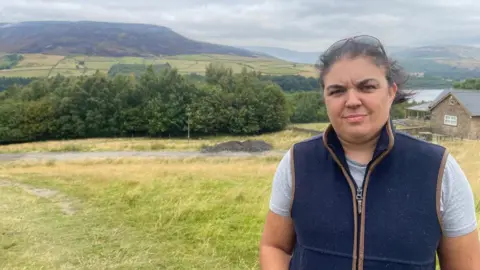
BBCLivestock farmer Nicola Naylor watched on in horror as neighbouring moorland was devastated by a long-running wildfire in Derbyshire.
Despite the plumes of smoke and the speed of the fire's spread, she was not surprised.
Along with her husband David, they recall looking on from their "unwanted ringside seat" as firefighters battled the blaze throughout the day and night near Tintwistle.
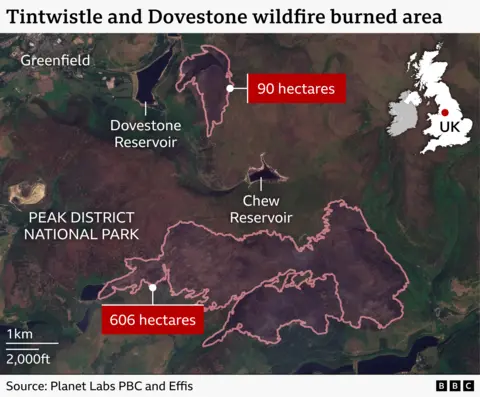
Tintwistle Moor burned for over a month, torching 606 hectares (1,497 acres) of the Peak District, and another 90 hectares (220 acres) were alight near Dovestone Reservoir, areas managed by the Royal Society for the Protection of Birds (RSPB).
The pair watched on helplessly from Blackshaw Farm, on the opposite side of the Woodhead Road valley, safely guarded by reservoirs.
"[Tintwistle Moor] is on fire almost every year, multiple times a year, and these fires now are getting more prolific," she said.
 South Wales Fire and Rescue Service
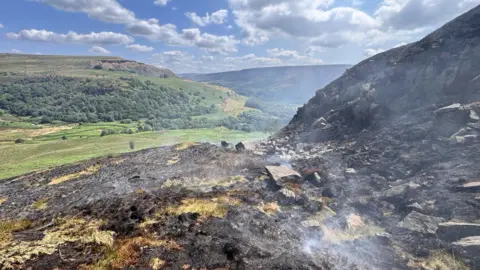
Crews were first called to Tintwistle Moor on 24 June, and the major incident declared on 12 July was stood down on 3 August, but firefighters and partner agencies continue to work at the scene.
On Thursday, two further sectors of the incident, Featherbed Moss and Crowden, were safely handed back to landowners.
Firefighters and partner agencies continue to work together to extinguish hotspots on the final remaining sector, Arnfield Moor, before that area can be safely handed over.
"When you see a lot of fire engines disappearing over the hill every night, that is quite alarming," said Naylor.
"People in Saddleworth and Oldham are shocked at how much smoke there has been - it was really distressing for them."
Naylor believes the devastating wildfire was "almost certainly" started by a person, and she condemned the use of disposable barbecues in the countryside.
Derbyshire Fire and Rescue Service said that "fires like this are likely caused by human behaviour, whether accidental or deliberate".
The service's wildfire lead Mark King said: "Given the scale of the wildfire at Tintwistle Moor, we may never be able to establish exactly how the fire started.
"It's been one of the most difficult wildfires to fight, and that's purely down to the access terrain and the size of the fire."
Earlier this week, drought officials declared 71.3% of England is now in drought, after the nation recorded its driest July since records began in 1836.
Naylor, who farmed the nearby moors in the past, has taken issue with the RSPB and said the charity had taken "rewilding to the extreme" by not creating firebreaks with controlled burns.
But Tom Aspinall, RSPB senior policy officer, said he remained committed to a no burning policy, and said the charity would continue to re-wet the peatland and cut vegetation to protect the moor.
"The evidence suggests that burning is harmful to peat and it affects its ability to be re-wet," he said.
Naylor disagreed with this approach and said: "Burns that are put in as preventatives, to stop wildfire going beyond an area where it starts, they are essential in my opinion."
 Google Maps
The RSPB has been the sporting right holder of the Dovestone site - giving it the right to hunt, shoot and fish on the land despite not being the owner - which includes Tintwistle Moor, since 2010, working in partnership with United Utilities.
Aspinall said the charity had been managing the vegetation and restoring the blanket bog to protect habitats for ground-nesting birds such as curlew, snipe and golden plover.
"The RSPB doesn't burn on our upland sites because the majority of the evidence points to burning being harmful for peatland habitats," he said.
"While it may, for a very short period, take away the vegetation on the surface, it then exposes the peat underneath to drying. Dry peat is a fire situation, something that we really, really want to avoid.
"We're confident that re-wetting, where re-wetting can be done, is the single most important approach to try and reduce the impacts of fires like this in the future."
 Geoff Eyre
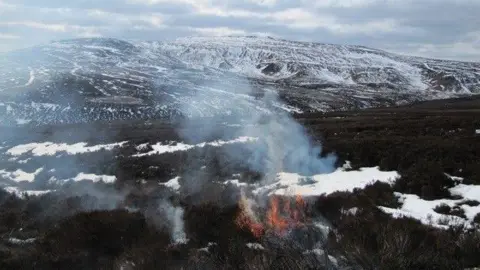
Geoff Eyre, of Mill Farm, has been managing moors for over 60 years and regularly made controlled burns on his 400 hectares (988 acres) within a couple of miles of Tintwistle Moor.
He made the burns in the wet winter months "so there is no chance of burning peat".
As well as being an experienced farmer, Eyre is an agronomist - a plant and soil scientist who has advised other farmers.
He said the RSPB needed a more substantial fire mitigation plan, otherwise its re-wetting program would have been a "big waste of money".
Aspinall acknowledged that re-wetting Tintwistle did not stop the fire, but remained committed to this approach, to "instill long-term resilience into these landscapes".
The Department for Environment, Food and Rural Areas (Defra) said: "Burning vegetation on moorland releases harmful smoke that can affect air quality across wide areas, which is why in September 2025 the government extended restrictions on burning, unless under licence, to nearly 700,000 hectares of deep peat.
"Wetter, healthy functioning peatlands are more resilient to the impacts of wildfire, but licensing allows land managers to apply for a licence to burn where no feasible alternative exists."
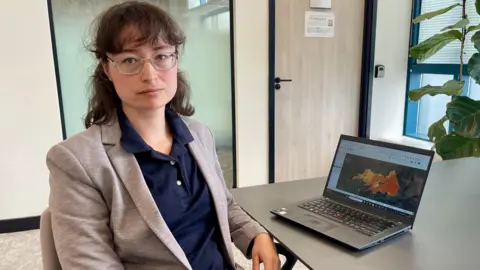
Dr Kirsten Lees, environmental sciences lecturer, specialising in zero carbon at the University of Derby, has monitored the growth of Tintwistle's wildfire to the "size of a small town".
She described the controlled burning debate as a "tricky issue with mixed evidence", acknowledging that rewetting "takes a while to establish".
"There can be a bit of a delay where land that has previously been degraded is not quite at the level where the water level is high enough and the vegetation community has shifted enough to prevent wildfires," she said.
"It's very, very hard for the science to determine the best methods to manage the land because we can't set up a controlled experiment to assess different management methods and the impact that those might have on a wildfire."
Derbyshire Fire and Rescue Service did not say whether it approved or disapproved of controlled fires as a preventative measure, but said "decisions relating to specific land management approaches are matters for landowners, policymakers and environmental specialists".
Listen to BBC Radio Derby on Sounds and follow BBC Derby on Facebook, on X, or on Instagram. Send your story ideas to eastmidsnews@bbc.co.uk or via WhatsApp on 0808 100 2210.
