Naming WWI's unknown soldiers over 100 years later

 Crown Copyright
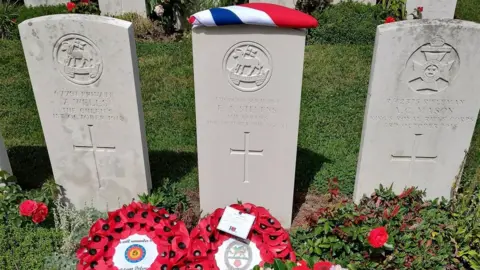
For more than a century, the identities of two World War One soldiers remained a mystery - their resting places bore only a rank, a regiment and the inscription: "Known unto God."
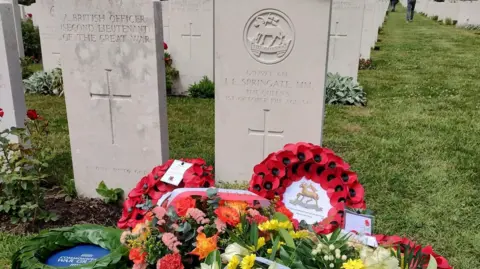
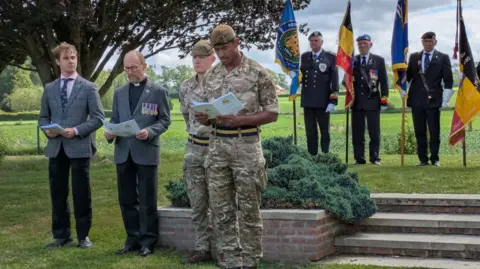
Last week, the two graves at Hooge Crater Cemetery near Ypres, Belgium, were finally identified and rededicated in a special service.
The families of John Edgar Springate, from Lambeth, and Ernest Albert Stevens, from West Wycombe in Buckinghamshire, now know exactly where their relatives came to rest.
It is just one of many cases that have been solved by the Ministry of Defence's "War Detectives" - the government group dedicated to ensuring that no soldier is ever forgotten.
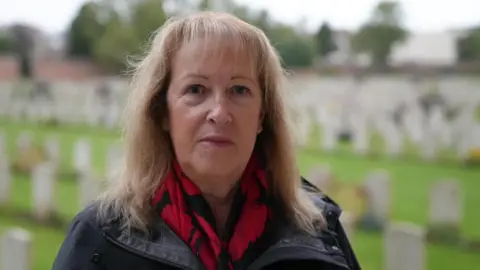
The small team, officially known as the Joint Casualty and Compassionate Centre, is led by Tracy Bowers out of Imjin Barracks in Gloucestershire.
The process often begins with the Commonwealth War Graves Commission, which receives enquiries from members of the public.
"So these could be a family member, could just be an interested historian," says Bowers.
"In this case, it was quite a young lad who sent the case in who is actually Belgian, who had seen these two graves and thought there was a chance that potentially they could be identified.
"There are some headstones that have clues on them - they may not have a name, but they do have a clue."
 Crown Copyright
For these two soldiers, the original headstones identified them simply as a "Sergeant of the Great War, the Queen's" and a "Lance Corporal of the Queen's".
Knowing rank and regiment, the War Detectives searched through the archives, cross-referencing war diaries and original exhumation reports to map the movements of the 11th Battalion, The Queen's Royal West Surrey Regiment.
Records showed that on 1 October 1918, the battalion launched a costly attack toward the Wervicq–Menin railway under heavy machine-gun fire.
Over just two days, the battalion lost 36 men - 15 of whom remained missing after the war, with their names listed on the Tyne Cot memorial.
The detectives drew up a list of every missing man from that regiment, worked out if they were the correct rank and geographically in the right place, and began ruling them out one-by-one until no other possible candidates were left.
According to the Royal British Legion, Lance Corporal John Edgar Springate was 33 when he was killed in action, while the website Buckinghamshire Remembers lists Sergeant Ernest Albert Stevens as being 23.
 Crown Copyright
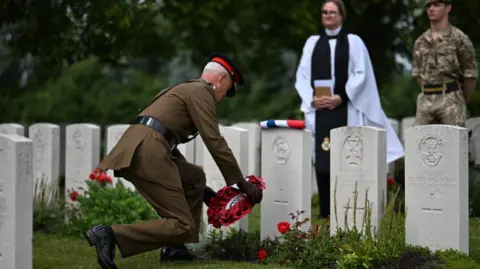
The re-dedication service took place on Tuesday, where new headstones were blessed by a military chaplain in the presence of members from the soldiers' modern-day regiment.
The War Detectives managed to track down members of both men's families, who provided readings for the occasion.
Bowers says it is often a surprise for the family, who do not even know the names of their great, great uncles, let alone that they fought in the war or where they might be buried.
Springate's great nephew, Jon Attkins, said learning about his relative "brings home to you what our forebears went through".
He has since been told of a family story when Springate's mother was told of his death, she apparently said: "He is lost but he will be home one of these days."
 Crown Copyright
A case typically takes between six and nine months to research to completion.
The coronavirus lockdowns triggered a huge influx of cases, as people had more time to carry out amateur genealogy research that hit dead-ends, causing people to seek out the War Detectives' help.
The team notes that it is working through these cases as quickly as possible, but they are still processing the volume of enquiries generated during the pandemic.
For Bowers, a veteran who served in the Army herself, the work of the War Detectives is deeply personal.
"I think it's really important that we recognise the sacrifice made by people, even if it is over a hundred years ago," she says.
"I think everyone deserves to have a name somewhere. These young men had a name on a memorial to the missing, but it was never actually known where they lay to rest.
"Now they have a name on a headstone and they are alongside their colleagues... it's important that they are given the respect and dignity that they deserve."
Do you have a story suggestion for Beds, Herts or Bucks? Contact us below.
Follow Beds, Herts and Bucks news on BBC Sounds, Facebook, Instagram and X.
