WWI soldiers buried a century after their deaths

 Ministry of Defence
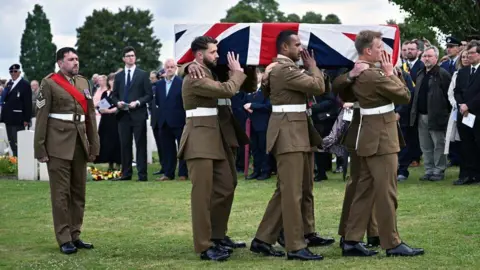
The bodies of six soldiers who died together in World War One have been buried in Belgium more than 100 years after their deaths.
The remains of the men, which were found in 2020 during archaeological work near the village of Geluwe, were identified based on DNA investigations.
They were: Pte Horace Cook of Matching, Essex; Pte Frederick Martin and Pte Charles Russell, both of London; Pte Thomas Whitaker, of Bradford; Pte Courtney Hart, of Northampton; and Pte Joseph Turnley, of Bristol.
On Wednesday, they were interred below headstones bearing their names at the Commonwealth War Graves Commission's Tyne Cot Cemetery.
The men still wore shoulder titles indicating their affiliation to the Queen's Royal West Surrey (QRWS) Regiment.
Pte Turnley's great-nephew Paul Turnley, from Wiltshire, said receiving the news in December was "the biggest surprise".
"Joseph was only known to us as a name on our family tree, but now he is a person," he said.
'Real privilege'
Joe Whitaker, from Doncaster, said his great-great-uncle, Pte Whitaker, had been found with a postcard of Bradford in his possession.
"We wrote a poem which I read today that conveyed his love of home," he said.
It was a "real privilege" to attend the service, Whitaker added.
"When you think about the tens of thousands who don't get this opportunity, we feel incredibly lucky that we are among the few who can give him a proper resting place."
The MOD's Joint Casualty and Compassionate Centre, also known as the War Detectives, created a list of men who may have been killed in the incident.
This was narrowed down by tracing and contacting the soldiers' relatives and collecting DNA samples until matches with the remains were found.
War detective Alexia Clark said it had been a "privilege" to research the case.
"I am delighted that they have now been laid to rest alongside their comrades in a dignified burial which they had been denied for so long," she said.
Equipment found with the men and historical diary entries showed they had been operating a Lewis gun, which required several crew members, when they were killed in a probable shell strike on 6 October 1918.
A spokesperson for the Ministry of Defence said it was "clear they had died together".
Listen to highlights from West Yorkshire on BBC Sounds, catch up with the latest episode of Look North
