Londoners go to the polls in local elections

 Getty Images
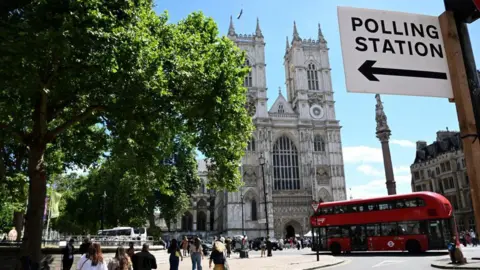
Londoners are heading to the polls to elect more than 1,800 councillors across the capital's 32 boroughs.
The mayors of Croydon, Hackney, Lewisham, Newham and Tower Hamlets will be elected at the same time.
More than six million London residents are eligible to vote in the local elections. The borough councils run services such as bin collections and adult social care.
Voting takes place between 07:00 and 22:00 BST with the results due to be declared from early on Friday morning into Saturday afternoon.
In the elections, the first-past-the-post system will be used. The ballot paper will tell you the number of candidates you can vote for.
The candidates with the most votes in each ward win and become councillors.
Most councils have wards that are represented by three councillors but in some it is two.
Labour currently runs 21 London councils, the Conservatives control five, the Lib Dems hold three and two councils are in no overall control. The Aspire Party controls Tower Hamlets council and mayoralty.
Local elections offer voters the chance to have their say on what is going on in their area - and to give their verdict on the performance of the political parties.
The directly-elected mayors in Croydon, Hackney, Lewisham, Newham and Tower Hamlets are the political leaders of the council.
They appoint a cabinet made up of elected councillors who are given specific portfolios such as finance, community safety and children's services.
The mayors are also elected by first-past-the-post. You vote for one candidate only in a mayoral election.
Use our tool below to find our more about elections in your area.
Polling stations are usually in public buildings such as community centres, churches and schools.
If you have not received a polling card, or have lost it, you can find your nearest polling station on the Electoral Commission website.
Everyone voting in person in the local elections in England must be 18 or over, and will need valid photo ID, such as a passport or driving licence.
There's a full list of acceptable identity documents on the Electoral Commission website.
You can use out-of-date ID as long as you are still recognisable.
Find out more about the elections here.
Listen to the best of BBC Radio London on Sounds and follow BBC London on Facebook, X and Instagram. Send your story ideas to hello.bbclondon@bbc.co.uk
