Soldiers 'overreacted' when they shot five people dead, judge says

 PA
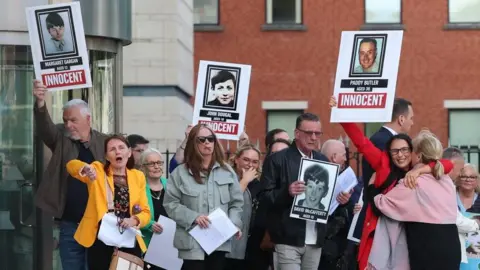
PAAn inquest into the shooting of five people in west Belfast in 1972 has found that the Army "lost control" in a number of cases and "overreacted to a perceived threat".
Fr Noel Fitzpatrick, 42, father-of-six Patrick Butler, 37, 15-year-old David McCafferty and 16-year-old John Dougal were killed by the same soldier in the Springhill estate on 9 July 1972.
Thirteen-year-old Margaret Gargan was shot "directly in the face" by a different soldier on the same day.
Coroner Mr Justice Scoffield concluded that the force used in all five shootings was "not reasonable".
He also concluded that evidence suggested that "some sporadic rounds were fired" earlier in the evening and rejected the "civilian case that not one round had been fired on the 9th of July".
The court heard that four of the five people killed were shot by the same soldier, and two were killed by the same bullet.
Mr Justice Scoffield concluded that "Solider A did not have an honest belief" that he was under immediate danger "or attack" from any of the individuals.
He said the "force used was not reasonable" and that it was "not in compliance with the yellow card" in the Army's rules of engagement.
No warning was given before the shootings.
The coroner said Fr Fitzpatrick, Patrick Butler, and Margaret Gargan were "wholly innocent victims" and David McCafferty was "regarded as an innocent victim".
He said while John Dougal's conduct prior to his death "remains unclear and suspicious", he "should not have been shot, having been shot in the back while retreating".
In a statement following the verdict, the Ministry of Defence (MoD) said they acknowledged the coroner's findings and were "considering them carefully".
"We remain firmly committed to supporting our veterans and to the delivery of truth, recovery, reconciliation, and closure."
 Family handout
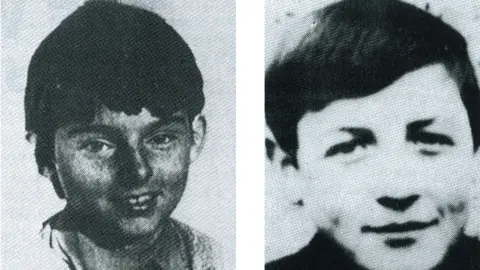
Margaret Gargan
Thirteen-year-old Margret Gargan was shot "directly in the face", posing "no risk at all", the court heard.
Mr Justice Scoffield concluded that the girl was killed in an "aimed shot" and that "no firing was at her location" at the time of her killing.
The court heard "no warning" was given by a soldier, known as Soldier E, and that he "fired prematurely and lost control".
The court heard Soldier E didn't "properly assess the risk" and the 13-year-old was "talking to her friends in the street".
She was "wholly innocent", the judge said.
Speaking after the verdict, her brother Harry Gargan said the verdict of "unjust killing will never end the decades of grief and trauma inflicted on our family".
He said the "truth of what happened to our beautiful sister Margaret was always what our late mother and father desired".
"The British establishment need to recognise this verdict with a genuine heartfelt and unequivocal apology for the decades of hurt and grief inflicted on our families," Gargan said.
 PA Media
John Dougal
The judge said he was "satisfied" John Dougal was "shot by an individual in Corry's Yard" and that he was killed by a single bullet to the chest in a "direct hit, not at close range".
He said he was "more than likely" running away to take cover at the time of his death, as he "considered himself to be at risk of being shot".
He said: "Soldier A is much more likely to have shot John Dougal."
The court also heard that there was no evidence that Soldier A shouted a warning at the teenager before firing the fatal shot.
The court heard that John Dougal was a member of Na Fianna Éireann (the youth wing of the IRA) but on the balance of probabilities he "had not progressed into the adult IRA".
The court also heard there was "no military intelligence to support that John Dougal had joined the IRA".
Mr Justice Scoffield concluded that he was "not satisfied" that John Dougal "was armed nor satisfied that he was acting innocently", but said he "should not have been shot dead by the Army".
His brother Jimmy Dougal said: "The British lost their identity.
"We want justice and those soldiers to be brought to the book for what they done."
'Killed by the same bullet' - Fr Noel Fitzpatrick and Patrick Butler
 Family handout
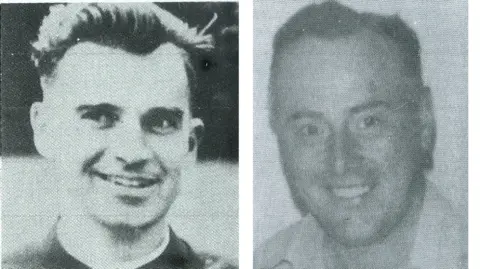
The court heard that Fr Noel Fitzpatrick and father-of-six, Patrick Butler posed "no threat to anyone" at the time of their deaths and were shot and killed by the same bullet.
Mr Justice Scoffield said it was "inherently implausible that either of them were armed or engaged in any attack on the army".
The court heard the men likely "stepped out of cover" and were killed. Both men were shot in the head.
The judge said they "should be seen as wholly innocent victims".
 Pacemaker
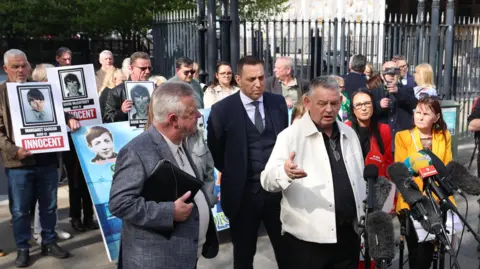
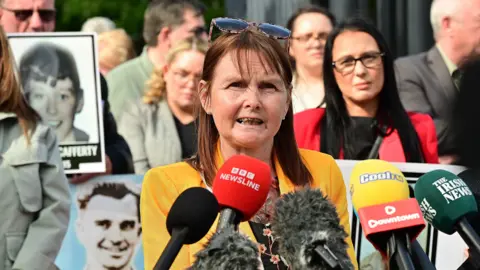
Patrick Butler's daughter, Jacqueline Butler said "after a lifetime of fighting" her father was "finally declared innocent".
"His only crime was his kindness, helping those who were injured – for that he was killed and wrongly labelled a gunman - that lie has burdened three generations of our family," Butler said.
"We were determined that no matter how long it took his name would be cleared, not only for us but for our children and grandchildren who will no longer have to carry this burden.
"Today we restore his dignity and today we can finally let him rest in peace," she said.
David McCafferty
 Family handout
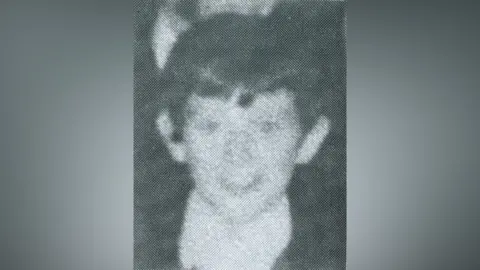
The court concluded that David McCafferty "was not armed" and "posed no threat to anyone" and was "assisting" Fr Fitzpatrick and Patrick Butler after they'd been shot.
The 15-year-old was shot in the back.
The court heard he was a member of Na Fianna Éireann (the youth wing of the IRA) "on the Official IRA side rather than the Provisionals".
Mr Justice Scoffield said David McCafferty was "unarmed at the time he was shot and was not engaging in activity at the time he was killed. He should be viewed as an innocent victim".
His sister Betty Kennedy said the ruling "brings a long-awaited clarity and justice to our family and to all those who lost their loved ones on that tragic day".
Kennedy paid tribute to both her and David's parents who "dedicated their lives to seeking justice and clearing his name".
"While no ruling can undo the loss suffered, it is our hope that the decision will allow our family and the others affected to begin the process of healing.
"The burden of blame and prejudice that has lingered for so long has now been lifted, and the record has now been set straight," Kennedy said.
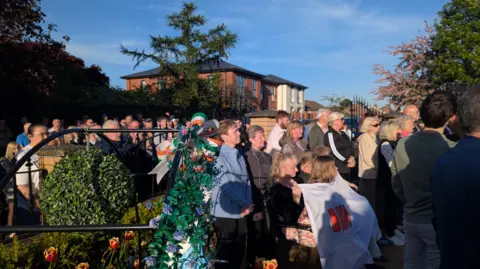
Around two hundred people attended a rally at the memorial garden in the Springhill estate on Thursday evening.
Several family members of those killed made speeches.
The rally had been organised to allow families to remember their loved ones, and to give the local community the opportunity to show their support for the families who had campaigned tirelessly for the truth around what had happened to their loved ones.
What happened at Springhill?
 PACEMAKER
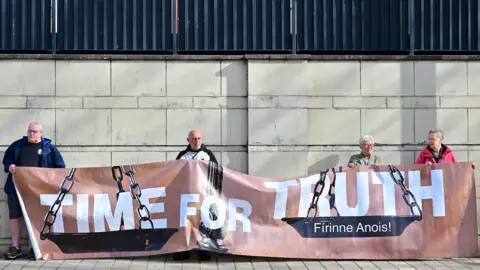
On 9 July 1972 three Catholic teenagers, a father-of-six and a priest were shot dead in the Springhill estate, west Belfast.
Their deaths came amid rising tensions. The previous summer eleven people had been shot dead in the neighbouring Ballymurphy area, and just five months earlier 13 people had been killed in Londonderry in a shooting that became known as Bloody Sunday.
A few weeks after the Springhill shooting, on 21 July 1972 19 Irish Republican Army (IRA) bombs exploded across Belfast killing nine people and injuring 130 others in what became known as Bloody Friday.
The original inquest into the Springhill shootings was held in 1973, with the coroner returning an open verdict.
