A doctor warned me I was in danger before I was almost killed

 Handout
Warning: This article contains distressing details.
A woman whose ex-partner attempted to murder her says a doctor warned her weeks before the attack she was in an abusive relationship - but she did not believe it.
In April 2025, Caz Goddard was taken to hospital in Bristol after trying to take her own life. That's where a doctor told her she was being coercively controlled.
"He told me you will get really hurt… next time was when the violence started," she said.
Her partner, James Stock, refused to leave her side in hospital - even sleeping on the floor. But after she returned home and built up the courage to ask him to leave, he unleashed a violent attack that almost killed her. Stock has now been sentenced to 20 years in prison for attempted murder.
'The violence started'
While she was in a relationship with Stock, Caz did not recognise what she was experiencing as coercive control - a form of abuse where one partner isolates or controls another's behaviour, often without physical violence at first.
"(The doctor) told me you will get really hurt," said Caz, from near Weston-super-Mare in North Somerset.
Weeks later, that warning became reality.
Stock attacked her when she asked him to leave her home in July last year. The next thing she remembered was Stock knocking her to the floor and strangling her.
She managed to escape and run to her room, where she called 999. While secretly still on the phone to police, Stock dragged her outside and repeatedly punched and kicked her.
The call handler feared Caz was killed in the 16 minutes it took for officers to arrive. When police found her, they too feared she was dead due to the extent of her injuries.
She said she still struggles to breathe and is awaiting surgery for a broken nose, while mentally, she has been left with post-traumatic stress disorder and night terrors.
"The doctor said 'you are a victim of domestic abuse'… and I sat there thinking, me? What are you on about? I know I am strong, there is no way I am," Caz said.
"I have no idea who I was at that point that's not who I am - and that's not who I'll ever be again."
 Handout
Looking back, Caz said the warning signs were there, but she did not recognise them at the time.
Stock had begun to message her insulting messages describing her as "ugly" and a "skank" and he lied to her repeatedly about dating apps and messages from "women everywhere".
While she was in hospital, he stayed constantly by her side, something she now understands as part of the control he had over her.
Doctors trained to spot warning signs
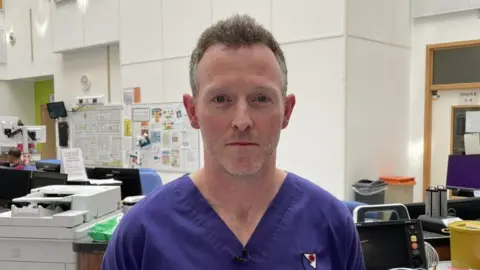
Emergency department staff say they are trained to recognise patterns of abuse, even when patients do not identify it themselves.
"There are little things that make you wonder, someone clearly being controlled by their partner," said Dr Duncan Courtney, an A&E consultant at the Bristol Royal Infirmary.
"We see spikes of domestic abuse during the World Cup, we are definitely picking more of it up but is it because there is more of it in society or is it we have better mechanisms to pick it up?"
More victims of domestic abuse are now believed to have taken their own lives than have been killed by their abuser, according to national figures.
Latest police figures recorded 150 suspected suicides linked to domestic abuse in England and Wales last year, compared with 80 domestic homicides.
Prosecutors say the figures highlight the psychological toll abuse can have, not just the physical violence.
Kate Brown, Chief Crown Prosecutor, said: "With the police having that knowledge we are seeing far more cases being investigated in order to see if we can put together a case that will demonstrate that to a criminal standard of proof."
Caz said part of the difficulty was not recognising herself as a victim.
"I thought, that's not me… of course I'm not," she said.
She now wants others to be more aware of the warning signs - and to take them seriously if someone raises concerns.
Coercive control signs
According to the charity Women's Aid, these are the common signs of coercive control:
- Isolating you from friends and family
- Depriving you of basic needs, such as food
- Monitoring your time
- Monitoring you via online communication tools or spyware
- Taking control over aspects of your everyday life, such as where you can go, who you can see, what you can wear and when you can sleep
- Depriving you access to support services, such as medical services
- Repeatedly putting you down, such as saying you're worthless
- Humiliating, degrading or dehumanising you
- Controlling your finances
- Making threats or intimidating you
According to the Office for National Statistics (ONS) there were 49,557 offences of coercive control recorded by the police in England and Wales in the year ending March 2025. This is an increase from 45,310 in the year ending March 2024.
There were 1,299 defendant proceedings and 853 offenders convicted of controlling or coercive behaviour in the year ending December 2024 in England and Wales.
Almost all those convicted for controlling or coercive behaviour in England and Wales in the year ending December 2024 were male – 832 out of 853.
- If you have been affected by any of the issues raised in this story, you can visit the BBC Action Line for support and information
Follow BBC Bristol on Facebook, X and Instagram. Send your story ideas to us on email or via WhatsApp on 0800 313 4630.
