Future uncertain for family watercress farm

 BBC
BBCThe Kingfisher Farm and Flower Shop in Abinger Hammer has been run by the same family for five generations - but its future is now in doubt.
When Barrie Arminson took on the business at 18 years old in 1956, it was enjoying a booming trade supplying watercress right across the country.
At the time, the entire site was covered with watercress beds, but it began to diversify in the 1990s and just six beds remain today. The farm shop keeps the business going.
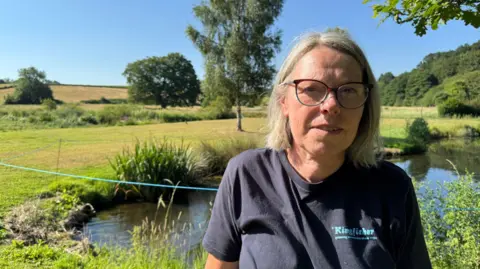
Arminson is now retired. His daughter, Marion McBurney, who is charge today, says she is unsure what the future holds for the family's beloved Kingfisher.

Arminson said: "You had to work in those days, no work indoors, so if you weren't harvesting watercress you were cleaning beds out to replant them and continue.
"But then the supermarkets changed it all and so we started selling watercress at smaller quantities. Then we started the farm shop. "
What has not changed is how the watercress is harvested and packed.
Stuart Rumbold, who has been working at Kingfisher for 33 years, gets to the farm every day at 06:40 BST.
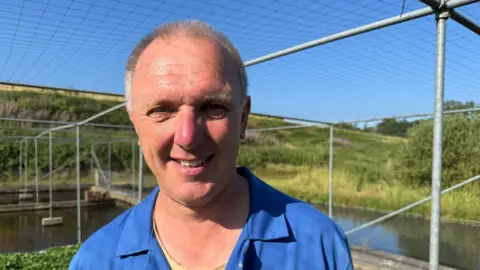
"We like to pick the cress early in the morning when it still has a nice dew, because it harvests a lot easier and otherwise, as the weather gets warmer, it dries the dew out and the plants start getting sticky.
"That makes it hard to keep tidy, and we like to keep it tidy for the next process."
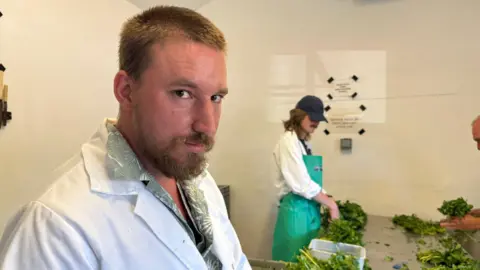
In a room at the back of the farm shop is Reece Overington, who is bunching the cress into a "gentleman's agreement" - bunches that are roughly four ounces each - to save time.
"When you do something every morning, you get used to it...all you see is cress...we dream of cress," he jokes.
Back outside, McBurney explained that even though watercress is central to Kingfisher, it is actually the least financially sustainable part of the business.
"It's very important to us, but as the money-making part of the business it's not the viable part, it's the shop that's keeping us together," she said.
"The difficulties that we find with growing watercress now are very much weather-influenced, for instance the massive heatwaves.
"We've found that the watercress has flowered a lot earlier, and in June, when it is trying to naturally flower, it flowered prolifically.
"As small business it's extremely difficult, not just in farming or the food industry, in general it's very much dependent on passionate business-owners to keep it going.
"I'm not sure what the future is for Kingfisher. It's a great business and we're so well supported by the local community. It would be sad to see it go."
Follow BBC Surrey on Facebook, on X. Send your story ideas to southeasttoday@bbc.co.uk or WhatsApp us on 08081 002250.
