From potato harvest to packet of crisps in 24 hours

 BBC
BBCCrisp manufacturer Seabrook sells 460 million packets a year, but what does it take to turn a humble spud into a multipack ready for supermarkets and lunchboxes?
In a field near York, the journey from the soil to the shelf is just beginning.
The current crop, planted in April, is bound for the Seabrook factory in Bradford.
This field is the size of 17 football pitches and contains about 2.5m potatoes, with each one enough to be turned into a bag of crisps.
Technological developments in farming mean they can be lifted from the ground using a mechanical potato harvester, rather than the slow, laborious process of being dug up by hand.
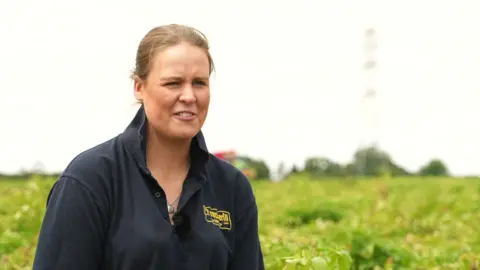
"We are looking at around hopefully 300 tones of potatoes from here, which should keep the Seabrook factory going for about two days," says Polly Megginson, supply chain manager at R S Cockerill, which supplies potatoes to supermarkets and crisp processors.
"In about 27 tonnes of potatoes we have about 240,000 actual tubers and from each one of those will be one bag of crisps."
The Cockerill family began growing potatoes, as well as carrots, 80 years ago and have expanded their business ever since.
 Abigail Jaiyeola/BBC
So what makes the perfect potato with the potential for bags of flavour?
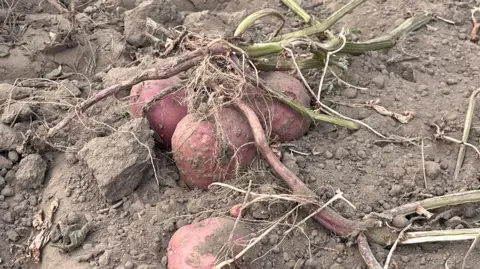
"We are looking for a really nice, round potato - not too big, not too small, around 50ml," says Polly.
"Hopefully that will make the perfect crisp."
The planting process requires both patience and regular quality checks, but there is also one other key ingredient: rain.
In recent years, prolonged spells of hot and dry weather mean that has been harder to come by.
According to the Met Office, last year's summer was officially the warmest on record for the UK, with a drought declared in Yorkshire.
Spring 2026 was also the warmest on record for England and Wales.
"Our biggest challenge at the minute is water availability," says Joe Weston, farms director at R S Cockerill.
"We are having longer, hotter, dry summers and our availability of water is key to our ability to grow potatoes."
Polly says having to irrigate is an added expense in the production process, adding: "It's less so the quality [impacted] but more so the size and amount."
 Abigail Jaiyeola/BBC
Once the potatoes have been harvested, they are transported about 50 miles to the Seabrook factory in Bradford, where the company's famous crinkle-cut crisps have been made since 1945.
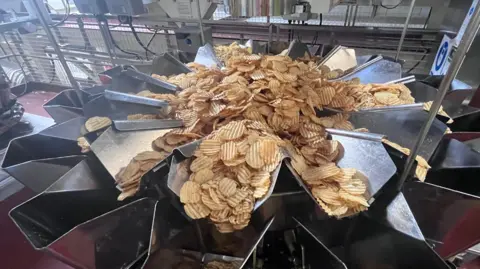
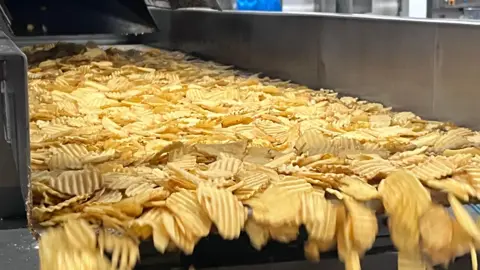
The process starts with washing, peeling and slicing the potatoes into a crinkle shape before they are fried then sent on to be seasoned in a drum while they are still hot.
In total, turning a potato into a crisp takes about 40 minutes, according to Peter Bacon, preparation manager at Seabrook.
The whole process, from harvesting to processing at the factory, is about 24 hours.
"It's a very fast process," says Peter.
"A day we are talking one to two million packets.
"A year, we are talking 460 million."
 Abigail Jaiyeola/BBC
Tommy Brown has worked at the factory for 40 years, following a family tradition, with his father also a former employee of Seabrook.
Having seen more crisps than he would care to remember, does he ever get sick of them?
"No. It's in my blood."
The UK loves crisps. According to survey company YouGov, Walkers is the third most popular food and snack brand among Brits, while Pringles comes in at number nine.
Estimates place the number of packets of crisps sold in the UK each year at 6bn.
But with harvests impacted by the warm weather, should crisp-lovers be worried?
"How I treat potatoes can change quite drastically, so if we have had a bad season potato-wise that directly impacts how I'm treating them," says Peter.
"The advantage that we have got is that we are very good at handling the potatoes and dealing with the variances, so we will be fine."
Listen to highlights from North Yorkshire on BBC Sounds, catch up with the latest episode of Look North.
