Dormouse 'dating agency' helps vulnerable species

 BBC
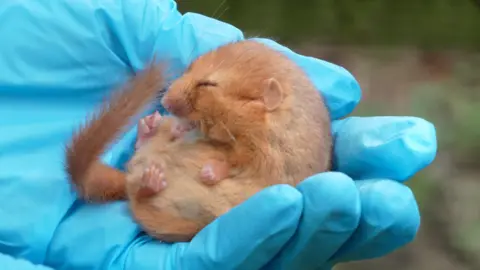
BBCAfter the most successful breeding season in its history 29 young hazel dormice, born at Wildwood Trust in Kent, are being prepared for release in the north of England.
Dormice populations have declined by 70% in the UK since 2000 and a 2023 report found them to have completely disappeared from 20 English counties.
Since 1993 conservationists have been working to reintroduce the dormice back into parts of the country where they have disappeared.
Hazel Ryan, senior conservation officer at the Wildwood Trust, said habitat loss and climate change had impacted dormice populations and recent research showed "in 50 years' time dormice will be extinct in the UK if we don't do more to help them".
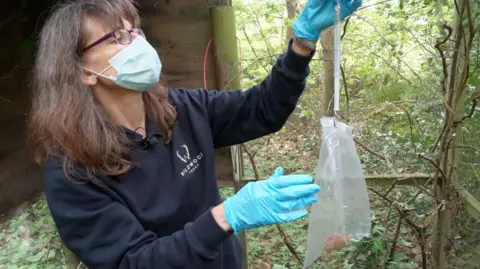
Born last year at Wildwood Trust, near Herne Bay, the young dormice being sent for release have just emerged from seven months of hibernation.
Ryan is one of the leading experts in dormice husbandry and has been breeding dormice for over two decades.
She said part of the success of this year's litters was down to improvements they made in the animals' diet.
Staff at Wildwood will carefully weigh each dormouse and check their teeth, eyes and fur are in good condition before they travel the hundreds of miles to the secret woodland release site in the north of England.
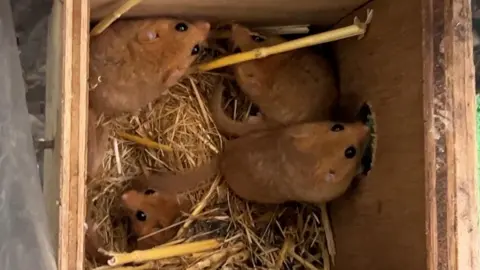
The young dormice will be microchipped to keep track of them and after a period of quarantine will be placed in mating pairs in large release cages in the woodland, to familiarise themselves with their new home.
After 10 days, small openings are made in the cages to allow them to forage for their own food.
 BBC / Fiona Irving
These dormice are among 51 being introduced to supplement populations in areas where previous releases have taken place.
Part of ensuring the reintroduction of dormice is successful is making sure those released into the wild come from as diverse a gene pool as possible.
Suzanne Kynaston, a conservation officer at Wildwood Trust, keeps the national dormouse stud book and records each individual animal's details and its ancestry.
It "essentially can act like a dating agency," she said.
"When we want to pair them up, we can work out which are the most unrelated genetically."
Kynaston said the more "diverse" the gene pool the more "resilient" the dormouse population was to things like climate change.
 BBC / Fiona Irving
Climate change is thought to have had a big impact on dormouse populations.
"They need a nice cold winter where they don't wake up," said Hazel Ryan.
She said if it was too warm in the winter dormice wake up when there's not food available and use up their fat reserves too quickly.
Ryan also said dormice have very fine coats so during wet weather they can't go out and forage.
Warmer autumns do give dormice the opportunity to have litters later in the year, but to survive winter the babies need enough food sources to forage so they can put on body weight before they hibernate.
'Flagship species'
Ryan said habitat loss has also aided population decline, adding "we've lost a lot of our ancient woodlands, we've grubbed out our hedgerows".
The woodlands selected for the dormice reintroductions are managed to support dormice with continuous woodlands or hedgerows to allow them to disperse into the wider countryside once the population becomes established.
Ryan said dormice were a "flagship species" - meaning a woodland managed for dormice will also benefit lots of other species like nightingales and some wildflowers.
Dormice population recovery is slow, as dormice only have one or two litters a year and average around four young per litter.
However, since 1993 a total of 1,142 dormice have been released to 26 sites in 13 counties.
Follow BBC Kent on Facebook, on X, and on Instagram. Send your story ideas to southeasttoday@bbc.co.uk or WhatsApp us on 08081 002250.
