Replica Christopher Columbus ship arrives in Liverpool

 Tom Walker/BBC
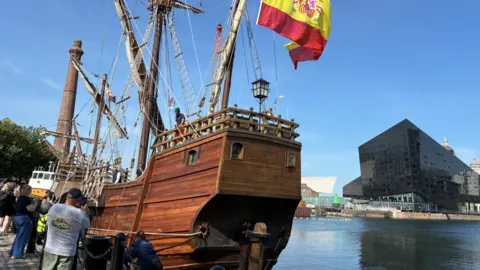
A replica of a ship on which explorer Christopher Columbus sailed across the Atlantic 500 years ago has docked in Liverpool.
The 180 tonne Nao Santa Maria will be berthed at the Royal Albert Dock for the next two weeks and is open to visitors.
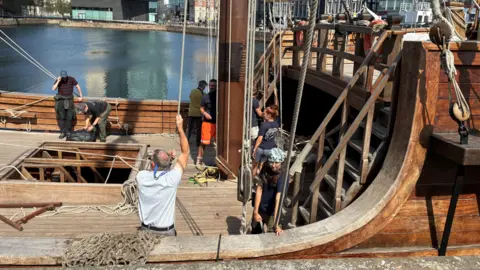
The vessel, with a crew of 14, is on a world tour involving 30 stops from its home port of Huelva in Spain, and aims to educate visitors about life for sailors in the 15th Century.
Desiree Gonzalez, project manager on the Santa Maria, said: "Christopher Columbus's history is something that changed the world, literally, and it's an opportunity to visit while we are here in a short time, this short period of time before we go to next port."
Gonzalez said sailors during Columbus's voyage in 1492, which led to Western explorers discovering the Americas, would have faced far harsher conditions than the current crew experienced.
"They didn't have any bathrooms or a kitchen," she said.
"They didn't have enough food, they didn't have refrigeration for their food. So, yeah, they drank a lot of wine because it didn't [go off].
"The conditions were very bad."
 Tom Walker/BBC
Ian Murphy, head of Liverpool's Maritime Museum, said the ship was a reminder of how daunting a voyage in the 15th Century would have been.
"It was a real sort of journey into the unknown for a lot of these sailors," he said.
"Out in environments with no sight of land, reliant on the skills that have been developed by seafarers for centuries before."
'Negative impact'
The arrival of Europeans in the Americas led to the spread of diseases - including smallpox, influenza and measles - against which native populations had no natural defences.
Estimates vary as to how much of the native population of the Americas was wiped out as a result of European settlement. They range from 50% to 95%.
Columbus's arrival also allowed Europeans to establish colonies, which in turn brought about the transatlantic slave trade.
Murphy also said the visit was a chance to reflect on the darker history of Columbus's voyages, which had had terrible consequences for native populations.
"These ships are a symbol of that kind of European encounter with civilizations and cultures elsewhere and that's often a difficult and messy history," he said.
"It's not always one of discovery. It's one of quite important impact on native cultures and native people.
"It's not always an easy meeting and it's a reminder that for all we do celebrate the achievements and the skills of sailors, the impact on Indigenous peoples is often a negative one."
The Santa Maria will be open for visitors until 25 August.
Listen to the best of BBC Radio Merseyside on Sounds and follow BBC Merseyside on Facebook, X, and Instagram. You can also send story ideas via Whatsapp to 0808 100 2230.
