New tool 'successfully filters harmful phosphates'

 BBC
BBCA start-up hopes its invention to remove a harmful pollutant from waterways can "go global" following a successful trial in a key reservoir - and help farmers cut costs at the same time.
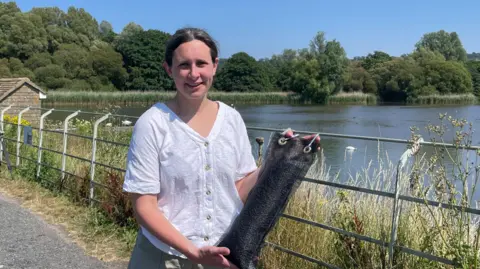
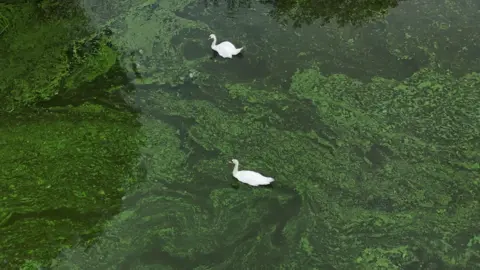
Rookwood Operations, based in Wells, Somerset, has pioneered a system to filter out phosphates, which in high concentrations can drive harmful algal blooms that choke water courses of oxygen.
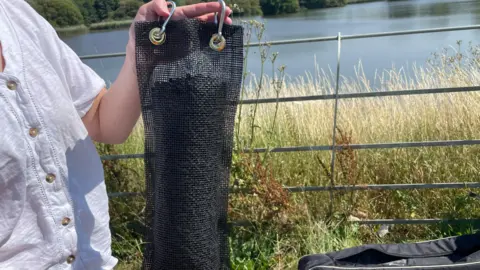
It binds phosphates to a sponge-like organic material deployed in permeable cartridges, and a trial conducted in Chew Valley Reservoir found it can remove the chemical even at very low concentrations.
Rookwood co-founder Jane Pearce said the gathered phosphate can then be reused as fertiliser.
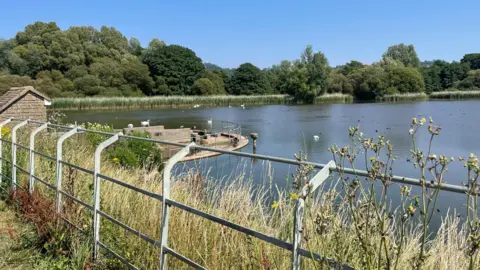
Phosphates can enter the waterways through sewage spills, but can also enter via water run-off from agricultural land because they are a vital component of fertilisers and some animal feeds.
It took more than 500 attempts for the company to develop an effective formula for the material in its cartridges, and currently the system can recover about 7kg of phosphate for every 60kg of material deployed.
Pearce said: "We're going to try and go global - phosphate pollution is very prevalent in this region but it's also very prevalent in the rest of the country and it's an international problem."
But farmers are in a bind, while phosphates can choke waterways, they are also dependent on them to meet yield targets.
Most of the world's supply comes via an intensive mining process from a handful of nations including China, the US and Russia, which exposes the UK to price volatility caused by international events.
"It makes a solution like ours, which not only mitigates the phosphate pollution that's causing environmental damage in the water, but allows it to go back to land as a fertiliser, even more important," Pearce said.
 PA
PARookwood is also hopeful its system could also help tackle the problem of delayed housebuilding projects in Somerset.
As many as 12,000 homes are currently blocked from being built across the county after a court ruling because of high levels of phosphate in water courses.
It ruled further burdening the sewage system through more developments would put too much strain on ecosystems already struggling to cope.
Following the trial in Chew Valley, conducted in partnership with Bristol Water, Rookwood is planning trials in more rivers and lakes, and also sewage treatment sites.
Helen Gavin, environmental lead at Bristol Water's operator South West Water, said: "The results provide evidence that the material is a practical and sustainable solution that can support Bristol Water's wider goals for improved water quality and resilience."
Penny Johnes, professor of biogeochemistry at the University of Bristol, has spent years studying the impact of phosphorus pollution, and previously chaired an expert group advising the government on setting new water quality standards.
Prof Johnes said the problem was "ubiquitous", with most waterways registering anywhere from three to 10 times the natural amount.
"Not only do we need to tackle new phosphate deposits coming from sewage and water run-off, but also the phosphorus that has accumulated over many decades in sediment at the bottom of lakes and rivers," she said.
She said new technology to tackle the issue was "really important", but warned it needed long-term commitment from successive governments to get it under control.
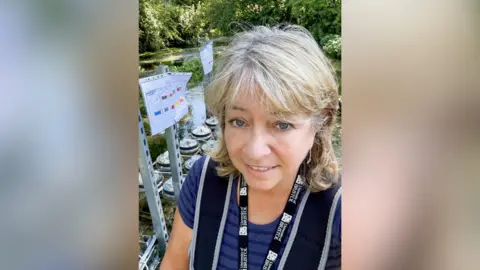 Professor Penny Johnes
"You're asking the government to invest in something which may not deliver a benefit that is measurable for decades," she said.
"So we have this mismatch between the political cycle and the political ambition and then the environmental function."
Follow BBC Somerset on Facebook and X. Send your story ideas to us on email or via WhatsApp on 0800 313 4630.
