Extra FMQs session confirmed in Holyrood shake‑up

 PA Media
First Minister's Questions will take place twice a week, the new presiding officer has announced in a shake-up of how Holyrood operates.
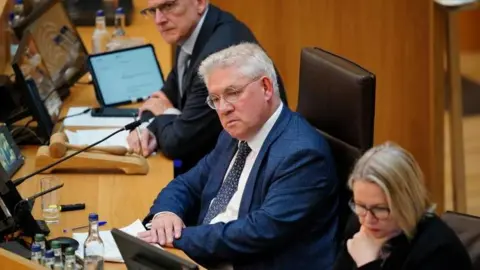
Kenneth Gibson, who has given up his SNP membership to replace Alison Johnstone in the role, told MSPs on Thursday the "status quo is not an option", as he pledged to transform how the parliament works.
As part of the overhaul, FMQs will increase from once a week to twice, with a 30-minute slot on Tuesdays for backbenchers to question John Swinney and another 30 minutes on Thursday for party leaders to quiz the FM.
Asked about the doubling of question sessions, Swinney told reporters: "As somebody once said in this building, bring it on."
The party fielding the first three questions as the main opposition will alternate each week between Labour and Reform UK Scotland – which tied on 17 seats after the recent election.
The Greens, on 15 seats, will also get three questions, while the Liberal Democrats and Conservatives, who returned 10 and 12 MSPs respectively, will receive two each.
Mr Gibson said "for devilment and to freshen things up" he may reverse the order of FMQs to allow smaller parties to go first.
As part of his overhaul, questions to the first minister will no longer be published ahead of time.
Opposition MSPs have previously complained that giving advance notice decreased accountability and led to scripted answers.
Time taken back for MSPs taking interventions during speeches will now automatically be added on to their time, with the presiding officer warning this may mean parliament runs over – although it previously did so frequently.
General and portfolio questions will increase from 32 to 38, which Gibson said will help improve the scrutiny of ministers while encouraging them to "shine".
He said: "I was elected on a mandate to shake up how we do things, make government more accountable to parliament, improve scrutiny and deliver more effectively for the people we represent.
"Parliament needs renewal and re-engagement with independent, innovative, and open-minded leadership – that is of critical importance and exactly what I will provide.
"The collegiate working anticipated in the 90s prior to devolution has not fully transpired.
"The status quo is not an option and I am keen to push at the boundaries of what is possible within my remit.
"We need to declutter and simplify how we work, make parliament more official, topical and effective for the people we all represent.
"It is crucial to examine what we do, why we do it, and consider if we need to do it better, if at all."
The changes will be implemented from 8 June.
