London only English region to see population fall

 Getty Images
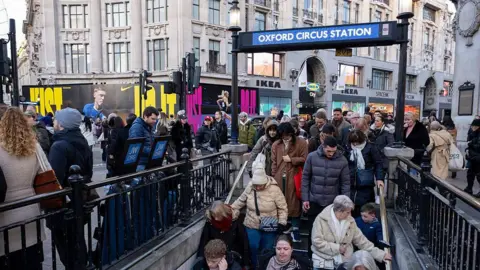
London was the only region in England to see its population fall last year, according to new figures from the Office for National Statistics (ONS).
The capital's population fell by 0.3% in 2025 compared with 2024, while every other region recorded growth. This was the first time London's population had decreased since 2021.
More than two-thirds of London's boroughs (23 out of 33) saw their populations shrink. The biggest falls were in Camden (down 1.8%), Westminster (down 1.5%) and Southwark (down 1.5%).
London's overall population was estimated to be 9,122,909 in 2025, compared with 9,149,646 the year before, according to the ONS.
The figures are based on the ONS's annual mid-year population estimates, which measure the population each June.
It found that Camden and Westminster recorded the largest percentage decreases of any area in England and Wales, apart from the Isles of Scilly, which has a small population and saw a fall of 3.5%.
London's population decline comes against a backdrop of slower population growth across England and Wales, with net migration to the UK continuing to fall from record levels seen in 2023.
The population of England and Wales was estimated to be 62 million in mid-2025, up by 224,900 people, or 0.4%, from 61.8 million a year earlier, the ONS said.
This was the lowest annual population growth rate since 2020.
More people continued to move to England and Wales from abroad than leave, but net international migration fell sharply.
It stood at 211,700 in the year to mid-2025, down from 612,500 in the previous 12 months.
There was also a slight drop in natural population change, which is the difference between the number of births and deaths.
There were 588,000 births and 568,400 deaths, meaning natural change added just 19,600 people to the population.
The number of births was the lowest since mid-1978, while the number of deaths was the lowest since mid-2019.
Although London recorded more births than deaths and saw a net growth in international inward migration, this was "more than offset by net outward migration to other areas of the UK", the ONS said.
Listen to the best of BBC Radio London on Sounds and follow BBC London on Facebook, X and Instagram. Send your story ideas to hello.bbclondon@bbc.co.uk
