Job vacancies at five-year low as smaller firms scale back recruitment

 Getty Images
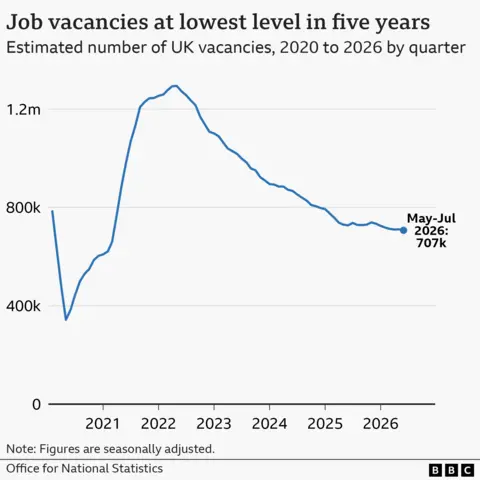
The number of job vacancies has fallen to its lowest level in more than five years as smaller businesses cut back on recruitment, official figures indicate.
Vacancy numbers fell over the May-to-July period to 707,000, according to the Office for National Statistics (ONS), which said small firms were citing labour and operating costs as reasons for scaling back hiring.
Energy costs have risen since the Iran war began, and companies have also said that increases in National Insurance and the minimum wage have made it more expensive to employ staff.
Earnings growth picked up slightly, although private sector wages grew at their slowest rate for nearly six years.
Regular earnings - which exclude bonuses - grew at an overall annual pace of 3.5% in the three months to June, the ONS said. Pay growth for the public sector was 6.1%, due to the timing of the latest NHS pay awards, while in the private sector it dipped to 2.8%.
"The UK labour market remains stuck in a low-churn limbo, with employers reluctant to hire, fire or offer bigger pay rises as they grapple with rising costs, intensifying global headwinds and heightened policy uncertainty," said Suren Thiru, chief economist at the Institute of Chartered Accountants in England and Wales.
"The persistent slide in vacancies is a red flag for the jobs market, suggesting labour demand is shrinking amid soaring employment and energy costs, while greater automation is also squeezing some entry-level roles."
The ONS said the labour market was "little changed overall", with the unemployment rate remaining at 4.9%. Its figures showed the number of payrolled employees fell by 13,000 in June, and early estimates suggest it dropped by a further 13,000 in July.
Responding to the latest figures, the Secretary of State for Work and Pensions, Pat McFadden, said it was "encouraging to see signs of progress".
"We've already put in places reforms to get Britain working again," he added, citing changes to Universal Credit "to remove barriers that held people back from employment" and spending on support to help people with health conditions and disabilities move into work.
But shadow chancellor Mel Stride said: "Job vacancies are at their lowest in over five years, and unemployment remains high. Labour are the party of welfare, not work."
On Tuesday, the Conservatives announced proposals to make it easier for young people to get summer jobs. The party said it would give young workers more flexibility around breaks and shift patterns, and simplify evening working restrictions at weekends and outside term-time.
'It's a bit frustrating'
 Jasmine Walker
Aaron Diangienda told BBC Newsbeat he has been looking for a role for more than a year.
"I've been trying my best, just making sure that I am finding the correct stuff to suit me and keeping on going with [the job hunt]", he says.
The 19-year-old has decided to return to college this September to study for his level three sport diploma and hopes this will help his prospects.
For Jasmine Walker, it's been a case of applying for jobs "literally anywhere and everywhere".
The 24-year-old says she has been looking for marketing jobs since she graduated from university in July, and estimates she has applied for more than 300 roles so far.
"It's a bit frustrating because you're researching and practising how to make your CV and applications pristine, and yet you still can't get anywhere with that," says Walker.
Government analysis released last week said businesses could face costs of up to £2.9bn a year under a planned crackdown on zero-hours contracts, which would cut the number of hours staff can work before they must be offered guaranteed time.
The British Chambers of Commerce (BCC) said business confidence was at a post-pandemic low, and measures such as the changes to zero-hours contracts means many firms "will be reassessing their recruitment plans".
"Much more must now be done to bolster business confidence and unlock hiring by tackling cost pressures on firms," said Patrick Milnes from the BCC.
But the TUC union body said "exploitative" zero-hours contracts had become "endemic" in the UK, and called on the government to end them.
"We need to get young people into work – but it isn't good enough to push them from unemployment into rampant insecurity... they deserve good, secure employment like anyone else," said TUC general secretary Paul Nowak.
Analysts said there were few signs in the latest ONS release of pay growth generating inflationary pressures, which meant it was unlikely that the Bank of England would increase interest rates in its September meeting.
"With underlying wage pressures remaining contained, there is little reason for the Bank of England to shift course, and we expect rates to remain on hold for the remainder of the year," said Yael Selfin, chief economist at KPMG.
Figures released last week showed the UK's economy grew by 0.4% between April and June. The ONS described the performance as "relatively robust", although analysts expect growth to slow in the second half of the year.
It also emerged last week that internal forecasts presented to the new prime minister and chancellor suggested UK growth could be as low as 0.3% in 2027, if the Iran war continues to disrupt shipping flows through the Strait of Hormuz.

