How the Noah Donohoe inquest came about after six years of delays

 Coroner's Court
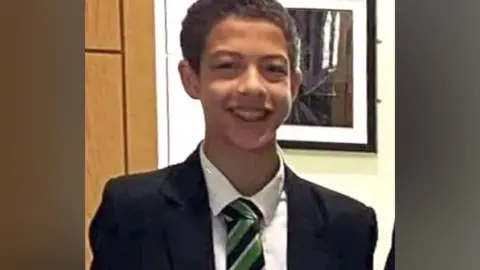
Noah Donohoe's disappearance and death six years ago captured public attention across Northern Ireland and the world.
The 14-year-old boy was found six days after he went missing in a north Belfast underground water tunnel, across the city from his home in south Belfast.
The outpouring of support for his mother Fiona and wider family, as well as baffled speculation about what happened to the teenager, quickly grew into a campaign for answers.
Now, six years later, a jury in the long-delayed inquest has found it was possible, but not probable, that failings by the Department of Infrastructure over the tunnel in which he was found dead contributed to his death.
The process has been a lengthy and sometimes frustrating one for Noah's family and friends.
Now that it has delivered its findings, BBC News NI looks at the inquest process, how it worked and why it took so long in Noah's case.
What is an inquest?
An inquest is a formal, public fact-finding investigation into a sudden, suspicious or violent death.
It is conducted by a coroner and its primary purpose is to determine the identity of the deceased, as well as how, when and where they died.
Crucially, an inquest is not a trial - it cannot legally apportion blame or assign criminal or civil liability to any individual or organisation.
Why did the Noah Donohoe inquest take so long?
 Pacemaker
The pre-inquest hearings started in 2020, the same year as Noah Donohoe's death.
But it took almost six years for the inquest to actually begin after a number of disputes, technicalities and obstacles held the process up.
The full inquest date was initially set for 10 January 2022.
However, it was delayed in November 2021 after Fiona Donohoe raised concerns that the date did not give her legal team enough time to prepare.
Lengthier delays were to follow over disclosure disputes.
The most significant of these came in 2022 when the Northern Ireland secretary signed a Public Interest Immunity (PII) certificate that allowed some police material relating to the Noah's death and the subsequent investigation, to be redacted.
In September 2022, the courts upheld the PSNI's application to withhold some information in the upcoming inquest.
In 2024, perhaps the most major disruption arrived when the coroner, Joe McCrisken, recused himself from the inquest.
He was subsequently replaced by Mr Justice Rooney, and a commencement date was set for 3 November 2025.
Before the date arrived, however, Mr Justice Rooney announced the inquest had been postponed again - this time until 2026.
The inquest formally began in January 2026 and ran for more than 20 weeks, during which time the coroner and jury examined 76 witnesses, statements from dozens of people, as well as maps, video footage, photographs, police logs and expert reports.
There were 62 days of evidence across a five-month period.
Even as the inquest seemed to be coming to a close, there was further delay.
The eight men and two women on the jury had been deliberating for three days, when the inquest was adjourned in the early hours of 3 July.
The jury was not yet able to come to a unanimous verdict as required by the court, and with four members set to go on holiday, the judge confirmed the adjournment, describing the situation as "unprecedented".
When the deliberations resumed on 14 September a member of the jury was discharged by Mr Justice Rooney, leaving seven men and two women. The reason for the discharge was not made public.
How was the inquest into Noah's death different?
 Getty Images
The major difference was the use of a jury.
Inquests are not typically held with juries, but can be requested in certain circumstances such as if the person died violently in custody, or if their death was the result of an act or omission of a police officer.
Juries may also be used at the coroner's discretion, if they think there is a good reason to.
Noah's mother, Fiona Donohoe, who headed a high-profile campaign to uncover the reason behind her son's death, pushed for a jury to be summoned.
She and her legal team argued this would help maintain public confidence in the process and increase the scope for independent scrutiny around the circumstances of schoolboy's death.
On 27 October 2022, Coroner Joe McCrisken deemed it "desirable" to summon a jury for the inquest.
How were the jurors selected?
More than 230 days ago members of the public filed into Laganside Court and the process of selecting a jury from 100 potential jurors began.
The selection for an inquest is similar to that of a criminal trial, but like any process, juror anonymity is central.
Jurors are called up in large groups and the court will outline the background of the case and a rough timeline.
Sometimes, like in the case of the Donohoe inquest, the case will run significantly longer than anticipated, but this step allows jurors to flag anything that may prevent them sitting for the full duration – it could be something like a planned medical procedure or a holiday.
This is different from excusal, which often happens well before this stage and can be down to serious illness or disability, a new parent with caring responsibilities, or if you are a student.
This stage is also vital for determining whether a juror knows any of the key people involved or has any connection to the case.
When the jury is chosen - between 7 and 11 people in an inquest - the process continues.
What can an inquest jury deliver in its verdict?
An inquest jury's powers are strictly limited by the Coroners Act (Northern Ireland) 1959.
They can deliver a factual conclusion, answering who the deceased was, and how, when and where they died.
They cannot express any opinion on questions of criminal or civil liability but they can make statements which relate to causes.
A coroner's court can also make recommendations designed to prevent similar fatalities occurring in the future.
For example, they often make recommendations to improve broad public health or safety issues, such as revising medical triage protocols or improving institutional record-keeping.
In the case of Noah Donohoe, the judge told the jury that they must exclude several theories from their judgement and base their verdict "solely on the evidence you have heard and seen in this court".
Can the facts found in an inquest be used in a criminal or civil case?
The raw evidence can be used but the coroner or jury's final verdict cannot.
Witness statements, documents and physical evidence uncovered during the inquest may be able to be used in other courts.
However, a prosecution cannot use a coroner or jury's final conclusion to establish guilt or liability in a civil or criminal context.
How are jurors compensated for earnings, childcare, travel and food?
Jurors allowances are set by law and the court has no discretion to exceed them.
They can claim three types of allowance: travel, subsistence allowance and financial loss.
Financial loss includes loss of earnings, childcare, National Insurance contributions and pension contributions.
If a juror's service lasts less than four hours, they are entitled to a maximum of £32.47.
For a period of more than four hours, a juror is entitled to £64.95 per day.
That rate changes on the 11th day to a maximum limit of £129.91 per day.
If after the 11th day a juror does a day that lasts less than four hours, the maximum compensation for that day is £64.95.
Financial loss compensation is not affected by meal or travel costs.
Meal allowance is granted at a rate of £5.71 if a juror is away from home/work over five hours but less than ten hours.
If they are away for more than ten hours, that increases to £12.17.
Receipts for any meals bought in these circumstances must be provided.
Most courthouses provide lunches for a jury when required.
