Officials 'erred' in culvert maintenance, Donohoe inquest finds

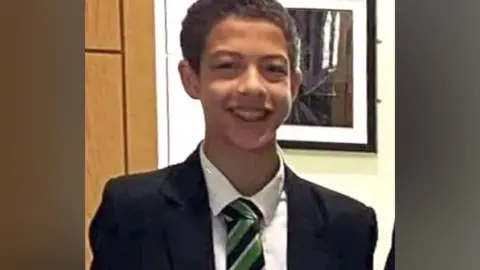 Pacemaker
Stormont's Department for Infrastructure (DfI) "erred" in its maintenance of a culvert entrance close to where Noah Donohoe was last seen alive.
The jury found that the DfI failed to identify a hazard at the site and there was no warning sign.
The jury also found that neither the DfI nor Police Service of Northern Ireland (PSNI) contributed in any way to the schoolboy's death.
However, as well as the finding against the DfI, the jury listed 13 failings by the PSNI during the police investigation.
No evidence of physical interaction
The jury also found that Noah died between 19:00 BST and midnight on 21 June 2020, the day he disappeared.
The nine jury members, who had 10 questions to answer, returned their verdict on Tuesday at the end of an inquest which began in January.
The lengthy hearing examined the mysterious disappearance and death of the 14-year-old boy whose body was found in an underground water tunnel in north Belfast more than six years ago.
There was no conclusive evidence at the inquest about why Noah was without his possessions and all the clothing he was wearing when he was last seen alive.
There was also no evidence about any physical interaction between the schoolboy and anyone else during his journey, which took about 20 minutes, from his south Belfast home and through the city centre before he went missing in the north of the city.
Criticism of DfI and PSNI
The tunnel system where Noah's body was found was maintained by the DfI.
The department was criticised at the inquest about aspects of its maintenance of the tunnel in terms of public access and safety.
The PSNI was also strongly criticised by the legal team representing Fiona Donohoe, Noah's mother.
During the inquest, the police chief in charge of the investigation apologised to the boy's mother for "missed" investigative opportunities.
A jury of eight men and two women began considering their verdict when all the evidence was completed at the end of June.
But the process was adjourned when it emerged that some jury members were scheduled to go on planned summer holidays after the third day of their deliberations.
Before the jury resumed their deliberations on Monday 14 September, the coroner Mr Justice Rooney announced that one juror, who had taken part in the previous phase of the deliberations, had been discharged.
No reason was given in public for the man's removal from the process.
The verdict was delivered by a jury consisting of seven men and two women.
Day of disappearance
The jury was also asked if they could explain why Noah behaved as he did after he left his home on the day of his disappearance.
They replied: "The evidence was insufficient to enable us to reach a conclusion."
The finding of the time period of Noah's death means that Noah could have died before his mother raised the alarm with the police at approximately 21.45 on 21 June 2020, or within an approximate two-hour period after he was reported missing.
There was no indication at that stage of Noah's precise location, other than he had left his home off the Lower Ormeau Road to travel across the city to Cave Hill.
The initial police searches that evening and night covered a wide area of Belfast based on the limed information available at that stage about Noah's intended journey from the south to the north of the city.
Noah's presence in the Northwood Road area was not known until the following day.
What happened to the schoolboy?
Noah's body was found six days after he went missing, more than 600 metres downstream from the tunnel inlet which is close to the scene of the last reported sighting of the St Malachy's College schoolboy.
The teenager was naked and without any possessions when he abandoned his bicycle on Northwood Road just before he disappeared.
The inquest heard evidence from 76 witnesses and statements from a further 42 people, and involved maps, video footage, photographs, police logs and expert reports.
Jurors were tasked with agreeing findings on 10 questions, including the date of Noah's death and whether any errors made by police contributed to his death.
