A deadly secret in the Thames - what is the SS Richard Montgomery?

 PA Media
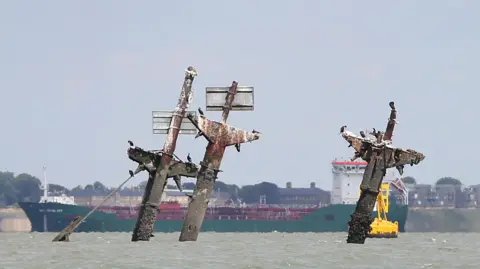
Shipwrecked in the Thames Estuary lies a boat packed with 1,400 tonnes of explosives that could blow at any point.
It is a story that has captivated generations since the SS Richard Montgomery sank in 1944 during World War Two.
Some believe a blast would wipe out parts of the Essex and Kent coastlines, while others say it would be nothing more than a "damp squib".
Thanks to a £9.5m project to remove the ship's masts, experts propose those residents can breathe a little easier - for now.
What happened to the ship?
The SS Richard Montgomery was part of a convoy heading from the US to Cherbourg, north-west France.
Loaded with 7,000 tonnes of munitions, it was a "Liberty" ship built in the US in 1943 and designed to help Allied forces in Europe.
On arrival in the Thames Estuary, the vessel, loaded with 7,000 tonnes of munitions, was directed to anchor off Sheerness, Kent, before the final journey.
However, on 20 August, she dragged her anchor in the shallow water overnight and grounded on a sandbank.
Thames Estuary historian Margaret McEwan says it was a "nightmare situation".
"You've got the nearby ships sounding their horns to warn the captain, who was asleep in his bunk, [and] the officer in charge did nothing," she explains.
Intensive efforts led to half of the ship's cargo being unloaded, but a crack in the hull caused it to flood and the salvage attempts were abandoned.
"She was left, to this day, with her explosives onboard," McEwan says.
Until this week, its masts could still be seen protruding from the water as far as five miles (8km) away in Southend-on-Sea on the Essex side of the estuary.
What if it explodes?
 Getty Images
There are 2,000 cases of cluster bombs, nearly 600 bombs weighing 500lb and more than 1,000 bombs weighing 1,000lb on the boat
The Maritime and Coastguard Agency (MCA) says the risk of a major explosion is "remote", but speculation persists.
In 1970, government tests on the site suggested a blast would hurl a 1,000ft (300m) wide column of water, mud, metal and munitions almost 10,000ft (3,050m) into the air.
The shock of the blast would shatter almost every window in Sheerness and generate a 16ft (4.87m) high wave that could sink a small craft, tests found.
In August 2004, a report in New Scientist magazine said that if the ship exploded it would be one of the biggest non-nuclear blasts ever.
Mick Hamer, who wrote the report, told the BBC at the time: "It's as dangerous now as it has been for the last 60 years."
McEwan is less sure. "It's an unknown quantity," she says.
"Some people think it's going to decimate Sheerness and the Isle of Sheppey; others think it's going to be a damp squib. We just don't know."
On its website, the MCA says it continues to monitor the condition of the wreck.
"Surveys are carried out by the MCA on a regular basis to ensure that any changes to the wreck, or its immediate environment, are discovered quickly," it adds.
Why were the masts removed?
 Maritime & Coastguard Agency
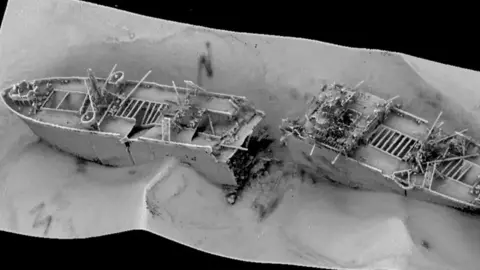
The last masts of the bomb-laden shipwreck were removed on Wednesday, after a project that was years in the making and cost £9.5m.
Officials feared their deteriorating condition meant they were at risk of toppling on to and detonating the explosives.
Engineers used a crane to support the masts as they cut through them and lifted them to safety on a barge.
Project lead Nolan Conway said it was "really important" to act before it was too late, as the last of the three poles were removed.
However, McEwan says the risk is far from over.
"The masts might be gone, but the problem still exists," she says.
Can you visit the wreck?
 Supplied
Yellow buoys indicate an exclusion zone that surrounds the ship, but it has not stopped people getting as close as possible.
Angus Brown runs boat trips to the wreck and describes it as "absolutely incredible".
"It's really an honour to be there watching these masts sit in the Thames Estuary," he says.
"We do get up close and we can go at different angles, so you can get right round the ship itself."
Both Brown and McEwan are saddened by the removal of the masts and the ghostly atmosphere they create.
"It's quite a landmark, a bit of history," says Brown.
McEwan adds: "They are iconic. People have grown up in the area and they remember seeing them when they were children.
"They're a real part of our heritage."
Do you have a story suggestion for Essex? Contact us below.
Follow Essex news on BBC Sounds, Facebook, Instagram and X.
