Masts to be removed from bomb-laden shipwreck

 Getty Images
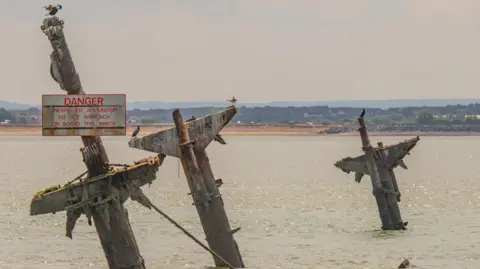
Engineers will work underwater to cut the masts off a World War Two shipwreck sitting on a sandbank in the Thames Estuary with 1,400 tonnes of explosives on board.
The Department for Transport (DfT) has confirmed work on the SS Richard Montgomery will start in September after plans from 2022 were delayed.
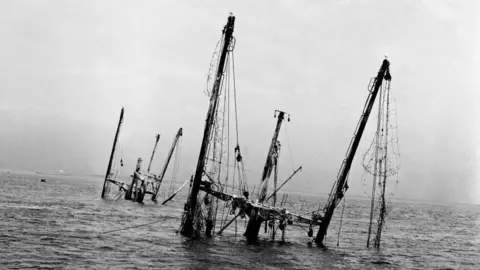
An underwater platform will be constructed to allow specialist maritime engineers to remove the three masts from the US Liberty ship, known locally as SS Monty, which sank off Sheerness, Kent, in 1944.
The DfT said independent experts had confirmed the £9.5m scheme could be carried out without increasing the risk posed by the explosives that remain onboard.
Last month, the US backed plans to keep the masts in the UK.
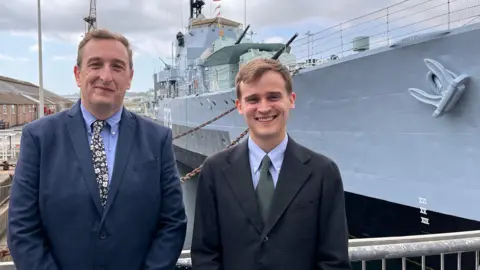
The artefacts will be conserved at Chatham Historic Dockyard.
Aviation, Maritime and Decarbonisation Minister Keir Mather said it was important for local people to be able to reflect on the contribution the area made to the UK's war effort.
The fact that SS Monty was a Liberty ship showed the strength of the UK/US partnership, he added, describing it as an "important" and "poignant" moment.
Paul Barnard, deputy chief executive of Chatham Historic Dockyard, said the masts had become "a familiar landmark for generations of people" and were also "an internationally important reminder of the Allied war effort".
Liberty ships were mass-produced cargo vessels built by the US during the war to carry troops and supplies.
SS Monty was loaded with 7,000 tonnes of munitions in 1944 and directed to anchor off Sheerness, but grounded on a sandbank and began to flood after the hull cracked.
Much of the cargo was removed, but the wreck remains in the sea, with masts visible at all tides and about 1,400 tonnes of explosives still in the forward holds.
 Getty Images
The shipwreck is surrounded by an exclusion zone, which will remain in place after the masts are removed.
Specialist contractors Resolve Marine will carry out the work after planning with emergency services, harbour authorities and other organisations.
Nolan Conway, project manager, said it was "a significant milestone" at one of the UK's most closely monitored wrecks.
Robin Rickard, managing director of Exord Ltd, which provided explosives advice to the DfT, said the masts would be removed with "minimal contact with the wreck".
He said there had been "wild speculation about catastrophic events and what that might look like" 20 or 30 years ago, but added: "We've come a long way since then."
Follow BBC Kent on Facebook, X, and on Instagram and listen to BBC Radio Kent on Sounds. Send your story ideas to southeasttoday@bbc.co.uk or WhatsApp us on 08081 002250.
