The 'happiest little girl' defying the medical odds

 Shaun Whitmore/BBC
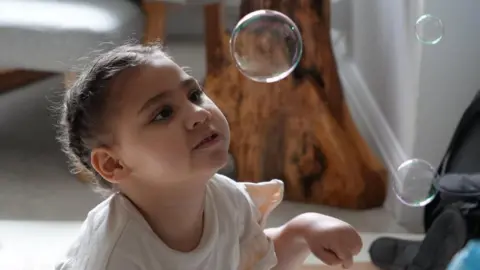
A "determined" three-year-old girl diagnosed with a form of cerebral palsy as a baby is continuing to defy the odds of her condition and is meeting her developmental milestones thanks to therapy.
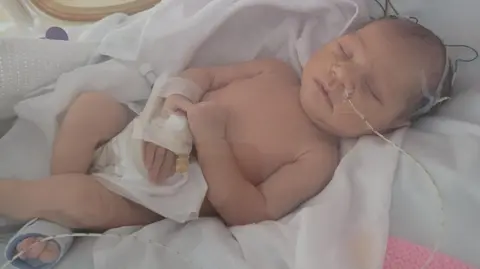
Amelia, from Spixworth in Norfolk, experienced hypoxic-ischemic encephalopathy around the time of her birth, in June 2022. It is believed her brain was deprived of oxygen for up to 25 minutes.
She spent eight weeks in a neonatal intensive care unit.
Despite the challenges, her mother Karis Fear says she is the "happiest little girl", adding: "The unknown was the worst part. It was just a scary time when no-one knew the future and what was going to happen and no-one could give us any definitive answers."
After seeking a second opinion from a specialist in London, an MRI scan showed Amelia had "severe" brain damage and at nine months old she was diagnosed with dyskinetic cerebral palsy.
Patients with dyskinetic cerebral palsy exhibit involuntary body movements and spasms and the condition is caused by damage to a particular part of the brain.
Karis adds: "They said that she would likely have motor impairments, cognitive difficulties and they said she might have a poor quality of life from what the MRI had shown.
"An MRI is a tool - but it won't tell you what she will and won't be able to do in life."
 Contributed
Speaking to professionals, Karis said people were "realistic" and did not want to fill her with hope over what Amelia would be able to achieve.
"As she grew up there was a lot of milestones she didn't hit and then she hit late," she said.
"It took her almost two years to roll... I just had to accept it might never happen.
"When she was close to two years old she rolled over for the first time and it just gave her a whole new level of independence."
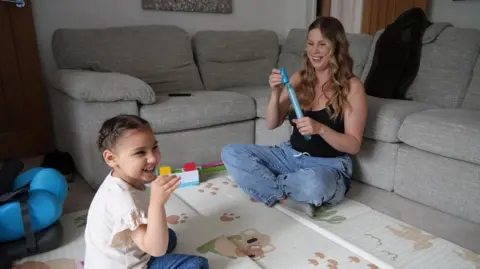
Before therapy sessions, Amelia was unable to sit up herself and use her hands in a functional way.
Karis said it had made a "huge difference" and Amelia was now able to sit up on her own.
Therapy aims to build strength but progress can vary.
 Shaun Whitmore/BBC
With her mouth muscles also affected, Karis said not being able to communicate with her daughter was harder than some of the physical challenges and relies on her facial expressions to understand how she is feeling.
"Although she is a really happy girl for the most part there are times when she is sad or upset or angry and she's not able to communicate that with us," she said.
"It can be extremely upsetting.
"She can be upset or she can be in pain and it's a guessing game you don't know why, you try your hardest, but it's just trial and error to find out what's wrong because she's not able to tell you.
"You can see her getting frustrated and upset. She's not able to tell me what she either wants or what she needs or how she's feeling."
Karis is fundraising to secure Amelia's spot for an intensive three-week course of therapy at the Neurological and Physical Abilitation (NAPA) centre in London.
"I just want her to have the opportunity to live life to the fullest and do as much as she possibly can," Karis said.
"She will always be somewhat dependent but the therapy gives her the chance to be as independent as she possibly can.
"As a parent that's all you want. You want your child to be loved, to be happy and to be given the best opportunities to be able to progress and do as much as she is able to do."
Do you have a story suggestion for Norfolk? Contact us below.
Follow Norfolk news on BBC Sounds, Facebook, Instagram and X.
