Mayor pledges youth facilities for every area of borough

 BBC
BBCThe mayor for a north-east of England borough that has seen deep cuts to local authority spending on youth services has promised to ensure there is provision for young people in all 20 of its wards.
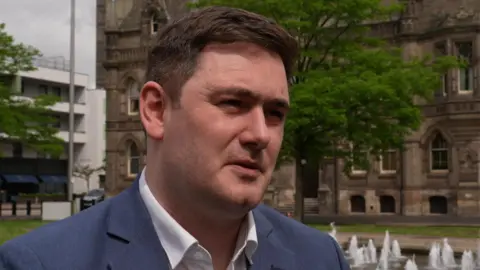
Middlesbrough Mayor Chris Cooke says £10,000-£20,000 grants for new and established organisations will prioritise areas where there is "no youth provision at all, and there hasn't been for many, many years".
How this provision will look is not yet confirmed, his office says, and some areas may not get a bricks-and-mortar youth club.
But Cooke argues that "if we invest in youth clubs and keep a sustained provision", it could lead to youth unemployment and knife crime being reduced.
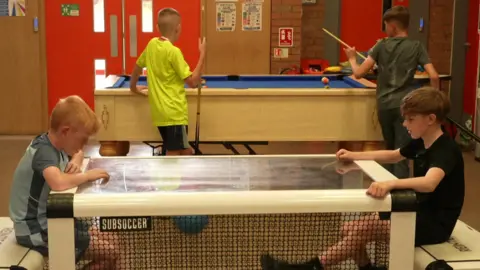
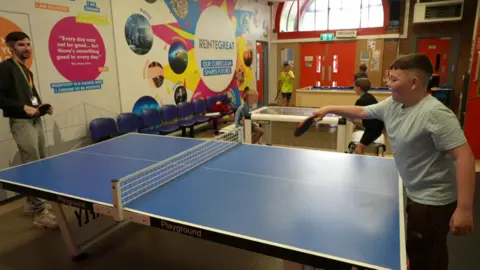
At a youth club in Pallister Park, run by one of the potential recipients of this funding and sitting in one of the most deprived wards in England, children say they come to socialise so they are not "glued to any screens" all day.
The charity Youth Focus North East (YFNE), which works with children and young people across the region, runs the evening group in a former council building and judo gym that is a school during the day.
During a Friday night session for 10-13-year-olds, Kalon practices penalties in the gym and enjoys a hot meal with his friends.
"I always have a happy feeling in my heart and it makes me warm," he says. "I can trust them."
He describes the youth workers as "kind, they're caring" and says "if I need help with something they'll always come and help".

Harvey has been coming to the youth club for almost three years and has seen a lot of change in the place.
"There's been some staff that have left," he says. "The activities have been getting better, in my opinion."
The club has reached 952 young people over the last nine years, with some of those who visited as children now working and volunteering there.
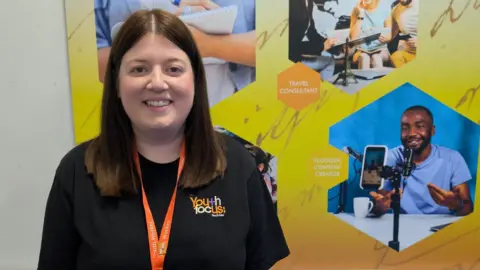
That transition is familiar to YFNE strategy manager, Heather Insull, who struggled at school before volunteering at a youth club in Stockton inspired her to pursue a career working with young people.
She feels the prospect of more funding is making it "a really exciting time" for Middlesbrough and says places like the Pallister Park club allow young people "to come and thrive, and just grow as humans".
 George Walker/BBC
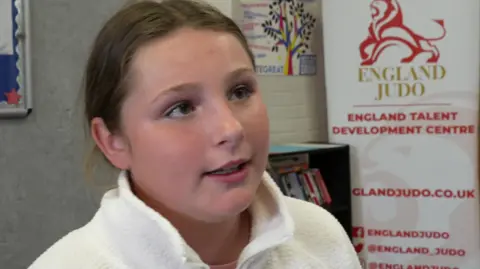
Stevie is a keen footballer who plays both at her school and the youth club and has a preference for being goalkeeper or midfielder.
"Some kids just stay at home and play on their Xbox's these days," she says. "It's better to get out and see the world.
"It makes me feel happy because I get to spend time with loads of people here and do loads of fun activities."
With funding splintering between local authorities, charities and private providers, there is no official record of which youth services exist where across the country.
The charity Social Investment Business (SIB) scoured Charity Commission and Companies House data to try and gather information on organisations it says are "likely to provide youth-related activities" across England.
It mapped these relative to rates of child poverty and anti-social behaviour to find what it calls "black holes" for youth work - areas where need is high and provision is limited. Its research identified more than half of Middlesbrough's neighbourhoods as "black holes".
Cooke agrees a "universal youth offer isn't there in some of those areas, and what we need to do is make sure there's an offer right across the town".
The council says the new funding will target wards which are currently "under served for youth provision", including Marton East, Marton West, Nunthorpe, Stainton and Thornton, Ladgate, Trimdon, Acklam, Linthorpe and Park.
The local authority is working with Middlesbrough Youth Mutual (MYM), a collaboration of youth organisations across the town, including YFNE, to map where youth provision does and does not exist, and determine where the funding could make the biggest difference.
MYM strategic coordinator Richard Fruin says instead of each organisation applying for individual funding it is "applying as a collective for multiple funding grants".
The youth charity YMCA estimates that, between 2010 and 2025, local authority spending on youth services in England fell by 76% in real terms, representing a loss of £1.3bn.
In Middlesbrough alone there was a 97% real-terms cut between 2010 and 2024, it says.
Cooke says youth unemployment and knife crime related to young people rose in this period, adding: "I guarantee that if we invest in youth clubs and keep a sustained provision, all those stats will start to go down."
The government has pledged £350m to build or refurbish 250 youth centres and £70m to open 50 Young Futures Hubs, which it says will bring together existing services to tackle mental health and crime under one roof. The move is part of a strategy aimed at bringing down the number of young people not in education, employment or training (Neet).
The Youth Futures Foundation (YFF), a youth employment research body, has developed a Neet risk index, which examines how factors like having special educational needs or few qualifications affects the likelihood of a young person becoming Neet.
YFF Deputy CEO Sarah Yong says: "Middlesbrough is the top local authority area when we look at risk of Neet indicators from the work that we've done.
"That tells you that you need to put very personalised, very localised, contextual support in those places for young people."
There are currently no plans for a Young Futures hub in the borough, though Cooke says he would "obviously advocate" for one.
Secretary of State for Culture, Media and Sport, Lisa Nandy, declined to be interviewed about how the government is supporting youth services in Middlesbrough and tackling the issue of Neets.
Instead, in a statement, the government says it is "focusing investment where it's needed most".
In Middlesbrough, "funding is already helping to open up new opportunities", including a Youth Hub "bringing services together so young people can get the right support for work, training and the future they want", a spokesperson says.
The government also says it will be targeting funding using the SIB's research and taking into account "areas experiencing a 'double disadvantage' of both high deprivation and low access to community and youth spaces".
Additional reporting by the BBC England Data Unit.
