Mum whose baby died in womb was 'ignored' by medical staff, inquest told

 BBC
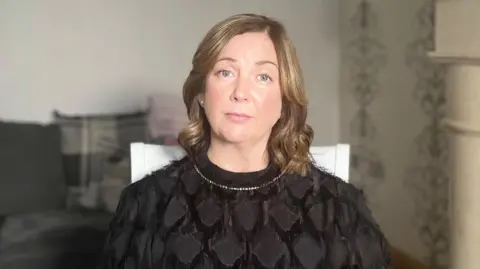
BBCThe mother of baby who died in the womb at 34 weeks has told an inquest she was "ignored" by some medical staff at the hospital she was admitted to.
Mallaidh Tierney died at the Maternity Unit in Craigavon Area Hospital in October 2021 after her mother Martina Tierney was admitted with severe abdominal pain.
An inquest into her death began on Monday.
Tierney's pregnancy was high-risk and consultant led, but she did not see a consultant after she was admitted with severe pain on 8 October.
'Our beautiful baby had passed away'
The inquest heard how between that day and 10 October her pain became "progressively worse".
Baby Mallaidh's heartbeat was checked during this time but Mrs Tierney told the inquest she asked for scans, requested an earlier C-section and told staff about her pain but she felt these things were "ignored, not listened to and not acted upon".
During a previous pregnancy she had experienced an internal rupture of a C-section scar and believed this was happening again.
She tearfully told the inquest she communicated to midwives that she believed her scar was opening.
"I physically couldn't get up out of bed and the pain was just through the roof," she said.
On 9 October, Tierney asked a doctor about having a C-section that night and was told it was "preferable to wait until the morning".
Tierney felt she was "being a hindrance to them".
Her pain relief was changed on that night and she had been told that might make the baby sleepy.
She said she took something sugary to help the baby move but she "couldn't feel the baby move" and asked for a check.
The next morning, the inquest heard, Tierney was told there was no heartbeat and "our beautiful baby had passed away".
A barrister for the Southern Health Trust asked Tierney about where the detail for her statement came from.
She said she had made notes "very early on" after Mallaidh died, while "it was fresh", tearfully adding "it's one of those things that you'll never forget".
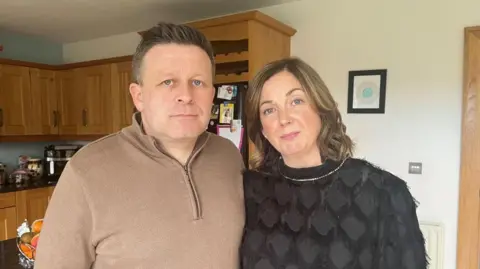
When the barrister put it to Tierney that a doctor who attended to her made no note of her expressing fear of an internal scar rupturing, she maintained that she had brought it up.
She said that doctor had been dismissive when she requested an earlier C-section.
Asked if at that stage she had received steroids, which help to develop the lungs of a premature baby in the womb, Tierney told the inquest she had received a dose.
A barrister for the trust asked Tierney: "Would you accept there was a delicate balance of decision making?"
She answered: "No. Given I was a high risk pregnancy, my pain increased, I think it was overlooked".
She said she was not taken seriously.
Tierney told the inquest: "I have so much guilt and I feel I should have done more and I should have shouted more."
Tierney was asked by a barrister representing the family about a Serious Adverse Incident (SAI) report carried out by the trust.
'Overcome with grief'
Two versions were produced after the family raised "inaccuracies in the initial report".
Tierney said some of the inaccuracies related to a midwife "being in two places at once" and inaccurate pain scores attributed to the mother which were noted as between zero and one.
Asked about the nature of meetings with the trust, Tierney said "they were so accusatory to myself and my husband".
She said they were made to feel "like we were looking compensation, which couldn't be further from the truth.
"We don't want anyone else to go through this".
Ryan Tierney's statement was also read. Because of Covid restrictions he was not present in the hospital.
He said he and his wife were "overcome with grief" and there would "always be an empty seat at our dinner table".
A consultant who saw Martina Tierney before she was admitted to hospital also gave evidence.
Dr Gillian McKeown told the inquest she saw Tierney on 6 October when a date for a section was set for 12 October.
She said Tierney was emotional and frustrated and had been in "pain for a number of weeks which we couldn't explain".
Asked if there was a risk of uterine rupture pre-labour in this case Dr McKeown said "any C-section delivery increases the risk".
Dr McKeown did not see Tierney again until she was informed that baby Mallaidh had died.
Constant pain
She was asked would she have expected to be informed about Tierney's admittance to hospital, she said it is not standard practice "unless there's clinical concern".
Asked by a barrister for the family about high risk maternity cases Dr McKeown said "70% of the women we see are high risk".
The barrister questioned whether this rendered the term "high-risk" meaningless, Dr McKeown replied: "I don't think so."
The barrister for the family made reference to an expert report which said a consultant should have been called after Tierney was admitted to hospital.
Dr McKeown said: "I don't agree with that no".
A trust barrister asked Dr McKeown what scenario would mandate a consultant being called in.
She referenced gynae emergencies such as ectopic pregnancies and was asked: "But not this scenario?" She answered: "No."
The doctor who admitted Tierney to hospital, Dr Rachel Bolaji-Alade, said she found that Tierney was in "constant pain" and noted a pain score of eight to nine.
She also noted Tierney had pain during foetal movements which paracetamol did not help.
Dr Bolaji-Alade was asked that given she had noted a pain score of 8-9 for Tierney what would she make of later pain scores noted at 0, she said "It doesn't sit easily".
The inquest continues.
If you are affected by any of the issues in this article details of help and support are available on the BBC Action Line.
