Emergency departments 'having to choose between very sick patients'

 Getty Images
Doctors are having to choose which "very sick people" they prioritise because of the pressures on Northern Ireland's emergency departments (ED), the Royal College of Emergency Medicine (RCEM) has said.
Department of Health (DoH) statistics for the first three months of this year show that no ED achieved targets for seeing patients within the four-hour and 12-hour benchmarks.
RCEM Northern Ireland said, so far, the figures for 2026 are "the worst they have ever been" and described the state of emergency departments in Northern Ireland as "utterly horrifying".
The association's vice president, Dr Michael Perry, said the environment staff are working in was making their jobs very difficult.
Health Minister Mike Nesbitt said he was "very aware that staff in emergency departments are under immense pressure and where I can provide support within the resources available to me I will continue to do so".
Speaking on Friday, Dr Perry said a long-term plan is needed to address the "perma-crisis" in emergency departments.
"We're basically pleading with our policy makers and our elected representatives in our government to allow us to do our jobs," he said.
"Don't put us in this position where we have to choose out of two very sick people who we prioritise," Dr Perry told BBC Radio Ulster's Good Morning Ulster.
Nursing staff turnover in Northern Ireland's emergency departments is "vast and it is largely to do with the environment that they work in", he continued.
"I've had staff very distressed where something's happened, they have tried their best to deliver the best care that they can, but because of the environment they're being forced to work in something adverse has happened.
Dr Perry said if the Northern Ireland Executive agreed a multi-year budget it "would allow a plan to be put in place to actually tackle this, rather than stumbling on through the same perma-crisis year on year".
A multi-year budget would allow Stormont departments to plan longer-term spending, but the executive has not agreed on one for more than a decade.
'No quick fixes'
In a statement to BBC News NI on Friday, Health Minister Mike Nesbitt said there were "no quick fixes".
"It will require a whole hospital, whole system approach to bring the sustainable improvement in patient outcomes and experiences of ED attendance our patients deserve," he said.
"It will also require long-term investment and that will remain a significant challenge given the current budgetary position."
He added: "My department has recently provided funding for trust recruitment of additional ED consultants.
"Increasing senior decision-maker presence in emergency departments will improve patient flow, but again, future support depends on available funding."
How long did patients spend in A&E?
Dr Perry said while there is a "narrative" that problems in emergency departments exist across the UK, Northern Ireland is "by far the outlier".
The figures showed that patients spent an average of 21-and-a-half hours in Altnagelvin's emergency department last month before being admitted to the Londonderry hospital.

There were also waits of more than 20 hours in Causeway Hospital's ED in Coleraine for people who were later admitted to hospital wards.
More than 72,000 people attended emergency departments in Northern Ireland last month.
Those who were later admitted to hospital spent three times longer in EDs than those treated and discharged.
It outlines monthly ED attendance times, performance against the DoH emergency care waiting time target for EDs, and key patient journey milestones including time to triage and start of treatment.
 PA Media
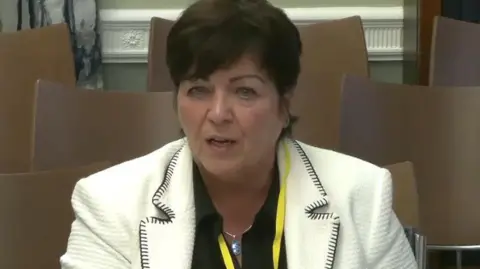
Director of the Royal College of Nursing (RCN) in Northern Ireland Rita Devlin said: "We are seeing EDs that are like third world countries, people lying about everywhere waiting to be seen."
She said that technology, staff and knowledge are all up to date - but the systems are not.
Devlin said this has been going on for about five to seven years, where "nurses and doctors are having to choose between who they treat and who they leave".
Speaking to BBC Radio Ulster's Evening Extra programme, Devlin said the situation has "just got progressively worse and worse" and there needs to be something done.
She added that a multi-year budget is something that the RCN would be asking for.
