Honduran ex-president controversially pardoned by Trump speaks to BBC
Just a month before US elite troops forcibly removed Venezuelan leader Nicolás Maduro from power, the former president of another country in the region - who had been found guilty of very similar drug trafficking charges - found himself in the opposite situation: pardoned and freed from jail.
The ex-president of Honduras, Juan Orlando Hernández, was serving a 45-year sentence in an American prison when US President Donald Trump granted him a "full and complete pardon", prompting an outcry among human rights groups and victims across Central America.
Speaking to the BBC from the US, Hernández says he is "thankful and just trying to rebuild his life" after the extraordinary turnaround which saw him released from Hazelton maximum security prison in West Virginia in December, after almost four years behind bars.
Trump had announced the pardon on social media on 28 November, just two days before the general election in Honduras.
In his Truth Social post, he also threatened to withhold funding from the Central American nation unless his favoured presidential candidate – Nasry Asfura from Hernández's conservative party – won, which after a close race and a delayed count, Asfura did.
Trump's interest in Honduras, and who runs it, can be explained by his administration's wider considerations in the Western Hemisphere, specifically the self-dubbed "Donroe Doctrine", under which Washington views the Americas as its sphere of influence.
Trump's pardon of Hernández, who prosecutors said had "partnered with some of the world's most prolific narcotics traffickers to build a corrupt and brutally violent empire based on the illegal trafficking of tonnes of cocaine to the United States" appears at odds with Trump's war on drugs.

 KENA BETANCUR/AFP via Getty Images
Challenged on whether he received the pardon for purely political reasons, aligning with Trump's policy in the region, Hernández robustly denies it.
Unsurprisingly, Hernández also refutes any idea that he and Venezuela's Maduro are just two sides of the same coin – that is, presidents on the right and left respectively, both accused of drug-trafficking, one who could count on Trump's backing and one who could not..
"My case is completely different," he insists. Instead, he believes Hondurans will appreciate that a "narrative" was constructed around his criminal past created by "leftist politicians in Honduras in tandem with left-wing politicians in Venezuela".
"There is a very strong connection between the two," he argues, referring to both a political connection and an alleged criminal one.
He claims that details could emerge during Maduro's upcoming drug-smuggling trial in the US which will show that "the politicians who negotiated with narcotics-traffickers were others" – referring to members of the country's left-wing Libre party.
Since stepping out of prison, the former Honduran leader has busied himself with a social media campaign to clear his name.
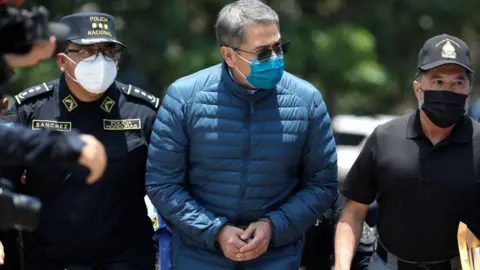 Photo by Jorge Cabrera/Getty Image
The pardon from Trump gave Hernández unconditional legal forgiveness for his crimes – and his appeal against his conviction was subsequently dismissed by the US Second Circuit Court of Appeals as moot, in light of the presidential pardon.
For its part, the Trump administration has characterised the pardon as a matter of undoing what it sees as one of the many wrongs of the Joe Biden US presidency.
However, in the eyes of many of the Honduran people, that does not change their view of probably their most notorious president in living memory, a leader who was removed from Honduran soil in shackles to face drug smuggling charges in New York.
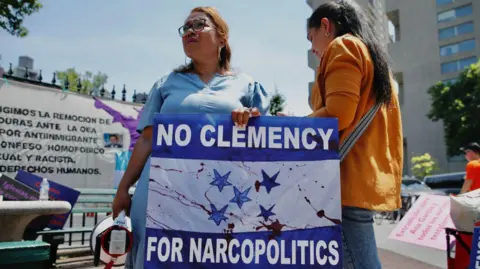
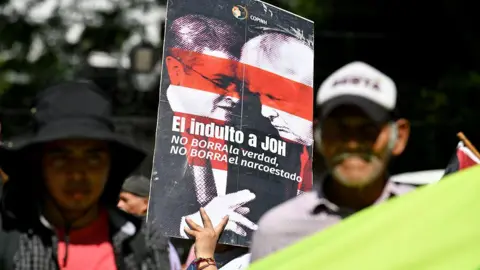
His pardon triggered protests by Hondurans living in the US, and those at home.
"It's a mockery for Honduras. This country doesn't deserve that," one resident told local TV at the time.
 Orlando SIERRA / AFP via Getty Images)
Hernández was convicted in March 2024 as a co-conspirator in a drug ring which brought 400 tonnes of cocaine into the United States.
Honduras has long been a key transit country for cocaine shipped from producer countries in South America to the United States but prosecutors accused Hernández of running the country like a "narco-state".
At his sentencing, Judge P Kevin Castel called him a "two-faced politician" who had used his influence and national security forces to protect drug traffickers who had bribed and supported him.
The former Honduran leader insists he did combat drug trafficking during his time as president.
He consistently points to an extradition law approved by his administration – in fact, the very law under which he was sent to the US for trial – as evidence.
He also says that it was this law which angered and frustrated the men who went on to testify against him.
One of the most damning phrases attributed to Hernández in his trial in New York was the one he reportedly said to a Honduran drug trafficker, who prosecutors alleged he had partnered with: "We're going to shove the drugs right up the noses of the gringos".
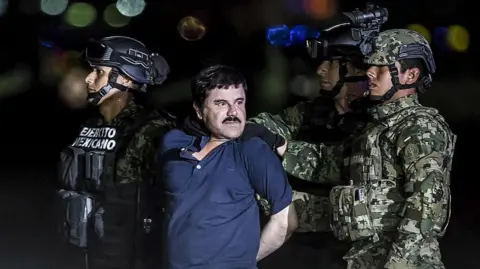
The former president was also accused of having received a $1m-bribe (£745,000) from the notorious Mexican drug lord, Joaquín "El Chapo" Guzmán.
 Daniel Cardenas/Anadolu Agency/Getty Images)
Pressed on these accusations, Hernández calls them "false and ridiculous" and insists that at the time of the alleged meeting with El Chapo, the Mexican drug lord's whereabouts were known by law enforcement, and that he was not in Honduras.
"If you look at El Chapo's trial, he doesn't even mention Juan Orlando Hernández," the ex-president tells the BBC.
Hernández is equally dismissive of another key piece of evidence against him: several supposed ledger entries by a known Honduran drug trafficker purporting to show payments to him and his younger brother, Honduran Congressman Tony Hernández, who has since been sentenced in the US to life in prison for drug-trafficking.
The successful prosecution of his younger brother, two years earlier, was at the heart of Juan Orlando Hernández's conviction.
Tony Hernández was covertly filmed meeting one of Honduras's top drug traffickers, who later testified in court against both Tony and Juan Orlando Hernández.
The trafficker alleged he had paid a $250,000-bribe in exchange for protection when Juan Orlando Hernández was a presidential candidate.
What was the president's brother even doing at such a meeting with perhaps the biggest drug lord in Central America, the BBC asked Juan Orlando Hernández.
"I ask myself the same question, it was a grave mistake," he answers.
The ex-president argues that the case against him boiled down to the testimony of "witnesses interested in revenge, sentence reductions and witness protection programmes".
He alleges it was "a political operation, that turned into a campaign in which Democratic Party leaders also participated".
He accuses an international alliance of left-wing politicians, including in Washington, of wielding the law against him - and he portrays himself as an unjustly maligned conservative leader.
Trump told reporters at the time of the pardon, that Hernández had been the victim of a "horrible witch hunt".
Hernández and his family have echoed Trump's words and do not tire of depicting the former Honduran leader on social media as the victim of a vindictive US justice department under the Biden administration.
In their view, Trump merely righted a wrong by pardoning him.
The BBC has spoken to several US justice department, state department and Drug Enforcement Administration (DEA) officials who worked on the Hernández case.
All of them insist their investigation was carried out with due diligence and without external political influence. In fact, they point out that their case work began during the first Trump administration and was not a solely Biden-era prosecution.
Ana María Méndez Dardón, the director for Central America at the research organisation Washington Office on Latin America says investigators spent years building the case against Hernández.
"The conviction had strong evidence that supported finding Juan Orlando Hernández guilty as a drug trafficker."
"There were many witnesses which exposed linkages with other transnational drug organisations, including El Chapo Guzmán. It was huge. And it goes beyond Juan Orlando Hernández as a former president and a former convicted drug trafficker."
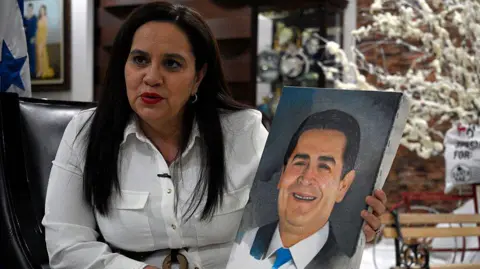
Since leaving prison five months ago, former-President Hernández has still not seen his family in the flesh.
 Orlando SIERRA / AFP via Getty Images
He still faces outstanding charges for corruption and misappropriation of state funds in Honduras and his wife, Ana García Carías, had visa restrictions placed on her after her husband's arrest.
He says his first aim is to go home but not, he stressed, back to politics: "I'm not interested [in returning to politics]. My interest is in my family. I'll never get back those four years I lost. Even today, I still haven't seen them."
However, with his old colleagues in the National Party back in power in Honduras, Hernández is increasingly hopeful of a return to his homeland.
If he does go back, he may find his biggest challenge lies in the court of public opinion and in convincing ordinary people - many of whom are tired of seeing political elites they describe as corrupt evade prison - of his version of events.
