'I'm conquering my fear of water by learning to swim'

 BBC
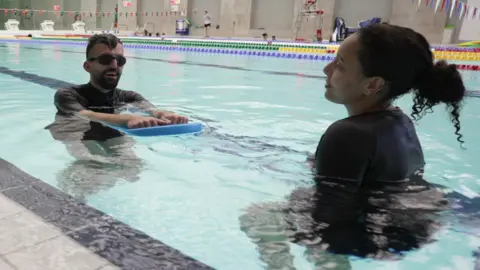
BBCLondon's deputy mayor for environment is very, very nervous. I have seen him address water company executives, here though he is way out of his comfort zone.
Mete Coban is one of an estimated 700,000 Londoners who cannot swim and he has decided to do something about it.
Rather unusually, the 33-year-old has invited us along to film his first swimming lesson.
Before his lesson he tells us, his fear of water started with a traumatic experience at a school swimming lesson.
"I had a really bad experience, like a lot of Londoners. When I was in year two, year three, I went to Britannia Leisure Centre. And you know that thing that you're told as a kid they'll stick you in the water and you'll just figure it out? That didn't quite happen with me.
"I went down the adult slide. It was six feet of deep water, and they had to pull me out and I've had the fear of water since.
"But also, my school didn't offer swimming, and now they do, more schools offer swimming classes, but when I was growing up, we didn't, and that's not a coincidence."
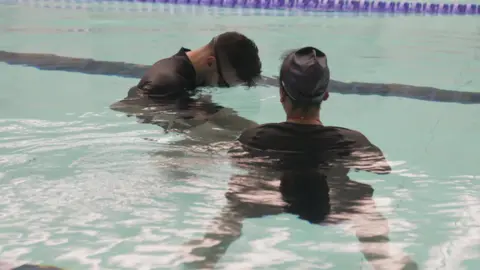
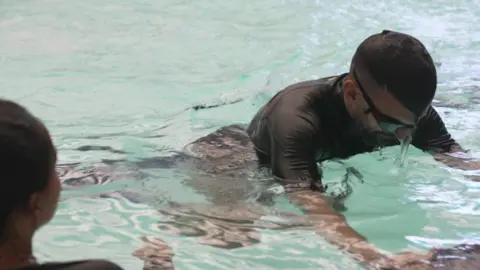
His first lesson is at the Aquatic Centre on the Olympic Park. It starts with the deputy mayor putting his face in the water. It progresses onto holding the side and kicking his legs, and floating with a buoyancy aid.
Omie Dale is Mete Coban's instructor. She is also a director of the charity Swimunity that offers free weekly swimming lessons to children and adults.
She says the deputy mayor made good progress in his first lesson:
"I was a little bit apprehensive of how much we'd progress, but he got his face in, he was exhaling underwater, getting the legs up off the ground.
"So, honestly, it's a really, really good lesson. So if someone's motivated, and if they've got a sports background, which he has, it's typically a lot easier."
She adds that having a "good connection to your body" and regular practice helps to get rid of the fear, although emphasises it is an individual journey as everyone learns at different rates.
In 2023, the charity London Sport did a survey that found that one in 10 (11%) Londoners have not learned to swim at all.
That equates to 750,000 Londoners.
The report also found that the inequality is significant with nearly one in five adults in lower socio‑economic and ethnic minority groups not able to swim. If you include weak and unconfident swimmers, the number would be much higher.
The Black Swimming Association also found in a survey that among those who took part and were from Black, Asian and other ethnically underrepresented communities across the UK, 48% of them did not know how to stay safe in water.
City Hall says access to swimming, such as using the city's nature and waterways, is a matter of social justice.
Mete Coban says there will be more announcements in the summer to help get people swimming, including funding for swimming lessons.
"A lot of Londoners who don't have access to either affordable swimming, or for lessons," he said.
"What I'm trying to do by learning how to swim is inspire other people to learn how to swim, but also, you know, [Mayor of London] Sadiq's plan to make sure that we can open up our rivers in a way where we can make more accessible to Londoners.
"I think the first steps for me is how to connect with water and feel more confident and hopefully by the time it gets to the summer, I'll be a pro."
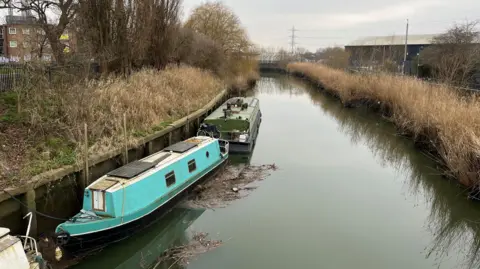
The Mayor of London has pledged to make some of London's rivers swimmable by 2034 there is considerable work to do.
When we visited the River Roding recently, there were many illegal sewage overflows and tonnes of rubbish in the river.
If people do find themselves in difficulty in the water, they should follow the RNLI's Float to Live steps:
- If you fall into water, fight your instinct to thrash around
- Lean back, extend your arms and legs
- If you need to, gently move them around to help you float
- Float until you can control your breathing
- Only then, call for help or swim to safety.
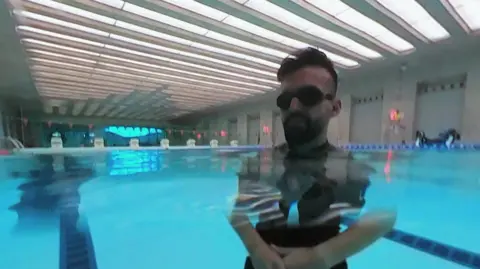
After his lesson, Coban was jubilant.
"It just gave me the confidence. One of the things that I've always been scared of is just falling in the water. Whereas, being able to put my head underneath the water, knowing that nothing's happened, I'm still alive, I'm still fine. That just gave me a lot of confidence going into the next exercise.
"The reason why I wanted to do this, I don't know how to swim, as you can see, but I don't think that I am unique. I think there's so many Londoners, especially my age, who don't know how to swim, because they haven't had access to affordable swimming."
He added that it was never too late to learn this "huge life skill".
"I think so many people can benefit from it. And I think actually taking this step, hopefully, will inspire so many other people to just be like: 'You know what? I've been putting this off. Maybe I should go learn'."
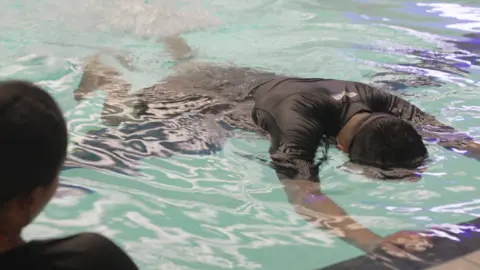
Omie Dale also thinks showing people learning to swim will have a benefit to non-swimmers.
"We do find disproportionately we work with a lot of people from ethnic minority backgrounds because disproportionately they are the least likely to swim and have lower participation rates.
"We also find socioeconomic background can impact that, but we do get lots of people who can't swim from all different walks of life."
She added that it was also important for people like Coban to learn to swim and to publicise this.
"I've swum my whole life, and I can talk about the benefits of learning to swim as much as possible. But there are many adults out there that think they're the only person that can't swim or the only person that has the fear of water," added Dale.
She also hopes that Coban being open about his fear of water would encourage others to take the first step too.
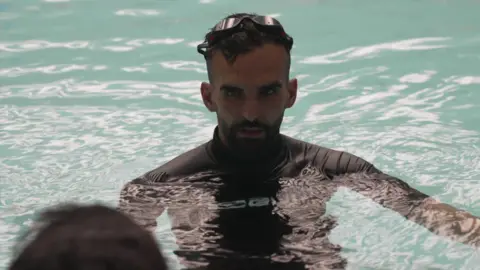
The ambition according to the deputy mayor is to get more Londoners swimming.
"We want to create more access to affordable swim spots across the city where we can support Londoners, to be able to educate and train them, support them, to learn how to swim," Coban said.
"We want to normalise it. Our city is built around these amazing rivers. That's how people got around, and it's just like we've got these beautiful blue treasures around our city, but it's such a shame that it's just not accessible to a lot of Londoners.
"So we're gonna create more affordable access, where it's safe to do so."
He added that City Hall would be working with leisure centres across the city to publicise events and get Londoners into their local pool.
Listen to the best of BBC Radio London on Sounds and follow BBC London on Facebook, X and Instagram. Send your story ideas to hello.bbclondon@bbc.co.uk
