'When it's a water rescue, every second counts'

 BBC
BBCAs the school summer holidays begin, fire services say they are gearing up for a rise in water rescues. Since mid-May, there have been at least 29 deaths in open water across the UK and crews are keen to reinforce the importance of staying safe around water.
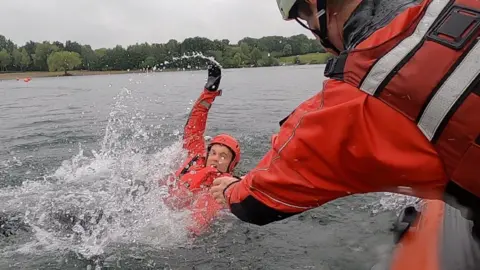
Sliding off the bright orange boat, the water rushes up my nose as I squeeze my eyes closed. The water is cool around my neck, but the dry suit does its job and keeps my body warm, as the life jacket brings me back to the surface.
Today I'm acting as a casualty for an exercise with South Yorkshire firefighters in Rotherham.
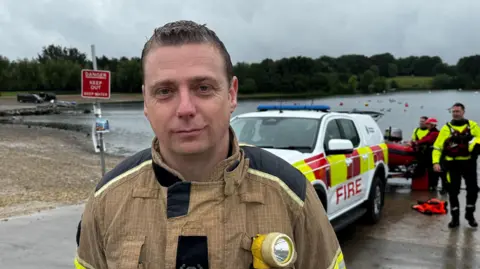
"The crews have to do quite a lot of training, in the boat, in the water, swimming, throw lines," Chris Tyler tells me next to the lake.
"It's essential. Everything we do here is time critical. When it's a water rescue, every second counts, which is why crews are really well rehearsed, professional and on it all the time."
Every year, about 33 young people in England drown, according to the Royal Life Saving Society UK, the equivalent of a classroom of children.
About a third of people who drown in the UK never intended to enter the water, Tyler adds.
It is a priority for the fire service to talk to young people about the risks of entering bodies of water such as this.
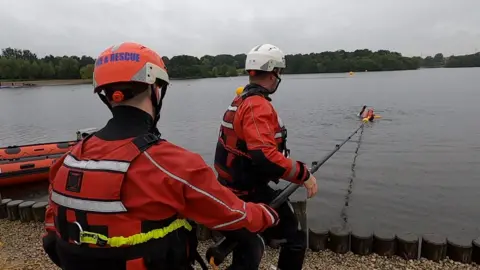
In the water, I'm wearing a life jacket and dry suit. I'm not an open water swimmer, so I'm used to water temperatures in a local pool to be about 27C (80F). Here, in the rain, the water temperature is about 16C (60F).
It's a noticeable difference for someone not acclimatised to the coolness of a vast body of water such as this.
"Open water, while it may look appealing and lovely, there's a lot of hidden hazards that people might not be aware of," Tyler says.
One of these hazards is cold water shock. That happens when water temperatures are below 15C (59F), and can leave people gasping for breath, while your muscles become stiff as the blood rushes to your heart.
Even in warmer temperatures, swim failure can take affect a few minutes after entering the water. It's a slower fatiguing of your muscles, but ultimately can render you unable to swim.
This is why life saving charities recommend Float To Live – a simple technique which could save your life, according to community safety manager Leanna Houlbrook, who works for the fire service.
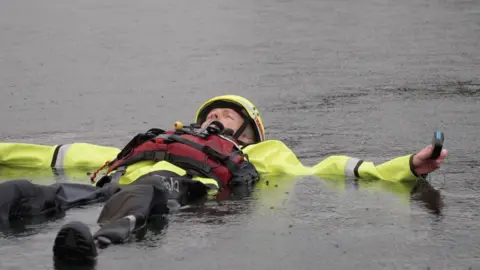
"We want people to lay on their backs, tilt their heads as far back as they can so their ears are submerged. That means their mouth is out of the water, and then they can use their hands in a starfish shape to keep themselves afloat."
This is what I'm doing in the water as I wait for the rescue boat to arrive. I'm supported by the dry suit and buoyancy aid, and I know safety is just a minute away, but the action is the same.
This lake is used safely by organised open water swimming groups, which say it can be "a great thrill if carried out in a safe, fun and responsible way".
"We just encourage people not to go into open water, and if you are going to do it, do it as part of these organised events," says Tyler, who himself uses the lake safely as a swimmer as part of a lifeguarded event.
"Places like here do regular events for training, it's a great place to get involved but it's a safe place to do it."
South Yorkshire Fire and Rescue Service has been working with schools to deliver educational messages for young people, including what to do if you see someone struggling in the water.
"Don't go in after them, I think it's a natural reaction to go and try to help somebody, but, for us, please don't go in. Call 999 and ask for the fire service, get us down here," Tyler adds.
"All of our firefighters are real people, they're not superhuman. When we go out there it affects us as well," says Houlbrook.
"We decide to come into this job to save lives and that's what we'll also do, but if we can get this education across to people to not put themselves into those risks and save as many lives as we can, then that helps us as well."
Listen to highlights from South Yorkshire on BBC Sounds, catch up with the latest episode of Look North
