Sign language developed to include marine species

 BBC
BBCA new set of sign language gestures covering animals that live in the seas around the UK has been created to make marine science more accessible to deaf and hard-of-hearing people.
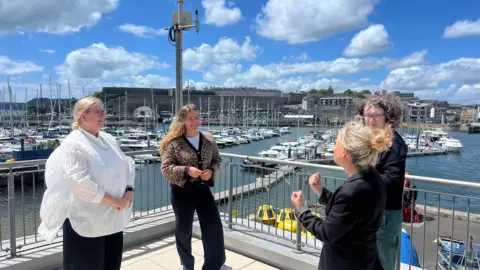
Rebecca Hegedűs is studying at the University of Exeter Penryn campus in Cornwall, and is one of eight deaf marine biology students around the world who helped created the new signs - with species local to each global region.
The signs added to BSL (British Sign Language) are for words including species like basking shark, sperm whale, grey seal and common dolphin.
Hegedűs said: "It is really important to know these signs because in BSL we don't really have that many signs linked to marine species," she said.
She added: "It's really important to create awareness to deaf children to be able to learn these signs and to give them more accessibility and communication."
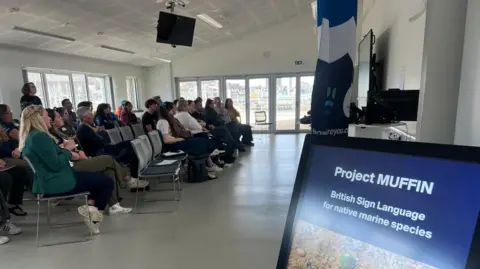
The launch of the international marine science initiative called project Marine Underwater Fish For Inclusion (MUFFIN) was held at Plymouth Sound National Marine Park on Monday.
Hegedűs, 23, said she worked with a team of eight marine experts, from a range of different countries, to create the new signs and educational videos.
"We discussed each animal in depth, looked at their characteristics, their feeding, habits, behaviours, where they live, what they look like and from there, started to create new signs," she said.
The project is led by Deaf Malta and funded by Erasmus+, in collaboration with partners from Italy, Spain, Croatia and the UK, where it has been led by the Scottish Sensory Centre's BSL Glossary Project from the University of Edinburgh.
The new glossary is organised by habitat zone including pelagic, subtidal and intertidal environments.
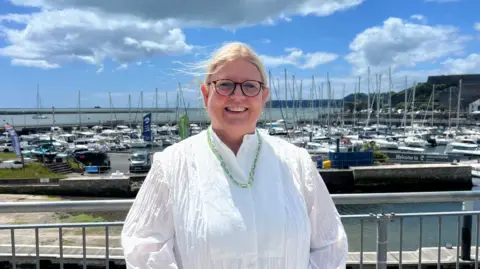
Dr Audery Cameron, UK project lead from the University of Edinburgh, who is deaf, said the new signs opened marine science to wider audiences and helped ensure deaf communities were included in conversations about the natural environment.
She said: "There are only six deaf marine biologists in the world.
"We have selected marine biologists from all over the world ready to be able to incorporate different sub species across the world to create new signs in each of those countries' languages.
"It's a diverse project."
Dr Cameron said the team had already received an "overwhelmingly positive" response, adding impact of the project would be "astounding".
At the global launch of project MUFFIN, an interpretive dance was performed by the Deaf and Hard of Hearing Dance Group from Eggbuckland Vale Primary School, which incorporated some of the new signs.
"You can see that impact already and their understanding and knowledge of marine life in the local area is already growing," Cameron said.
She said historically there had been a lot of "oppression" of deaf children not being allowed to sign in school until the government officially recognised BSL under the British Sign Language Act 2022.
"BSL has been around for a very long time but because it was banned from schools, it means there's lots of gaps in deaf young people's vocabulary.
"Our plan is to fill those gaps with this language and that's why we're focusing on this particular topic."
Plymouth Sound National Marine Park said it helped deliver the project which reinforced its commitment to improving accessibility and inclusion in the marine environment so it could be "enjoyed, understood and valued by everyone".
Follow BBC Devon on X, Facebook and Instagram. Send your story ideas to spotlight@bbc.co.uk.
