Katya Adler: Europe's Nato allies push back at reported US threat to Spain

 Reuters
It's become a joke - through gritted teeth - these days in EU circles, that whenever leaders meet, as they did these last two days in Cyprus - expecting to discuss practicalities, such as the new EU budget - they get railroaded by yet another crisis.
There is the ongoing energy crisis provoked by the US-Israel war on Iran, Russia's aggression in neighbouring Ukraine, now in its fifth year. And this Friday morning, souring relations between Europe and the United States, along with a potentially devastating defence impact, reared its Medusa-like head. Again.
"No worries," Spain's determined-to-appear-calm Prime Minister Pedro Sanchez said to waiting journalists as he arrived at the leaders' summit. "We are fulfilling our obligations toward Nato."
What did he feel compelled to say he wasn't fretting about?
An email, originating from the US Pentagon and first reported by Reuters on Friday had leaked, suggesting measures for the US to punish allies it believed had failed to support the US-Israel campaign against Iran. The email said the US could seek to suspend Spain from Nato over its stance.
There is actually no provision in the Nato treaties to expel a member country. And any action to bar Spain from filling key civilian or military roles in Nato, also alluded to in the email as possible punitive action, would have to be taken unanimously amongst all Nato members .
Fellow EU leaders at the Cyprus summit, who are also in Nato, leapt to Spain's defence. Dutch Prime Minister Rob Jetten said he wanted to be "crystal clear" that Spain was and would remain a full Nato member. He said European countries were currently "doing a great deal to strengthen Nato". That, he said, was also in America's interest.
A high-ranking German official said: "Spain is a member of Nato. And I see no reason why that should change."
 Byron Smith via Getty Images
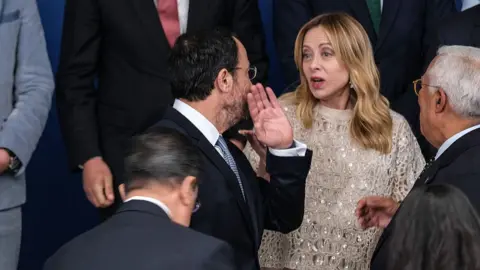
While Italian Prime Minister Giorgia Meloni – who was once seen as so close to Donald Trump as to be viewed as a "Trump whisperer" or go-between between Europe and an increasingly irritated, or seemingly irritable, US – criticised the tensions between Washington and Madrid as "not at all positive".
Growing public opinion in Italy as across Europe has turned against Donald Trump. Meloni feels forced to take a stance against her erstwhile best buddy, drawing his ire at Rome too.
The Italian prime minister has denied the US permission to use the Sigonella airbase in Sicily for military operations against Iran. As the head of government of a country that considers itself culturally Catholic, she also described Donald Trump's recent derogatory remarks about the Pope as "unacceptable". The US president, who previously considered Meloni "one of the real leaders of the world", lashed out and told an Italian newspaper that "she's the one who's unacceptable" and "no longer the same person".
The leaked Pentagon email also suggested a possible potshot at former "special ally", and fellow Nato member, the United Kingdom – reviewing the US position on the UK's claim to the Falkland Islands in the south Atlantic, which are also claimed by Argentina.
Why?
Donald Trump has remained furious with UK Prime Minister Sir Keir Starmer ever since he initially denied a request to use British military bases ahead of launching attacks on Iran in February. The UK has now allowed the US to use bases to launch strikes on Iranian sites targeting the effectively blocked Strait of Hormuz. RAF planes have also taken part in missions to shoot down Iranian drones.
But Sir Keir insists that greater involvement in the war and the current US blockade of Iran's ports are not in the UK's interest. Trump has repeatedly lashed out at him verbally as a result.
When it comes to Spain, though, Trump appears particularly incandescent.
Sanchez was outspoken in his opposition to the US-Israeli strikes on Iran from the get-go, describing them as illegal under international law. He immediately denied US forces permission to use joint US-Spanish military bases in Spain for operations against Iran. This led to threats (not as yet enacted upon) of trade sanctions from Trump. The Spanish prime minister had previously already grievously irritated Washington by being the only member of Nato to refuse the US president's demand to boost defence spending by 5% of GDP.
Spain has been dismissive of the leaked Pentagon email. Sanchez commented that "We do not work based on emails. We work with official documents and official positions taken, in this case, by the government of the United States."
The mail betrays a "fundamental misunderstanding" in the Trump administration about what Nato does and what Nato is, says Camille Grande, the former Nato assistant secretary general for Defence Investment and current secretary general of ASD Europe (Aerospace, Security, and Defence Industries Association for Europe).
"Are Europeans sufficiently aligned with the US, according to Trump's tastes?" That is the wrong question for Washington to be asking, according to Grande. The defence alliance is based on consensus, not run by the United States.
Grande compares Trump to a landlord seeking to expel tenants from his building if they don't pay sufficient rent in his opinion. But Nato is not Trump's building, he emphasises.
 Getty Images
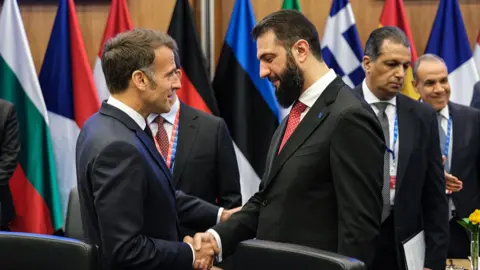
Even more damningly, French President Emmanuel Macron has accused Trump of "hollowing out" Nato by repeatedly undermining the alliance in public.
Trump likes to call Nato a "paper tiger". He's threatened to leave the defence alliance on a number of occasions, recently posting on social media that he had always considered Nato to be a "one-way street".
"We will protect them, but they will do nothing for us," he has written.
These public displays of disunity are corrosive and potentially deeply damaging in defence terms for Europe.
Countries in the east of the continent feel threatened by an expansionist Russia. Its war economy is being buoyed by cash Moscow is hoovering up as a result of being able to export oil at a high price worldwide now, thanks to the energy crisis provoked by Iran's effective blockade of the Strait of Hormuz – and the US counter-blockade.
Traditionally an arch trans-Atlanticist, Polish Prime Minister Donald Tusk openly questioned this week whether the US would actually come to its allies' aid militarily in case of an attack, as envisaged in Article 5 of Nato's founding treaty.
Nato reckons Russia would be ready to attack a Nato nation in three years' time. The Dutch military intelligence service MIVD noted this week that in its assessment, after the war against Ukraine ends, Moscow would be ready to initiate a regional conflict against Nato within the year.
"The Russian objective of such a conflict would not be to defeat Nato militarily, but to politically divide Nato through limited territorial gains. If necessary, under the threat of nuclear armament," said MIVD in its annual report.
Tiny, high defence-spending EU and Nato member Estonia, which neighbours and fears Russia, experienced a slap in the face by the US this week regarding defence capabilities. Because of its own needs in the war with Iran, the Pentagon told Estonia it would have to delay delivery of six units of a high-tech weapons system (the High Mobility Artillery Rocket System) that Estonia had contracted to buy from the US government.
The US Embassy in Tallinn had called the purchase "one of the most significant capability upgrades in Estonian military history". Estonia is now left feeling exposed. This despite Estonia, along with its neighbouring Baltic states ostensibly being in Trump's "good books".
Late last year, US Defence Secretary Pete Hegseth seemed to suggest the Trump administration was essentially dividing up its allies into "good guys" and "bad guys".
In his address to the Reagan National Defense Forum on 6 December, Hegseth said: "Model allies that step up like Israel, South Korea, Poland, increasingly Germany, the Baltics and others will receive our special favour. Allies that do not, allies that still fail to do their part for collective defence will face consequences."
"The president is obviously upset by Europeans that failed to fully support the US war in Iran. But punitive measures like removing force posture in Spain seem over-reactive in light of the fact that allies were never asked to assist the US and Trump has frequently denied that the US actually needed European support," Julianne Smith, former US ambassador to Nato and president of Clarion Strategies, told me.
"Furthermore, in a moment when the transatlantic relationship is still reeling from a stated US policy to 'get' Greenland (a territory belonging to Nato ally, Denmark), pursuing these types of punitive measures could very well issue another devastating blow to the relationship and cast a long, dark shadow over the upcoming Nato summit in July."
At the EU summit in Cyprus this week, leaders were sufficiently spooked as to want to explore a once little-known clause of the EU treaty - the mutual defence article 42.7. Could it be used if Nato's Article 5 proved to be redundant, at least as long as Trump is president, some leaders wondered?
Unfortunately for them, the head of the European Commission, the EU's executive arm, that is regarded as the guardian of the treaties, said she was flummoxed.
"The treaty is very clear about the what," said Ursula von der Leyen, explaining that EU member countries are obliged to come to each other's aid under article 42.7. But "the treaty is not clear about what happens when, and who does what", she added, rather unhelpfully.
Stuck between public opinion hostile to the Trump administration, and the economic and defence capability necessities of trying to keep Washington onside as much as possible, many of Europe's Nato (and EU) nations, led by France and the UK, are preparing along with other nations, an international maritime patrol and mine-sweeping capabilities for the Strait of Hormuz after hostilities have ended. In the hope, amongst other things, of somewhat placating Trump.
The US is not part of the maritime discussions – as France has indicated it would prefer, though the UK is reported to think otherwise.
Reacting to a comment, by the German Chancellor Friedrich Merz, that the war on Iran was not Nato's war, the Trump administration responded that it had been involved in trying to resolve the war in Ukraine (though that was not Washington's war).
Former Nato Secretary Jens Stoltenberg warned this week in a number of media interviews, that bearing all these tensions in mind, Nato's continued existence was not guaranteed ten years from now.
But the alliance's survival is in the US interest, he insists. In contrast to other global powers, like China, the US has allies and therefore global military and economic structures it can (normally) depend on.
"The United States is 25% of the global economy. But together with Nato allies, we are 50% of the global economy and 50% of the world's military might. So it makes the United States safer to have friends and allies – something that Russia and China don't have at all," according to Stoltenberg.
The former head of Nato has pushed back on the idea that Europe has broadly abandoned the United States over Iran, arguing most allies have still provided logistical support behind the scenes.
"There are some exceptions, but most have contributed."
Referring back to Trump's description of Nato as a paper tiger, Stoltenberg says such alliances become far less useful once set on fire by their own critics.
Europe's Nato members have said over and again in recent weeks that theirs is a defence alliance, not designed (or requested by Trump) to formally endorse offensive action over Iran. The US-Israel attacks are viewed in Europe as a war of choice.
The disagreement between European powers and the US is not over whether Tehran poses a threat but rather how to deal with that threat.
Governments in Europe favour diplomacy and sanctions, not unilateral military action.
