Israel strikes Beirut and southern Lebanon after large-scale evacuation orders
Waves of Israeli strikes have hit southern Lebanon, targeting Hezbollah infrastructure, according to the Israeli military.
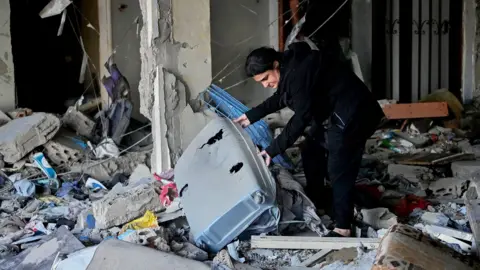
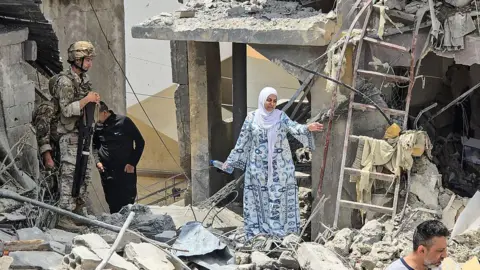
Social media videos from Tyre, one of Lebanon's biggest cities, show dust-covered crowds of people gathered around collapsed buildings. Hours later, the Israel Defense Forces (IDF) said it had carried out a "targeted" strike in the capital, Beirut.
On Wednesday, the IDF urged residents to move north of the Zahrani River, about 40km (25 miles) from the Israeli border, saying it would act "with extreme force".
Both Israel and Hezbollah - the powerful Shia group supported by Iran, have accused each other of repeated violations of a ceasefire which came into force on 17 April.
At least 11 people have been killed in the latest strikes, according to the Lebanese health ministry.
At about 14:00 (11:00 GMT), the IDF said it had struck Beirut in a "targeted manner" and would give further details later.
Earlier on Thursday two sets of Israeli strikes hit Tyre and an area to the city's east, Lebanon's state-run National News Agency (NNA) reported.
Footage from Tyre captured explosions and fires burning through the night and into Thursday morning.
Videos showed streets lit orange by flames, smoke-filled roads, and at least one vehicle engulfed in fire.
By daylight, a massive fireball was filmed erupting near a cluster of high-rise residential buildings, sending a mushroom-shaped column of smoke rising above the city skyline.
Stunned residents looked on as debris spread through surrounding streets.
Israel said the strikes targeted suspected Hezbollah infrastructure.
A Hezbollah member in Tyre told the BBC rescue and recovery crews have had to stop their work because conditions remain "too dangerous" and workers received calls from the Israeli military warning them to evacuate the area.
Ambulance teams in Tyre are continuing to drive through neighbourhoods urging residents to leave, amid fears of further strikes.
More Israeli evacuation orders were issued overnight as people were asleep. The scale of displacement is now straining the wider region.
Shelters in the city of Sidon have reached full capacity, the head of the municipality told the BBC, with no space remaining for newly displaced people. Tyre's authorities are advising residents to travel further north to the capital, Beirut.

 Mohammed Zaatari / AP
Additionally, NNA reported that an Israeli drone strike had hit a family trying to flee threatened villages in southern Lebanon for safety, killing six people, including children.
Wednesday's evacuation order was the largest since the ceasefire took effect, covering about 14% of Lebanese territory.
The strikes came after Israeli Prime Minister Benjamin Netanyahu announced an expansion of its ground operation following Hezbollah drone attacks on troops occupying part of southern Lebanon and on civilians in northern Israel.
Wednesday's evacuation order for Tyre was swiftly followed by air strikes. Residents watched with horror from balconies, filming on their phones, as Israeli forces hit the city.
Rida, 52, owned a cafe near the beach that was destroyed alongside his home in an air strike minutes before the ceasefire started last month. He previously told the BBC he would never leave Tyre.
Now, the feeling is different. "I went to the port next to the beach and a lot of people are there," Rida said over the phone on Wednesday. "People packed up their stuff. Everyone is scared."
The later evacuation order for areas south of the Zahrani River covers about 300 towns and villages. Many residents, including those already displaced from other parts of southern Lebanon, have nowhere obvious to go.
The head of the International Committee of the Red Cross (ICRC) delegation in Lebanon warned the situation in the country's south was "nearing a perilous tipping point".
"Ongoing hostilities create conditions that are untenable for civilians and risk long-term consequences," said Agnes Dhur.
Also on Wednesday, Lebanese media reported a wave of Israeli strikes across the south and the eastern Bekaa Valley, with four people killed in the towns of Choukine and Nabatieh.
 AFP
AFP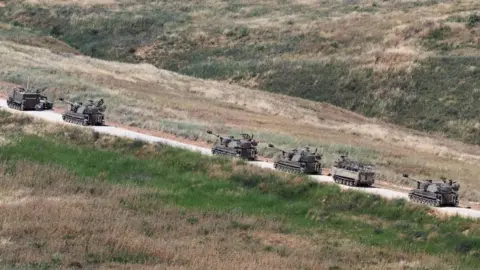 Reuters
Hezbollah said on Wednesday that its fighters had clashed with Israeli forces "at point-blank range" in Zawtar al-Sharqiyeh, north of the Litani River. The town, about 30km (19 miles) from the border, lies outside the Israeli-declared "buffer zone".
Israeli officials have said Hezbollah's attacks are violating the temporary ceasefire deal between the Israeli and Lebanese governments, which has been extended twice since it came into force last month.
Lebanese officials have pointed to the Israeli strikes themselves as violations.
The escalation threatens to derail talks aimed at ending the war between the US and Israel on one side and Iran on the other. Iran insists that any deal must also cover Lebanon. Israel says it reserves the right to continue to fight the threat from Hezbollah.
Lebanon was drawn into the war on 2 March, when Hezbollah launched rockets into Israel in retaliation for an Israeli strike that killed Iran's supreme leader. Israel responded with an air campaign across Lebanon and a ground invasion.
At least 3,213 people have been killed in Lebanon since the start of the war, according to the country's health ministry - its figures do not distinguish between combatants and civilians.
Israel says 23 of its soldiers and four Israeli civilians have been killed over the same period on both sides of the border.
Additional reporting by Angie Mrad.
