Former Sunday World editor Jim McDowell dies

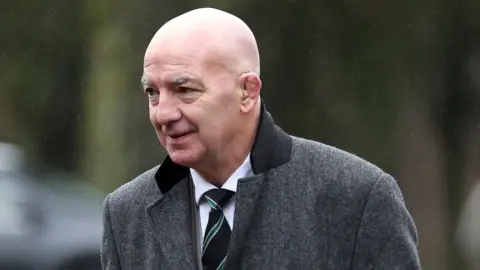 Pacemaker Press
The veteran journalist Jim McDowell has died.
He was the northern editor of the Sunday World for 25 years until 2015.
The Belfast man received death threats during a decades-long career where he reported on controversial stories, including criminality andparamilitary drug dealing.
McDowell, who was 76, is survived by his wife Lindy, daughter Faye and sons Jamie and Micah.
McDowell was a journalist for almost 50 years, starting his career in the News Letter.
He covered many atrocities during the Troubles, including Bloody Friday in Belfast in 1972 when 19 bombs exploded in the city and the Milltown shootings when loyalist Michael Stone killed three mourners in a gun and grenade attack at a funeral for IRA members killed in Gibraltar in 1988.
He was also a campaigner for justice for his murdered colleague, Martin O'Hagan, who was shot dead by the Loyalist Volunteer Force (LVF) in 2001.
The BBC's former security editor and author, Brian Rowan, remembers calling McDowell to give him the news of the murder.
Speaking on Evening Extra, he said: "I can still remember the shock in Jim's voice, him not wanting to hear or believe the news I was telling him."
"He lived with those risks," Rowan said, adding: "He was very brave."
Rowan, who visited McDowell in hospital on Thursday, said he was a "legend".
"He stood his ground. He was hard as nails. He fought with people and he fought for people," he said.
Richard Sullivan, northern editor of Sunday World, described McDowell as "fearless, honest, [and] compassionate".
"It's not an understatement to describe Jim as a powerhouse of this industry, he shaped journalism in the North."
Beaten up by drug dealers
McDowell made headlines himself, telling the BBC in 2009 that he had been beaten up in the centre of Belfast.
McDowell was injured in the head, arms and legs, but did not need hospital treatment.
At the time he blamed drug dealers for the attack.
He retired in 2015 after 25 years at the helm of the Sunday World in Northern Ireland.
A funeral service will be held on Saturday 2 May at St George's Church of Ireland, in Belfast.
More from BBC News NI Communities correspondent Mark Simpson
Jim McDowell's career spanned five decades and included working at the News Letter, Sunday World and the now-defunct Sunday News, where he was editor.
McDowell was also frequently seen on TV and radio, talking in his distinctive deep Belfast brogue about current affairs.
He was threatened many times by paramilitaries and drug-dealers but it did not deter him.
He reported at length over the years from Belfast City Hall which he nicknamed the Dome of Delight.
As well as politics, McDowell was a sports fanatic. He was a keen runner and played rugby.
His wife, Lindy, is also a journalist and has been a long-time columnist for the Belfast Telegraph.
Within Belfast journalism, McDowell was a mentor to many young reporters.
In his role as northern editor of the Sunday World he wrote a weekly column which was notable for its humour as well as hard-hitting analysis of current affairs.
After he stood down from the northern editor role, he continued to write.
He told the Belfast Telegraph: "My motto is 'Never look back, never step back and we are not bate yet'."
Bate is Belfast slang for beaten.
McDowell had a colourful turn of phrase.
He used to play rugby for CIYMS in east Belfast. The official name of the club is Church of Ireland Young Men's Society. McDowell called it Come In Yer Ma Is Shouting.
He also played for Malone and was a big supporter of Ulster rugby.
He was brave on and off the rugby pitch, not afraid to tackle dangerous issues and people in Belfast with his journalism.
It meant spending some of his time looking over his shoulder in the city, but he had no regrets about his career path.
When he moved into journalistic semi-retirement, he said: "I love it. I would do it again without a moment's hesitation."
