How a 1986 event helped turn grey into green

 Staffordshire Record Office
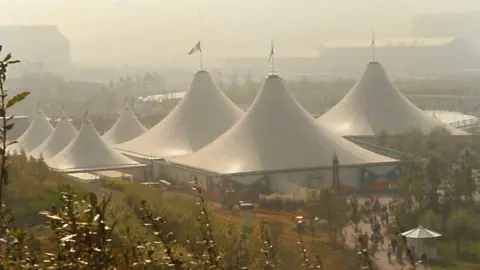
When they were first being planned in the early 1980s, the concept of garden festivals were a new one in the UK, but similar events were regularly seen over on the continent from as far back as the early 1950s.
They gradually grew in scale and popularity - Hanover's spectacle in Germany in 1951 attracted 1.5 million visitors, while Munich's 1983 event managed to draw an audience of more than 11 million.
They were seen as a way of revitalising many of Germany's cities - including Hamburg, Cologne, Stuttgart, Dortmund, Essen and Mannheim - initially as part of rebuilding after World War Two, but later became a way to create new parks.
Here in the UK, Liverpool's event in 1984 was the country's first major garden festival, following a decision by the government in 1980 to stage the events in urban areas in need of regeneration.
 Potteries Museum and Art Gallery
Although Stoke-on-Trent was in the running to host the first UK festival, riots in Liverpool in 1981 meant its event went first and reclamation work there was accelerated as a result.
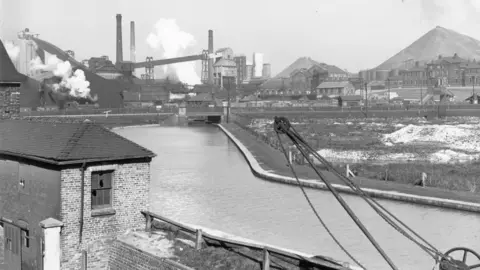
When Stoke-on-Trent's turn came, a 180-acre area of reclaimed industrial land near the city centre, part of a former steelworks, needed to be transformed.
 Janine Wiedel
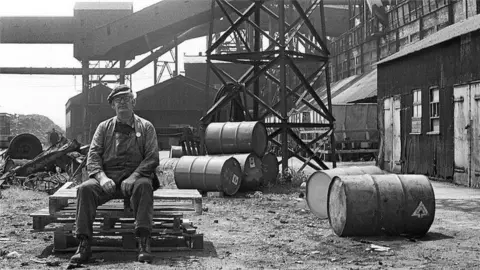
It was described as "a desolate moonscape" and "the worst example of inner-city dereliction in the country" according to the official guidebook, following its closure in 1978.
Four years later, in 1982, clearance work began - including sealing old pit shafts and reclaiming open cast coal mines.
Vast amounts of tar, slurry and asbestos had to be disposed of, as did electric cables, old railway track and gas mains.
In addition, disused buildings were dismantled and the steelworks' concrete foundations were excavated and removed.
The aim was to turn grey to green, and bring tourism to forgotten spaces.
But while preparing for the festival was the focus of the work, efforts to ensure the site had a long-term future were integral too.
New sewers and drains were laid, and new roads were built for use once the festival was over.
Much of the excavated material was piled up at the centre of the festival site, covered in soil and peat and planted with 70,000 native trees.
It was a scene that resonated with artist Antony Gormley, whose sculpture A View, A Place was located next to a trig point at the top of the ridge.
"It was a moment of witnessing, from the top of what I took to be a slag heap, towards the town with all of its history of turning earth into vessels," he said.
"You looked at this landscape that was so involved in social but also economic history and stood next to the sculpture and did the same thing."
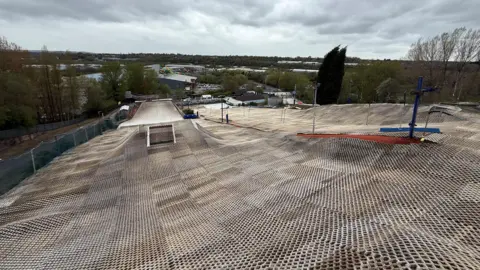
Although his artwork is no longer there, the woodland ridge has remained and is an open space with woodland, and footpaths offering panoramic views of the city.
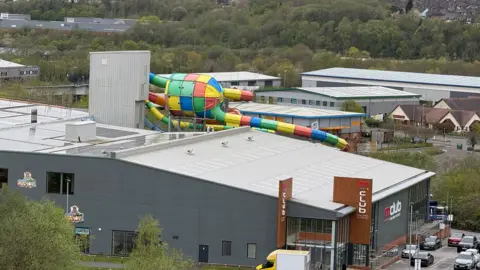
Festival Park beneath - its name offering a reminder of the event from the summer of 1986 - is now home to large retail units such as Next and B&Q, while the wider site is also home to the Waterworld aqua park and a dry ski slope, as well as a hotel and numerous offices.
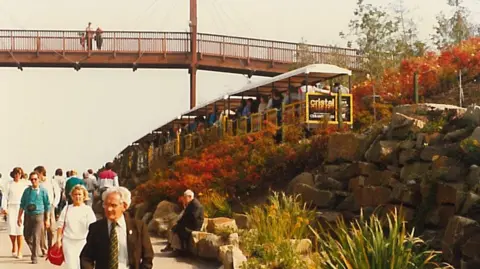 Potteries Museum and Art Gallery
Malcolm Hawksworth was the event's commercial manager, and reflected on what had been achieved by him and his team.
"There's no nicer thing to feel, than to know you've been part of a success," he said.
He was brought in about 18 months before the festival opened, and said he was tasked with bringing in additional funding to bolster the festival's budget.
"I can remember doing deals on things like the houses, the marina and the pub," he said. "It was a wonderful environment to be in."
Vivien Lovell, who curated the event's sculptures, also believes the event achieved its aims.
"The idea was to use them as regenerative elements in cities that needed it," she said.
"It's now widely accepted that art is an essential element in that process."
That is a viewpoint also shared by tourist attraction Heights of Abraham owner Andrew Pugh.
"I remember it before they started, and it wasn't an asset," he said.
"As a result of [the garden festival] that was a huge investment and it created that momentum that gave Stoke-on-Trent what it has today."
Follow BBC Stoke & Staffordshire on BBC Sounds, Facebook, X and Instagram.
