Trump said RFK Jr could run 'wild' with health policy. Instead he's reined him in

 Getty Images
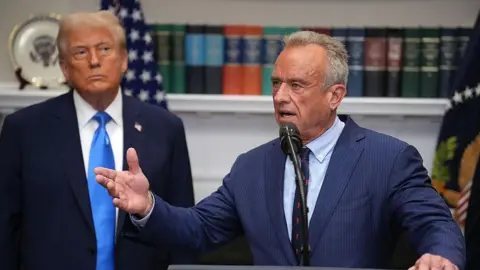
A year ago, US President Donald Trump pledged to let Robert Kennedy Jr "go wild" on health after tapping him to lead the Department of Health and Human Services (HHS).
Kennedy and Trump had forged a unique coalition during the 2024 presidential campaign. As the face of the "Make America Healthy Again" (MAHA) movement - a riff on Trump's slogan "Make America Great Again" - Kennedy brought in a diverse slice of the American electorate, including mothers, tree-huggers and health enthusiasts, who felt passionately about issues like vaccine hesitancy, nutrition, environmental safety and chronic disease.
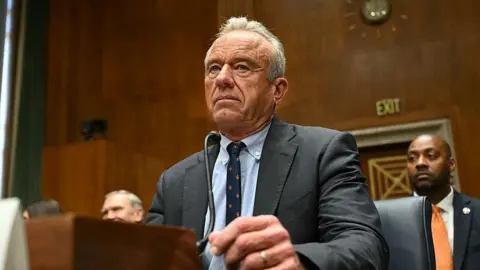
But cracks in this relationship have begun to show, especially this week after Kennedy was grilled in Congress for several days by lawmakers from both sides of the aisle.
Several raised a statement from Kennedy supporting Trump's executive order to increase domestic production of glyphosate, an herbicide that Kennedy's health-conscious base has long fought, arguing it causes cancer.
"This seemed like an opportunity for you to really stand up for your agenda," Brian Schatz, a Democratic senator from Hawaii, prodded.
"I've got a lot of friends back in Hawaii who supported you because of issues such as this, and they were hurt, shocked, confused when you were explicitly in favour of Trump's executive order," Schatz said. "What do you say to those folks?"
"I was very clear with the president about my own displeasure with the executive order," he responded. "The president felt it was necessary for national security."
The tense exchange came as Kennedy tries to make progress with his own, oftentimes controversial, agenda amid several setbacks – including some from the White House itself.
A year into his post, some of Kennedy's allies and supporters say he has not been given the free rein he expected, leading to fewer concrete accomplishments. Some Republican strategists, meanwhile, believe Trump is missing an opportunity to connect with Kennedy's base on less controversial policy goals while the president's favourability rating is at a low.
"Kennedy only has so much authority at HHS," said Jeff Hutt, a former national field director for the MAHA Institute.
"He himself is more of a spokesperson at the end of the day more than anything else," Hutt added, meaning "the change is going to come much slower".
In a statement responding to a question from the BBC about frustrations from MAHA voters, HHS said Kennedy's team remained "focused on the priorities Americans consistently say matter most to them, including chronic disease prevention, childhood nutrition, food quality, and affordable health care".
A pivot from vaccine politics
During his nomination hearing, Kennedy was circumspect about whether he would try to change US vaccine policy. But once he was in office, he quickly turned to dismantling what public health experts say was decades of research-backed vaccine policy.
He fired the members of a committee that makes recommendations on shots, replacing them with several vaccine sceptics. The panel stopped recommending the Hepatitis B vaccine to all newborns, while the Centers for Disease Control and Prevention (CDC) slashed the number of recommended childhood immunisations.
Kennedy also ousted the leader of the CDC, Susan Monarez, after she refused to rubberstamp the panel's vaccine recommendations, Monarez said, leaving the agency without a leader for months.
The changes came as the US faced its worst outbreak of measles in decades, with over 4,000 cases reported in 2025 and 2026, killing two children in Texas.
Kennedy's vaccine changes were seen as a win by some in his MAHA base.
"It just gives people a little more choice or time to make those decisions on their own," said Jacqueline Capriotti, who worked on social media for Kennedy's campaign and runs a Facebook group for MAHA moms. "I think that's a very healthy conversation for us all to have - informed consent, to really fully understand what you're putting into your body."
But those early wins for vaccine-hesitant MAHA voters have increasingly faced resistance, from the courts and even Kennedy's boss, Trump.
In March, a judge halted much of Kennedy's vaccine policies, ruling that members of the vaccine panel lacked credentials, a decision HHS indicated it would appeal, but hasn't yet.
 Getty Images
At the same time, Kennedy was told by the Trump administration to pivot away from vaccine politics before the midterm elections, Kennedy allies confirmed to the BBC.
Whit Ayres, a longtime Republican pollster, said it was clear Trump's team had decided promoting vaccine scepticism was "political poison" because the overwhelming majority of Americans support vaccines.
The judge's March ruling was something of a blessing, said Abby McCloskey, an advisor to Republican campaigns.
"It almost takes it off of RFK Jr's plate and gives him reason to not talk about it."
The pivot from vaccines was evident during Kennedy's appearances before Congress in April, when he also said every child should be vaccinated against measles.
'We were outraged': MAHA policy tensions with Trump
While his vaccine campaign has languished, Kennedy has turned back to other issues central to his MAHA base - chronic disease, and food and environmental safety.
He has remade the American food pyramid - with mixed reviews from public health experts - and has attempted to persuade corporations to voluntarily phase out synthetic food dyes.
But some of these policies have clashed with Trump, a longtime lover of fast food whose glyphosate order also angered many in the MAHA base. In the end, Kennedy released a statement publicly supporting Trump's order, saying the agricultural sector was reliant on it.
"I don't think he had a choice," Hutt said. "I wish he had not done it. I think that's the way that most people felt."
Zen Honeycutt, founder of the MAHA-aligned advocacy group Moms Across America, said many like-mindedmoms were "outraged" by the decision.
"It's seemed to us like the chemical companies were sitting there, that they wrote [the order] for them," she said.
She said Kennedy has been restricted because of outside pressures from big pharmaceutical, chemical and food corporations.
"But I do not doubt his commitment to the health and safety of our children," she said.
Others may feel differently. A Politico poll suggests that 47% of voters who self-identify as MAHA do not believe Trump and Kennedy have done enough - as opposed to 44% who say they have.
An HHS official told the BBC that the economic security impacts of the agricultural sector losing access to pesticides would be "severe". The official added that the agency's new dietary guidelines focus on whole fruits and vegetables, in an attempt to reduce reliance on "chemical-intensive" agricultural production.
 Reuters
A swing state tour and a podcast: What's next for Kennedy?
Despite these conflicts, Trump seems to believe Kennedy has power as a messenger, Republican strategists said.
In the autumn, the health secretary is expected to travel to several swing states as a political surrogateahead of the midterm elections in November, Politico reported.
He is also launching his own podcast to have "fearless conversations with critical thinkers, including independent doctors".
He has announced a new initiative to research the effects of microplastics, and a renewed focus on tackling chronic disease.
Ayres said it's unclear whether this new pivot will convince Americans to get on board with MAHA and Trump.
"Kennedy is so widely associated with anti-vaccine advocacy that it's going to be difficult for him to redefine himself in any other way," he said.
McCloskey said Kennedy's public messaging efforts on their own only go so far. The Trump administration, she said, has been ignoring an opportunity to reach "a large constituency" of MAHA parent voters - those who care about nutrition and other children's health issues.
"What's really missing is what the next suite of concrete policy items or agenda items are like," she said.
Hutt said that even with these challenges, Kennedy could still count on his supporters to stand by him, simply for bringing MAHA issues to the forefront.
"People who supported Bobby [Kennedy] understand that his ability to be a change agent is really limited by how much rope the president gives him," he said.
But, he added, Kennedy and his team, "don't understand how strong they could be politically".
