US and Iran exchange strikes across Middle East for second day in a row

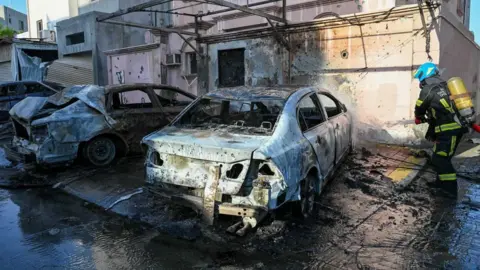 Bahrain Interior Ministry/X
The US and Iran have exchanged strikes across the Middle East for a second consecutive day, further straining a shaky ceasefire agreed between the two countries in April.
US Central Command (Centcom) said it had completed a wave of "self-defense strikes" targeting military, surveillance and radar sites in southern Iran, hours after President Donald Trump vowed US forces would hit Iran "hard".
Tehran responded to the attack with a round of strikes targeting US military assets across the region in Bahrain, Kuwait and Jordan.
Iran's foreign ministry said early on Thursday that the overnight attacks violated the two-month-old ceasefire, rendering it "practically meaningless".
It said in a statement that responsibility for the "extremely serious consequences of this criminal act" lay with the leaders of the US.
Iran's Islamic Revolutionary Guard Corps (IRGC) said it had fired ballistic missiles at a US command centre in Jordan, state media reported.
It said it had destroyed "a large number" of US fighter jets and "facilities" after firing 12 ballistic missiles at the Muwaffaq Salti Airbase.
Jordanian state media reported 20 missiles had been intercepted and shot down by the country's air defence systems and air force, citing an unnamed military official.
The missiles had been fired towards Azraq in central Jordan, it reported, "without any human casualties or material damage" caused.
Meanwhile, Bahrain's interior ministry said its air raid sirens were activated and that falling shrapnel from intercepted Iranian drones had damaged homes and vehicles in the capital, Manama, and Hamad Town.
An 11-year-old girl was treated for a "minor injury", the ministry said, calling Iran's strikes "sinful".
Kuwait's Army posted on X that its anti-air defence systems intercepted "hostile aerial targets".
Kuwait said it had temporarily closed its airspace due to the Iranian attacks, before reopening it early on Thursday.
In Iran, state media reported explosions around Tehran, the port city of Bandar Abbas and other southern areas near the Strait of Hormuz.
The IRGC said it had hit two oil tankers passing through the crucial shipping channel shortly after state media reported it was "completely closed to all type of vessel" - although there was no immediate confirmation of a strike.
Centcom, however, said "commercial ships are continuing to transit in and out of the Strait of Hormuz".
Oil prices rose shortly after the closure of the shipping channel and the apparent attack on the ships was announced.
Brent crude oil, seen as the global benchmark, climbed to around $95 a barrel after rising by about 2%.
Hours before the US launched its latest attack, Trump had warned: "We hit them hard yesterday and we're going to hit them hard again today."
Trump wrote on Truth Social that Iranian leaders had "taken too long to negotiate a deal" and threatened further attacks were a deal not reached.
US Defence Secretary Pete Hegseth said Iran had been given a chance to make a deal but had not taken it and said bombs would be "dropping on key facilities" in the country.
Iranian President Masoud Pezeshkian said the country would "stand firm against any pressure or threat". The foreign ministry in Tehran has accused the US of damaging the diplomatic process through "contradictory messages".
Separately, the US confirmed on Thursday it had struck a third tanker it accused of violating its blockade of Iran's ports in as many days - including one attack in which three Indian sailors were killed.
The Palau-flagged MT Settebello came under attack in the Gulf of Oman on Wednesday, accused by the US military of "attempting to transport oil from Iran".
US Centcom said an aircraft fired "precision munitions" into the engine room of the tanker "after the crew repeatedly failed" to follow directions.
It later confirmed it had also disabled the Guinea-Bissau flagged M/T Jalveer the same day. India's shipping ministry said there were 20 Indian sailors on board, all of whom were reportedly safe and being evacuated.
The first vessel, the Palau-flagged MT Marivex, was hit on Monday.
In April, the US and Iran agreed a ceasefire that was initially meant to last for two weeks. Both sides have since exchanged intermittent fire, without returning to full-scale hostilities.
However, recent efforts to broker a peace agreement have stalled and attacks have grown more frequent.
This week, a US helicopter was downed in an attack that the US blamed on Iran. The IRGC in turn responded by targeting US bases across the Middle East.
The US and Israel launched wide-ranging strikes on Iran on 28 February.
Iran responded by attacking Israel and US-allied states in the Gulf, and effectively closing the Strait of Hormuz, through which around 20% of the world's oil and liquefied natural gas travels.
That oil comes not only from Iran, but also Gulf states such as Iraq, Kuwait, Qatar, Saudi Arabia and the United Arab Emirates.
Shortly after a ceasefire was agreed in early April, the US established a blockade of Iranian ports, which Trump said would remain "in full force and effect until an agreement is reached, certified, and signed".
